Lighthouse v26.10.25.1
Export Any Report as a PDF
A report often has to reach people who never open Lighthouse: a sponsor, a steering meeting, a slide deck. Until now that meant screenshots, cropped and pasted, and already out of date by the next meeting.
Every report now has Export PDF, next to its name and in its row on the Reports tab. Lighthouse reads the report fresh and opens your browser’s print dialog. Save it as a dated, branded PDF with a header and footer on every page, and you never leave the page you were on. Export PDF is part of Community.
Full detail: Export PDF.
Bugfixes and Improvements
- Quiet updates no longer recalculate your forecasts. When nothing a Portfolio’s forecast reads has changed, Lighthouse confirms the forecast in seconds instead of simulating it again for minutes.
- Picking a Jira Release for a Delivery loads once and never shows a guess. The Delivery dialog shows when it is still loading or could not load. The Release picker says why a Release cannot be picked, and that you can type to search.
- Paste your Jira address straight from the browser. Jira Cloud addresses with a
/jira/path and Jira Data Center installations served under a path now work. - A failed connection save says why. The wizard tells you what went wrong and keeps your entries.
- Updated various third-party libraries.
Contributions ❤️
Special thanks to everyone who contributed feedback for this release:
Lighthouse v26.10.19.10
Set a Connection’s Defaults Once, Not for Every Team
Every Team on a Jira or Azure DevOps connection that reads its parent from the same link needs its own Parent Override Field. Forget one on a new Team, and its Work Items sit unparented with nothing pointing at the cause. A Portfolio repeats the same choices for its Dependency Field, Size Estimate Field, Feature Owner Field and Estimation. Change the field on the connection, and every one of them has to be found and changed by hand.
Those settings now live on the connection, once. Set them under Defaults for Teams and Portfolios on the connection page, and every Team and Portfolio that uses that connection follows the default. A Team or Portfolio can still own its own choice, including a deliberate None, and it keeps that choice when the default changes.
- Jira and Azure DevOps offer the Parent Override Field and Estimation for Teams, and the Parent Override Field, Dependency Field, Size Estimate Field, Feature Owner Field and Estimation for Portfolios.
- CSV offers Estimation for Teams, and the Feature Owner Field and Estimation for Portfolios.
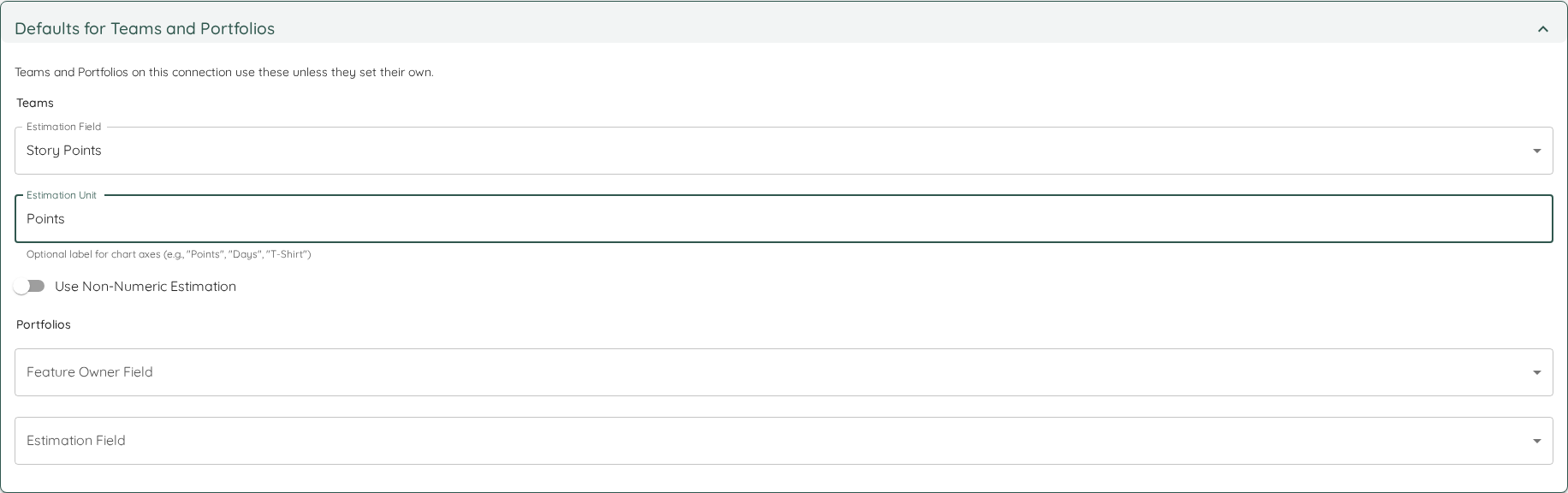
Full detail: Defaults for Teams and Portfolios.
Lighthouse Stays Responsive While Forecasts Run
A long Portfolio forecast could make Lighthouse stop answering: pages hung, refreshes sat queued behind it, and Stop did nothing. Restarting was the only way out.
Lighthouse now keeps room free to answer your requests while forecasts run. Stopping a forecast in the Task Manager ends it within seconds and keeps the forecast you had before. And when the instance is busy with more than you want, Cancel all in the Task Manager stops everything running or queued at once.
A Feature that is too big to finish within five years no longer gets an invented date decades away. Lighthouse simulates up to five years and then says More than 5 years, wherever the forecast is shown and in what it writes to your Work Tracking System. The Lighthouse CLI and MCP server say it too.
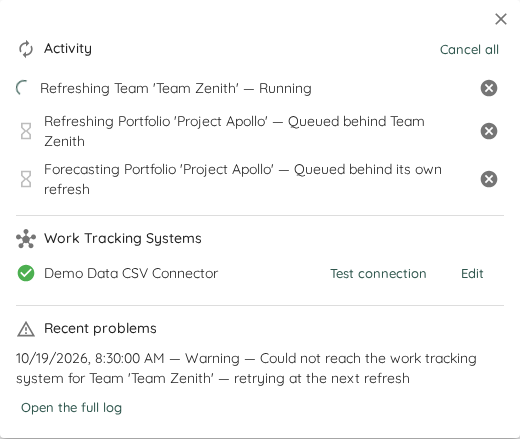
Full detail: Task Manager and When a Forecast Reaches Beyond Five Years.
Dependencies From Any Jira Link Type or Azure DevOps Relation Type
Lighthouse only read Jira’s is blocked by links and Azure DevOps Predecessor links, so a Portfolio whose waits are recorded another way showed nothing under Features → Dependencies. Name that link type, or the end of the relation type on which the work waits, as the Dependency Field, and Lighthouse reads the waits from it. A named link that no Feature carries, or one that points both ways, is reported in Refresh History.
Full detail: Jira link types and Azure DevOps relation types.
Bugfixes and Improvements
- Your AI assistant sees the same stale Work Items you do. Which Work Items are stale was worked out only in the browser, so the CLI, the MCP server and the agent skills could not tell. Lighthouse now decides it once, with one rule, and every place reads that answer: the Stale Items Overview, the red Time in State badges, the Work Item Aging Chart and the API. The Daily Flow Review skill now names stale Work Items with the reason. Full detail: What counts as stale.
- Jira Cloud Teams with long project keys refresh again. Teams whose Jira project keys are long failed on every refresh, and forecast write-backs to that connection failed too, with Jira answered 414 RequestUriTooLong. Lighthouse now sends its Jira Cloud searches in a way that has no length limit.
- Starting Lighthouse twice no longer duplicates Work Items. A second Lighthouse started on the same machine and database could not get its port, but stayed alive in the background and ran every update a second time. The two updates could store the same new Work Item twice, and from then on that Team’s refresh failed. A Lighthouse that cannot start its web server now exits.
- Updated various third-party libraries.
Contributions ❤️
Special thanks to everyone who contributed feedback for this release:
Lighthouse v26.10.16.6
Feature Size on the Team
How much of a Feature does your Team usually take on? Until now, the only Feature Size chart was the Portfolio’s, and it counts every Team’s Work Items. A Team that wanted its own number had to open the Portfolio and subtract everyone else’s.
Every Team now has the Feature Size chart and the Feature Size Percentiles widget. On a Team, a Feature’s size is the Team’s own share of it, and the Status Indicator flags an open Feature whose share has already grown past what the Team usually finishes. Reading the Team is enough: Features from Portfolios you cannot open are counted too, without naming those Portfolios.
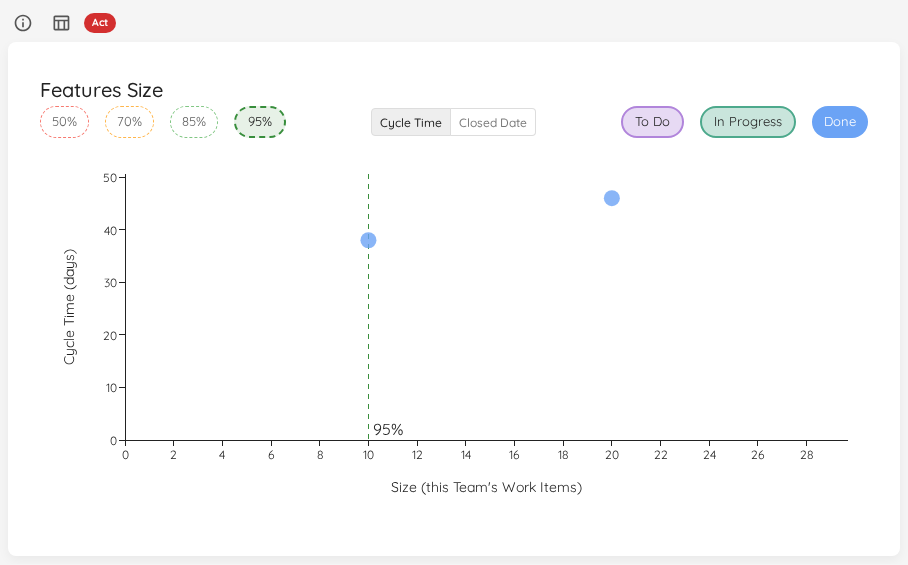
Feature Size Percentiles also gets View Data, on Teams and on Portfolios, listing the closed Features its percentiles are based on. Full detail: Feature Size on a Team.
Reporting: Then & Now
You started coaching a Team three months ago. They limited their WIP and began slicing smaller. Then someone asks: did it change anything? The Metrics tab shows only recent days, so the “before” has long dropped out of view, and screenshots taken back then never quite compare to today’s.
Every Team and Portfolio now has a Reports tab, and its first report type is Then & Now. Pick a window, Then, such as the 90 days before you came in. Lighthouse freezes its flow metrics on the spot, rebuilding them from history if Then ended in the past. Now slides and always ends today. Each time you open the report, Cycle Time, Throughput, WIP and Work Item Age sit side by side, Then against Now, with the change on every line. A summary at the top tells you at a glance what improved and what got worse.
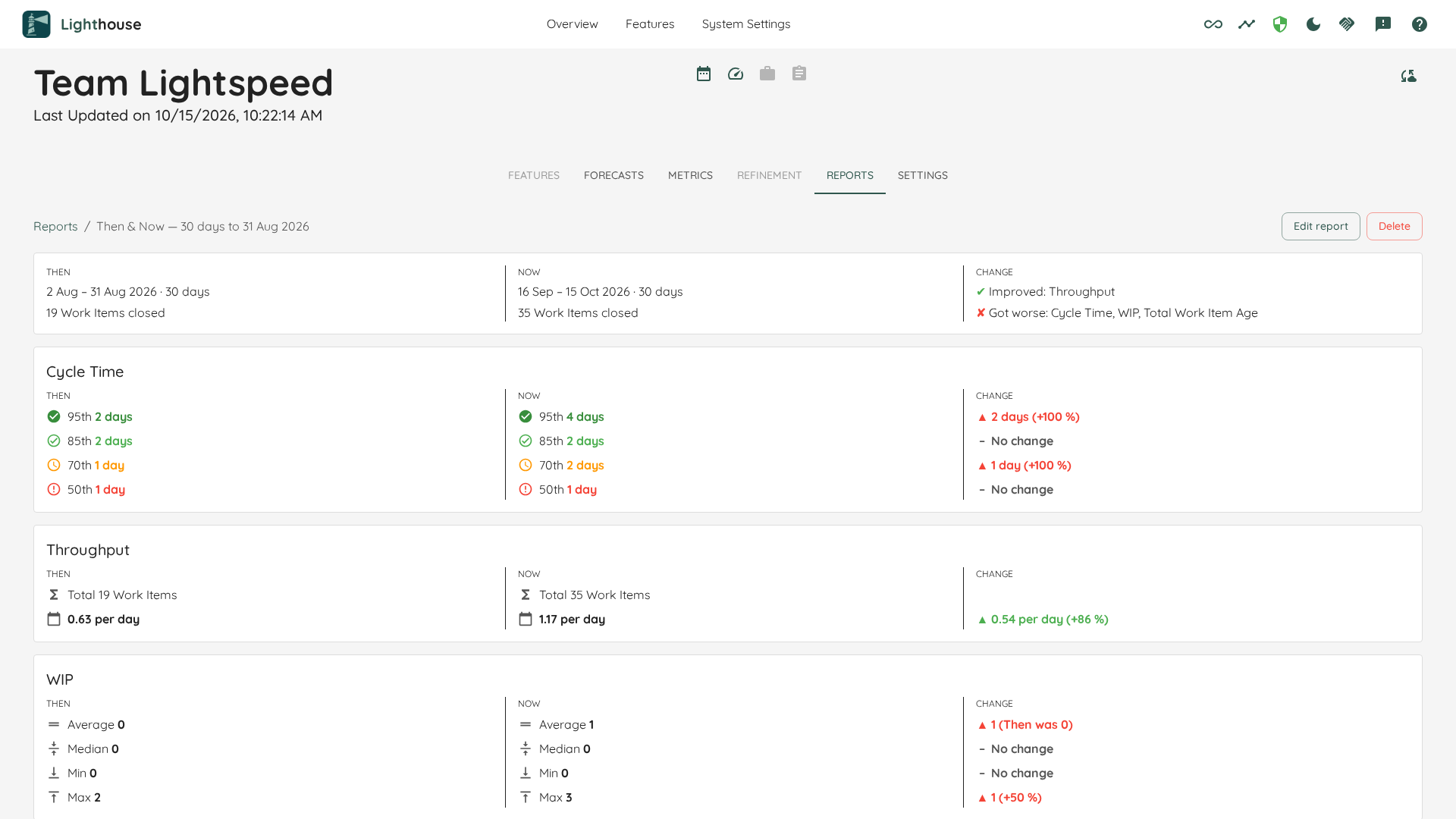
Reports are listed on the Overview next to each Team and Portfolio, so the evidence is one click away when the question comes. Community includes one Then & Now report per Team and Portfolio; Premium has no limit. Full detail: Reports.
Bugfixes and Improvements
- Clicking a chart now lists the Work Items with the columns that explain why they are there. The Estimation vs. Cycle Time dialog shows each Work Item’s Estimate next to its Cycle Time, the Blocked list shows since when each Work Item is Blocked, a Feature’s child items show when each started and closed, and Manage columns offers the rest; the layout you choose is remembered for each chart. Full detail: Viewing the Data Behind a Widget.
- Every row of a long list can now be reached. A list used to stop at its first 100 rows without saying there were more, so a Team with 143 Work Items in refinement could not vote on the last 43. A list of more than 100 rows now says how many it holds, for example
1–100 of 143, and its arrows page to the rest. Sorting, filtering, the search in Third-party packages, and Export and Copy all cover the whole list. Lists of 100 rows or fewer look as before. - The Overview’s Deliveries column stays readable. It shows at most two Deliveries per Portfolio, then a +N more link to the rest. While loading it shows a spinner, and if the Deliveries cannot be loaded it says so, instead of claiming there are none.
- Deliveries can follow a Jira Release on Jira Server and Data Center too. On a self-hosted Jira the list of Releases to pick from came up empty, so a Delivery could not be bound to one, and nothing said why. Lighthouse now reads Releases the way Jira Server and Data Center (version 8 or later) serve them: the picker lists them, a bound Release’s date and Work Items refresh, and the forecast is written back to the Release. Jira Cloud works as before.
- Over-time charts always fill in the days Lighthouse missed. Fill in past days on over-time charts left a Team added last week, or an instance that does not run every day, with a short or gappy trend wherever someone had switched it off. It is no longer a Preview and no longer a setting: Percentiles Over Time and PBC Over Time fill in past days on every instance, including ones where it had been switched off. Filled days cannot be told apart from recorded ones afterwards, so take a backup before you upgrade if you might want your unfilled history back. Full detail: Filling in past days.
- Jira status changes keep their real time on every server. On a Lighthouse server that does not run in UTC, the moments a Jira Work Item or Feature changed status, and the day it was created, were stored shifted by the server’s offset, so a change made late in the evening could count on the next day and Cycle Time could be a day off. They are now stored as the time Jira names. Times stored earlier are corrected the next time Lighthouse downloads that Work Item or Feature again with its complete history, which happens once it changes in Jira; until then it keeps the times it had. A history entry Jira sends without a readable time no longer stops the whole item from loading.
- Work Items whose Jira links name several issues now land under the right Feature. When the parent comes from an issue link type and a Work Item is also linked the same way to an incident or another issue, Lighthouse used to leave it where it was and only warn. Now only Features count, and among several Features the oldest link wins, then the Feature created first, then the lowest key. Features with several parent links are placed the same way. Every refresh lists what it decided in a warning, and Settings > System Info shows how many records needed it. Full detail: When a Work Item’s links name more than one issue.
- A new Additional Field fills in without a manual update. Adding a field to a connection left it empty on every Work Item already in Lighthouse until each Team and Portfolio on that connection had been updated, so a rule on the new field quietly matched nothing. Saving a change to a connection’s Additional Fields now offers to update its Teams and Portfolios straight away, and the field fills in within that update. Full detail: Additional Fields.
Contributions ❤️
Special thanks to everyone who contributed feedback for this release:
Lighthouse v26.10.10.1
Support for Team-Level Refinement
Most Teams refine by habit: an hour every week, whatever is on top of the backlog, until the time runs out. Some weeks that leaves the Team starving for ready work; other weeks it builds a queue of refined Work Items that sit and go stale.
Every Team now has a Refinement tab. It lists the Work Items in the Team’s refinement states, in backlog order, and answers two questions before the next Refinement.
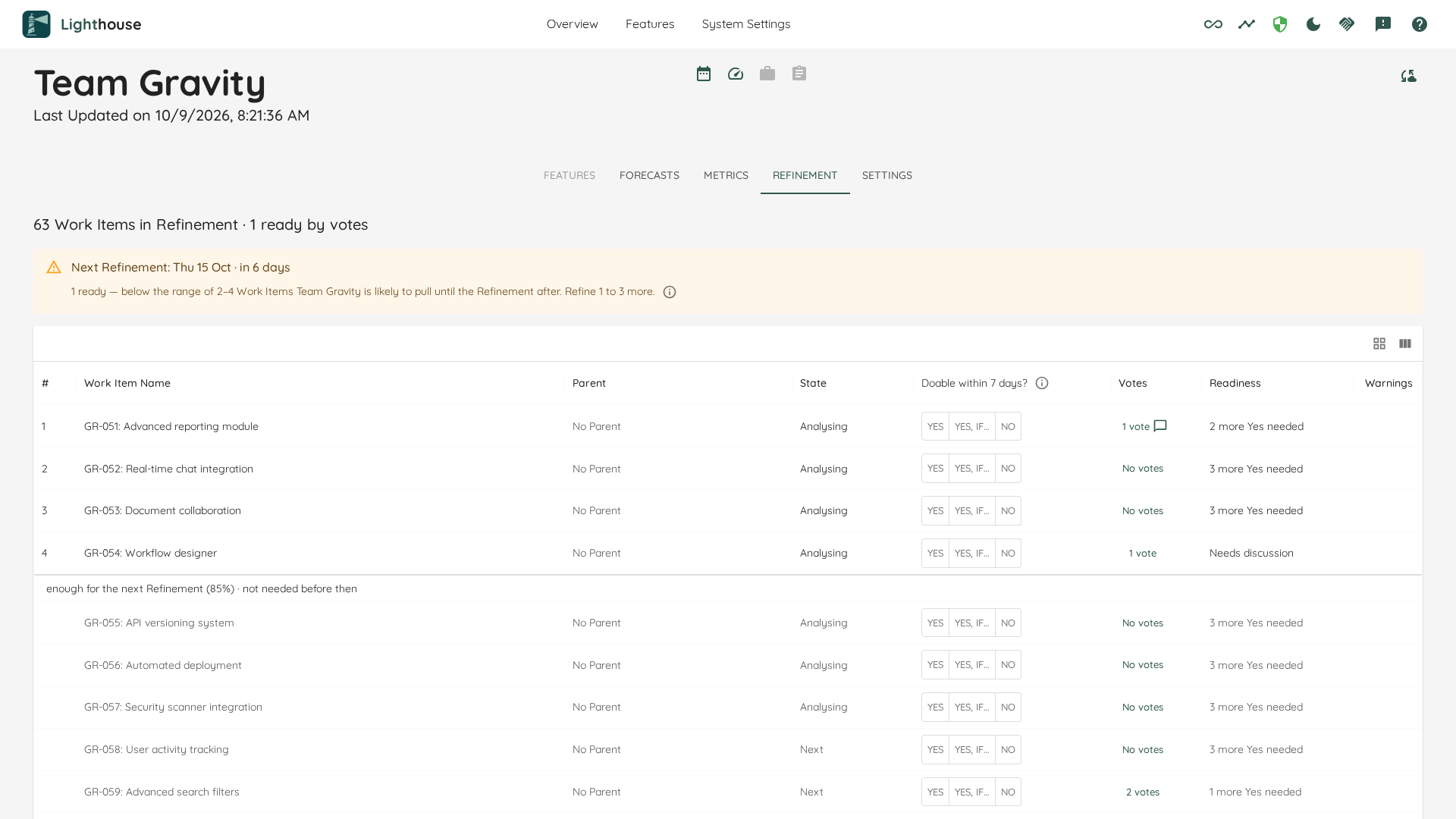
How much should we refine? Give the Team a Refinement cadence, and Lighthouse compares how many Work Items are ready with how many the Team is likely to pull until the Refinement after the next one, using the same How Many forecast as the Forecasts tab. The answer is one of three: refine 2 to 5 more, nothing more is needed, or stop refining. The Work Items needed first are numbered, and a line shows where “enough” ends. Having too much ready is flagged as clearly as having too little.
Is this Work Item small enough? Instead of estimating, everybody votes on one question: is this doable within our SLE? The answers are Yes, Yes, if… (with the condition written down) or No. Votes can be cast at any time and without a meeting, and enough Yes votes make a Work Item Ready. If your work tracking system already tracks readiness, stage rules let it decide, and the votes sit beside it as a second opinion.
Refinement is part of every Lighthouse installation, community and premium. Full detail: Refinement and Refinement settings.
Reworked Agent Skills
The Lighthouse skill has been reworked, and two new skills join it, each walking your AI assistant through one recurring Team routine:
- Refinement gets a Team ready for its next Refinement: whether to refine more or stop, and which Work Items are worth the session’s time. Try: “Are we ready for Thursday’s Refinement?”
- Daily Flow Review opens a Team’s daily with what to discuss today: Work Items that are blocked, past the SLE or at risk of missing it, and WIP over its limit. Try: “What should Gravity discuss today?”
Both new skills grew out of ideas from Liz Rettig. Each skill is its own download. Full detail: AI Integration.
Bugfixes and Improvements
- Each chart widget now shows a loading indication while its data is refreshed, and says so when its data cannot be loaded, instead of showing the old answer or an empty chart.
- Parents from Jira issue links now work for Work Items that are both a child and a parent. If you set a one-way phrase like is caused by, type the phrase the child uses to point at its parent, or the link type’s name. Full detail: Parent Override Field.
- Usage data from the CLI and MCP.
lhand the MCP servers now ask for consent to share usage data, just as the browser does, and report the same events once you agree. Each event is labelled with where it came from. Nothing personal is sent. Full detail: Usage Data. - Updated various third-party libraries.
Contributions ❤️
Special thanks to everyone who contributed feedback for this release:
Lighthouse v26.10.3.6
Forecast Reality Check
A backtest answers “would this one forecast have held?”. It cannot tell you whether a Team’s forecasts hold in general, or whether the sampling window behind them is a good one — and that is the question that decides how much weight a forecast can carry.
On a Team’s Forecasts tab, press the new Run reality check below the backtest inputs. Lighthouse replays the Team’s recent forecasts — horizons of 1, 2, 4 and 8 weeks, each forecast from 14, 30, 60 and 90 days of history plus your own setting — and holds every one at 50%, 70%, 85% and 95% against the Work Items the Team actually completed.
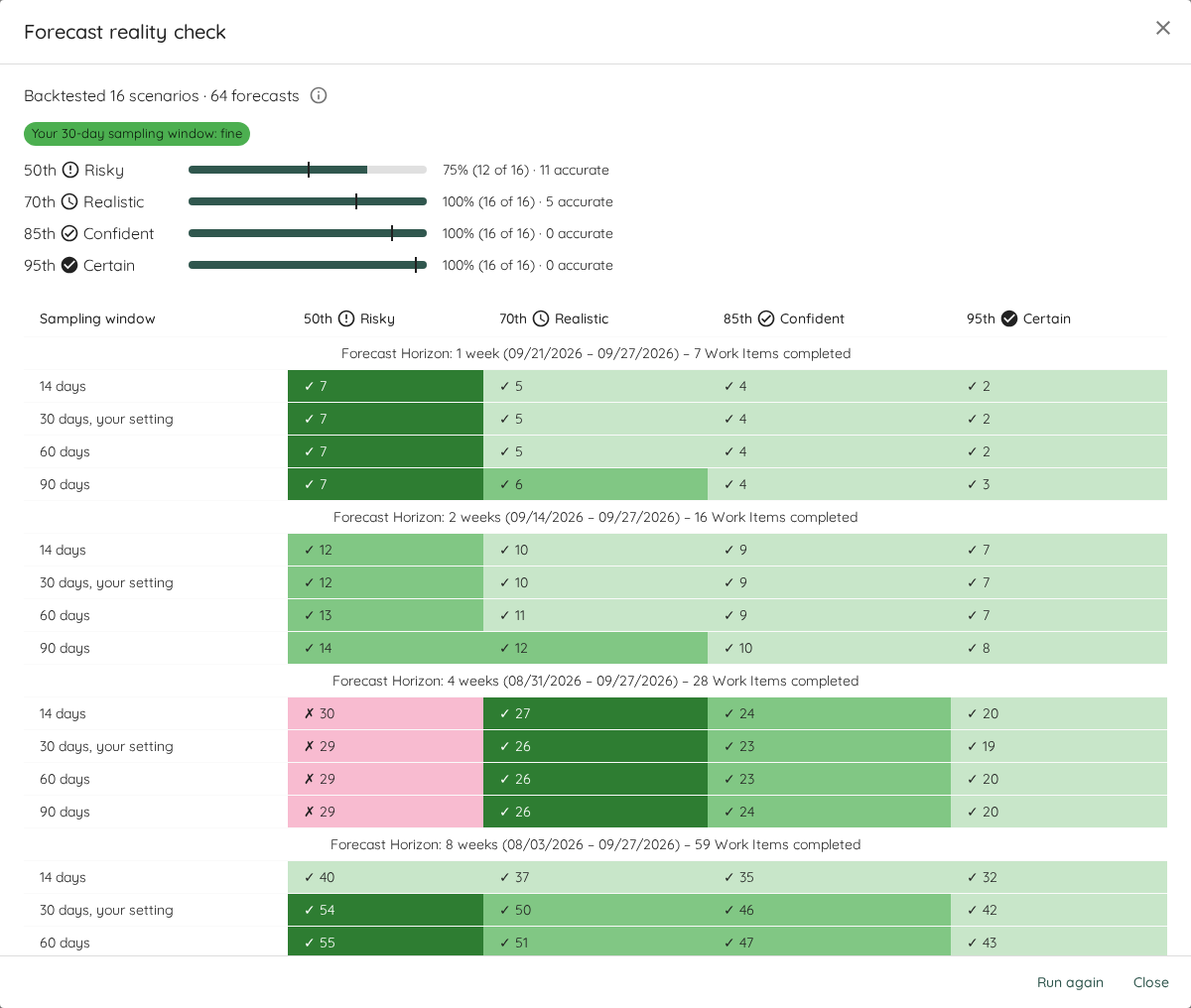
The answer opens on a summary: whether your sampling window held up, how often each confidence level held against the rate it should hold at, and how many forecasts landed within 10% of what was delivered. Below it, every forecast sits beside the actual, shaded by how close it came. It does not crown a “best” window — each scenario covers a different real period, so they are evidence to read side by side.
The method follows Nick Brown’s article The Full Monte. Full detail: Forecast Reality Check.
Filling in Past Days is now On by Default
The Fill in past days on over-time charts behaviour setting from the last release is now switched on by default, so Percentiles Over Time and PBC Over Time show a full line rather than only the days Lighthouse happened to record.
Upgrading switches it on once — also on instances where it had been turned off. If you want it off, switch it off again under Behaviour Settings and it stays off from then on. Restoring a backup brings the setting back as the backup held it. It is still a Preview. Full detail: Fill in past days.
Bugfixes and Improvements
- Adding a Data Sync Mapping for a new field works again. The mapping and the field it targets are now saved together, instead of failing on the first save.
- New Teams and Portfolios get the same defaults everywhere. A Team created through the API started with 30 days of throughput history while the UI used 90; both now use 90. A Portfolio saved with a percentile history of 0 now falls back to 90 days as well.
- The Helm chart now runs PostgreSQL 18 and upgrades the bundled database for you. On
helm upgrade, the bundled Postgres carries its data from 17 to 18 before it starts, and keeps the old copy so you can roll back. Full detail: Upgrading the bundled PostgreSQL. - Updated various third-party libraries.
Contributions ❤️
Special thanks to everyone who contributed feedback for this release:
Lighthouse v26.9.24.6
Delivery Timeline
A forecast tells you when a Delivery will be done. It did not show you how it gets there — which Features get worked first, which ones sit in the queue behind them, and where the target date falls in all of that.
Expand a Delivery and open its new Timeline tab: one bar per Feature, in board order, running from the day work on it is forecast to begin to the day it is forecast to finish. Switch between 70%, 85% and 95% and both ends of every bar move together, so each bar is always one consistent scenario. Switching to 95% and checking whether the last bar still lands before your target date is the quickest read on how much slack you really have.
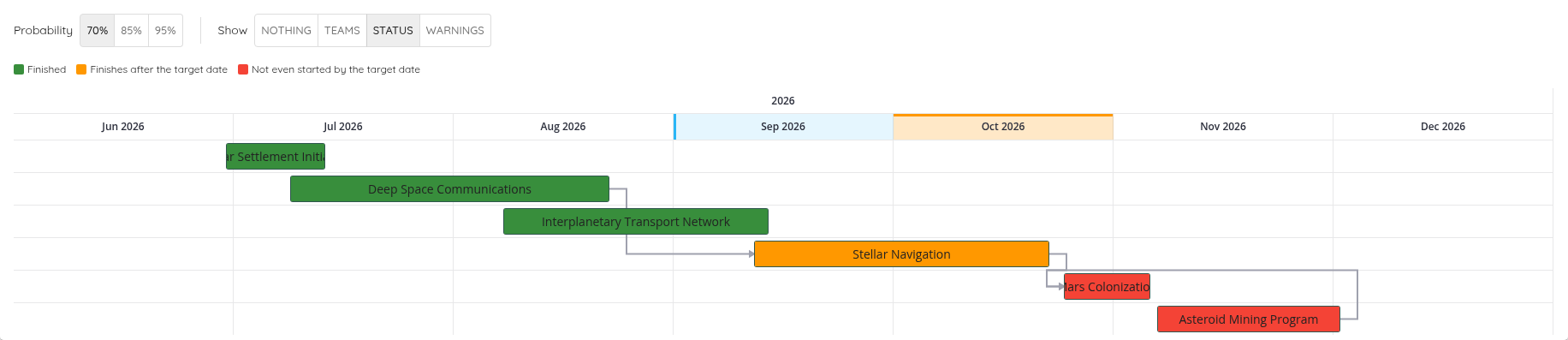
The bars can answer one more question at a time:
- Status — which Features finish after the target date, and which ones will not even have started by then.
- Teams — a Feature worked by several Teams splits into a row per Team, each with its own dates.
- Warnings — the same warnings the Features table shows, right on the bar.
Where a Feature waits on another and the forecast took that into account, a line joins the two bars. Waits the forecast could not honour are spelled out on the bar instead of drawn. Features that cannot be placed are listed beneath the chart with the reason, never silently left out.
The Timeline is a premium feature. Full detail: Delivery Timeline.
Forecasted Start Dates
Lighthouse has always forecast when a Feature will be done. Now it also forecasts when work on it will begin.
The new Forecasted Start column sits beside the completion forecast, with the same four probabilities, from the same simulation. A start date far out is Lighthouse telling you about the queue: nothing starts until the Teams working it are free of everything ordered above it. A Feature that has already started shows the day it actually started — a date that has happened is a fact, and no probability moves it.
The column appears wherever Features are listed and needs no licence. Just like the completion dates, the start dates can be written back to Jira and Azure DevOps through Data Sync Mappings, so your plans in the tracker show both ends of every Feature.
Full detail: Forecasted Start.
Fill in Past Days on Over-Time Charts (Preview)
Percentiles Over Time and PBC Over Time only ever showed the days Lighthouse happened to record. A Team added last week, or an instance that does not run every day, got a short line or one full of holes — even though the Work Items needed to work out those days were already stored.
Switch on the new Fill in past days on over-time charts behaviour setting, and opening either chart works out the missing days in the background from the history Lighthouse already keeps. A day nothing can be worked out for stays empty — nothing is invented to fill it.
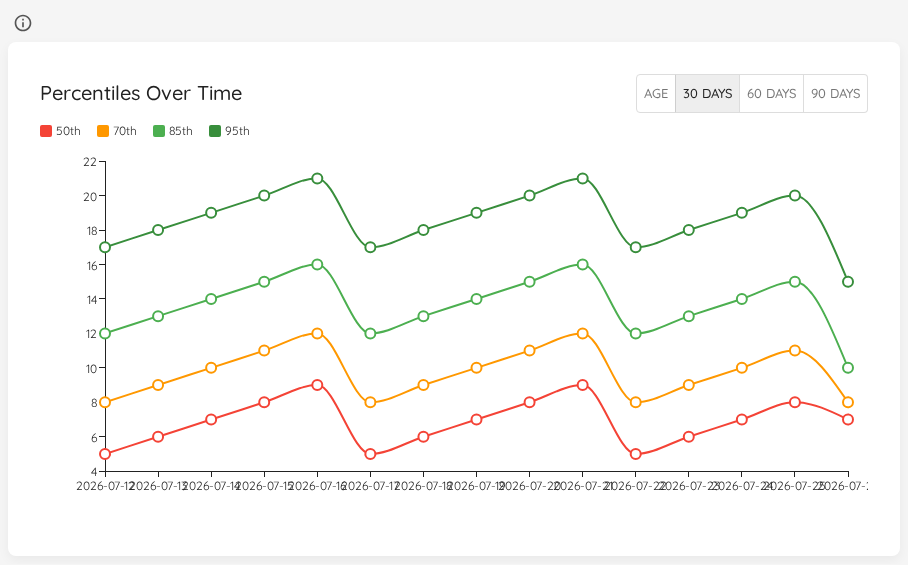
It is a Preview and off by default — a System Admin switches it on, no restart needed. A filled day is worked out against today’s configuration, and days already filled stay when you switch it off, so take a backup first if you might want to undo it.
Full detail: Fill in past days.
Bugfixes and Improvements
- Faster Updates is no longer a switch. Every refresh that can download only what changed now does, on every instance. An instance that had it turned off gets the faster refresh too.
- The SLE Risk tooltip says how much of the evidence missed the SLE, and the risk column takes its target from the Team’s SLE.
- The Task Manager’s activity rows lead with the work rather than the Team or Portfolio, and a queued row no longer names itself as the thing it is waiting for.
- No more Kestrel warning at startup about the listening address being set twice.
- Updated various third-party libraries.
Contributions ❤️
Special thanks to everyone who contributed feedback for this release:
Lighthouse v26.9.19.10
Display Risk of Missing your Service Level Expectation
An aging chart tells you how old an item is. It does not tell you whether its age is a problem.
Lighthouse now puts a number on it. Every in-progress Work Item carries the chance it will finish later than its Team’s SLE, derived from that Team’s own cycle time history.
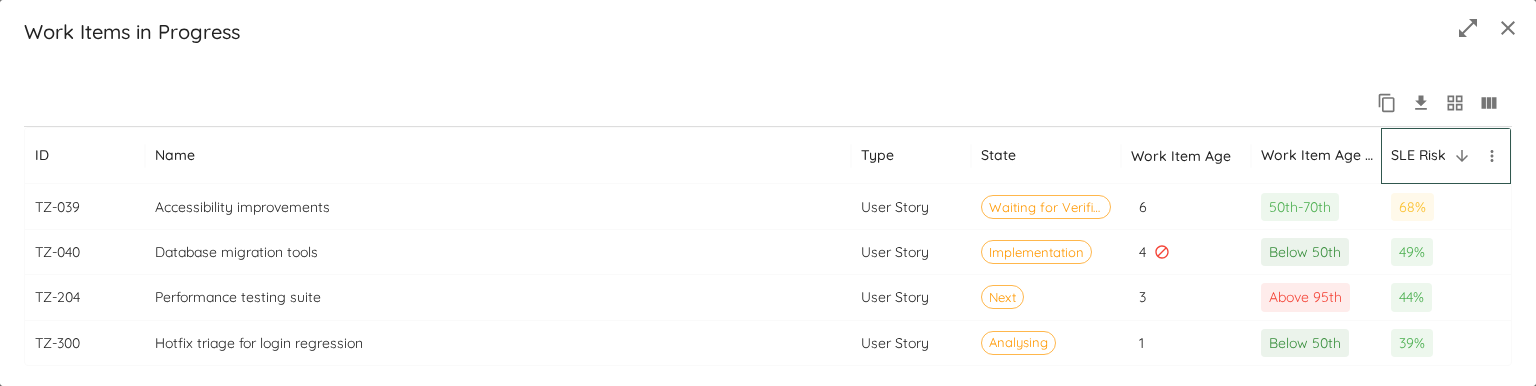
As an example, let’s assume your SLE is 5 days at 80%. Your relevant history includes 45 items that were closed. You want to know the risk of breaching your SLE for an item that is right now 3 days old. Of your historical 45 items, 20 items had a Cycle Time of 3 days or more. 8 of those were breaching the SLE (Cycle Time of 6+ days). That means, for your current item, the risk is: (100 / 20) * 8 = 40%
The number can be seen in the Work Items Dialog for in Progress Items, as well as in a new widget that shows you all the “At Risk” items currently in progress. At risk means that there is a 70+ percent chance that you breach the SLE.
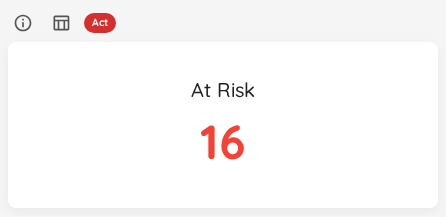
Full detail: Flow Metrics.
Task Manager
“Is Lighthouse doing anything right now?” had no good answer. A refresh that hung, a connection whose credential quietly expired, an error that scrolled past in the log — all of it invisible unless you went digging.
Now you can watch what Lighthouse is up to when you click on the timeline icon in the header: what is refreshing and what is queued, the health of every connection to your Work Tracking Systems, and what has gone wrong recently.
You can also stop a refresh, which was not possible from the UI before — every connector now notices the stop mid-page rather than finishing the fetch anyway.
It names every Team, Portfolio and connection on the instance, so it is shown to System Administrators only.
Full detail: Task Manager.
Parents read from Jira issue links
Some Jira instances do not record hierarchy as a parent field at all. They record it as an issue link — “caused by”, “results in”, etc. You can now define additional fields that point to those “link types”, and use them as “Parent Overrides” for your Teams and Portfolios.
This allows Lighthouse to set up Portfolios with Features and proper forecasting, even if you don’t use any built-in Parent-Child connection on your Jira instance.
Jira only, Data Center and Cloud, and free — no licence needed. Full detail: Team settings and Portfolio settings.
Usage Data Collection
Up until now, we used to have no indication who and how Lighthouse is used. The nature of the tool, allowing to self-host and all made it tricky. We understand that not everyone wants to send their usage data, and that’s completely ok. However, some people may be ok with that. And it would be of great help to us.
So we introduced a strictly opt-in feature that enables sending of some data points. If enabled, Lighthouse can now tell us which parts of it get used, plus a little about the instance doing the using: its version, how it is deployed, which licence tier it runs on.
To repeat, nothing is sent until somebody using that instance agrees to it, and anyone can stop it again with one click.
We don’t send any info about your work items, team names etc., but only basic information about your instance as well as what you are using. You can see the full details in the docs below.
Important: If you are using a premium license, a system administrator can disable any usage data sending for the full instance. This will prevent sending data for anyone that uses this instance, independent of their individual answer.
Full detail: Usage Data.
Lighthouse is now source available
This is the first release under the Lighthouse Source Available License 1.0. The source stays public on GitHub: you can read it, run it, audit it and change it for your own use, but it is no longer MIT.
Everything up to and including v26.9.9.9 remains MIT licensed in perpetuity. That is not retroactive: if you run one of those versions, or hold a copy or a fork, your rights are untouched.
For almost everyone, nothing changes. Running Lighthouse inside your company for as many people as you like, modifying it heavily, forking it, building plugins or dashboards on top of it, and consulting or coaching with it all stay permitted. What is not permitted is offering Lighthouse as a hosted or managed service to other people, removing or bypassing the licence key check, and building a separate product out of the source whose primary purpose is to replace Lighthouse.
Publishing the source is how we let you verify that your delivery data stays on your own infrastructure, and we want to keep doing that. What we did not intend was to hand someone a complete forecasting product to resell, or to make the paid tier trivially removable. There is a free Community edition, and there always will be.
Full detail: Licensing.
Bugfixes and Improvements
- Team creation failed validation on Jira Data Center. Selecting a board could fail with a bare 400. The query had outgrown what fits in a request line — Lighthouse now asks Data Center for issues over POST.
- A Portfolio refresh could fail with a 400 that said nothing. Lighthouse now reports what Jira actually said, and names the query it sent when Jira will not say what was wrong. A configuration that narrows nothing gets no query rather than an empty one, and board filters and sub-filters are bracketed independently.
- A mistyped additional field killed every refresh on Jira Data Center. An unresolvable field reference now names the field it could not find, pinned to the Additional Fields input, instead of throwing an unexpected error.
- Azure DevOps blamed the wrong thing for a refused field list. A field-metadata lookup that fails now says so, instead of reporting an unreachable URL or a bad token — and fields that cannot be resolved are no longer dropped in silence.
- A failed connection validation hid what Lighthouse already knew. The verdict now carries what the connector itself said.
- The log viewer opens at the tail. It opened at the top, which is the wrong end of a log when you are looking for what just went wrong.
- Updated various third-party libraries.
Contributions ❤️
Special thanks to everyone who contributed feedback for this release:
Lighthouse v26.9.9.9
Named time ranges, and stepping the metrics window
Every metrics dashboard opened on a range you had to set with two date pickers, one end at a time. Click the date range in the header and there is now a row of named ranges — 7, 14, 30 or 90 days for a Team, 30, 90 or 180 for a Portfolio — that jump straight to a window ending today.
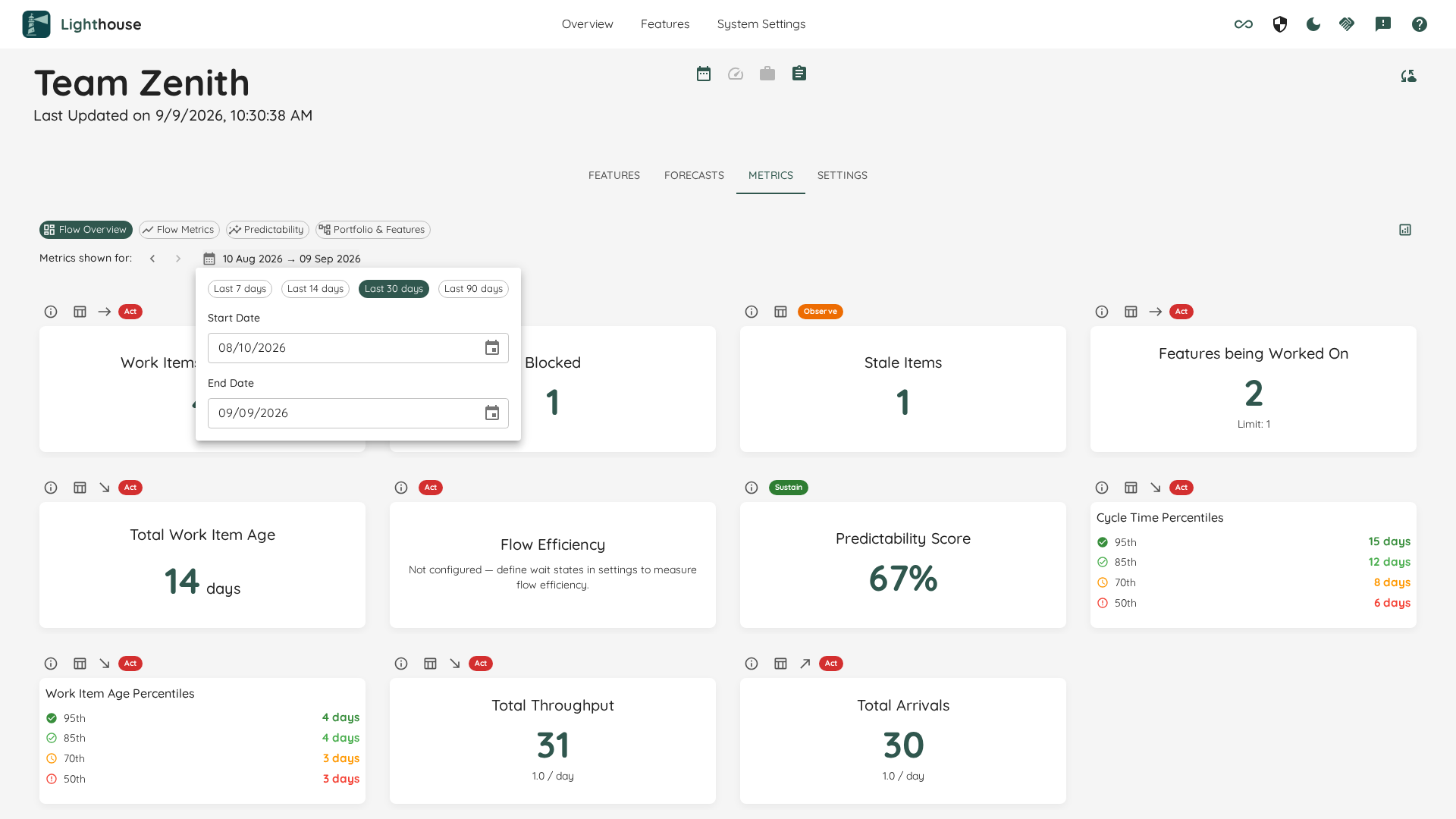
Either side of the date range sit two arrows that walk the window you already have backwards and forwards, keeping its length: a week at a time for a Team, four weeks for a Portfolio. That is how you compare the same span of time across consecutive periods without doing the arithmetic yourself. Click them several times in a row and Lighthouse waits until you stop before it reloads, so six steps cost one fetch rather than six.
Full detail: Filtering.
Work Item Age bands in the work item dialog
The Work Item Aging chart already paints a coloured pace zone behind every dot: how this item’s age compares against how long finished Work Items historically took to leave the state it is sitting in. Reading that meant going dot by dot.
It is now a value on a row. Open the work item dialog from View Data or by clicking a bubble, and each row carries a Work Item Age Band — Below 50th, 50th-70th, 70th-85th, 85th-95th, Above 95th, or No history where the state has nothing to be measured against. Sort worst-band-first, cut the list to a single band with the column filter, or export it as a CSV whose band column reads in words.
The bands are per state rather than per total age, so an item three days into a state everything else leaves in one reads worse than an item that has been in progress a fortnight and is exactly where it should be.
Full detail: Work Item Age Band Column.
Behaviour Settings
Instance-wide switches were spread out: Optional Features in one place, Feature Ordering in a section of its own. They now sit in one table under Settings → Behaviour Settings, a row per switch, each saying what it does and — where it applies — which licence unlocks it.

Feature Ordering moved in as one of those rows, and your existing choice came with it. Turning it on still hands out places to the Features that do not have one yet and re-forecasts; turning it off still leaves those places alone, so taking the order back over adds to the end instead of renumbering everything.
Full detail: Behaviour Settings.
Faster Updates is on by default
Faster Updates — the two-phase refresh that sweeps your query for what actually changed and downloads only that — is out of preview. New instances start with it on. Existing instances keep whatever you had, and the switch is still there, now as one of the Behaviour Settings rows.
Bugfixes and Improvements
- The metrics date pickers no longer crash on a half-typed date — typing a
0into the day or the month dropped the dashboard onto an error screen. A date is now applied only once it is complete and valid, which also means typing your way through a date no longer reloads the widgets on every keystroke. - Updated various third-party libraries.
Contributions ❤️
Special thanks to everyone who contributed feedback for this release:
Lighthouse v26.9.1.6
Fixed: updating from inside Lighthouse could leave it unable to start
A Windows or Linux server binary updated to v26.8.31.7 from inside Lighthouse could fail to start, exiting with:
FATAL: The encryption key supplied by EncryptionSettings__EncryptionKey is the key
published with Lighthouse. [...] Lighthouse will not start on it.
Nothing was lost — the instance stopped before changing anything, and every stored credential is still readable. Lighthouse now ignores that leftover key and keeps one of its own instead.
Already stuck? You do not need this release to recover. Delete the EncryptionSettings block from the appsettings.json next to Lighthouse.exe, start Lighthouse again, then press Move stored secrets under Settings → Encryption. Do not copy that value into Encryption__Key.
Docker, Kubernetes and macOS were never affected.
Lighthouse v26.8.31.7
Improved Encryption Options
Lighthouse has always let you supply your own encryption key for stored credentials — but almost nobody ever did, so almost every instance was protecting its Jira and Azure DevOps tokens with the key that ships inside every copy of the product.
Every instance now makes and keeps a key of its own on first start, or takes one you supply. The published key is no longer accepted as an active key. Settings → Encryption shows where your key came from, where it is kept, how many credentials sit under it, and lets you Rotate, Move stored secrets and Check secrets.
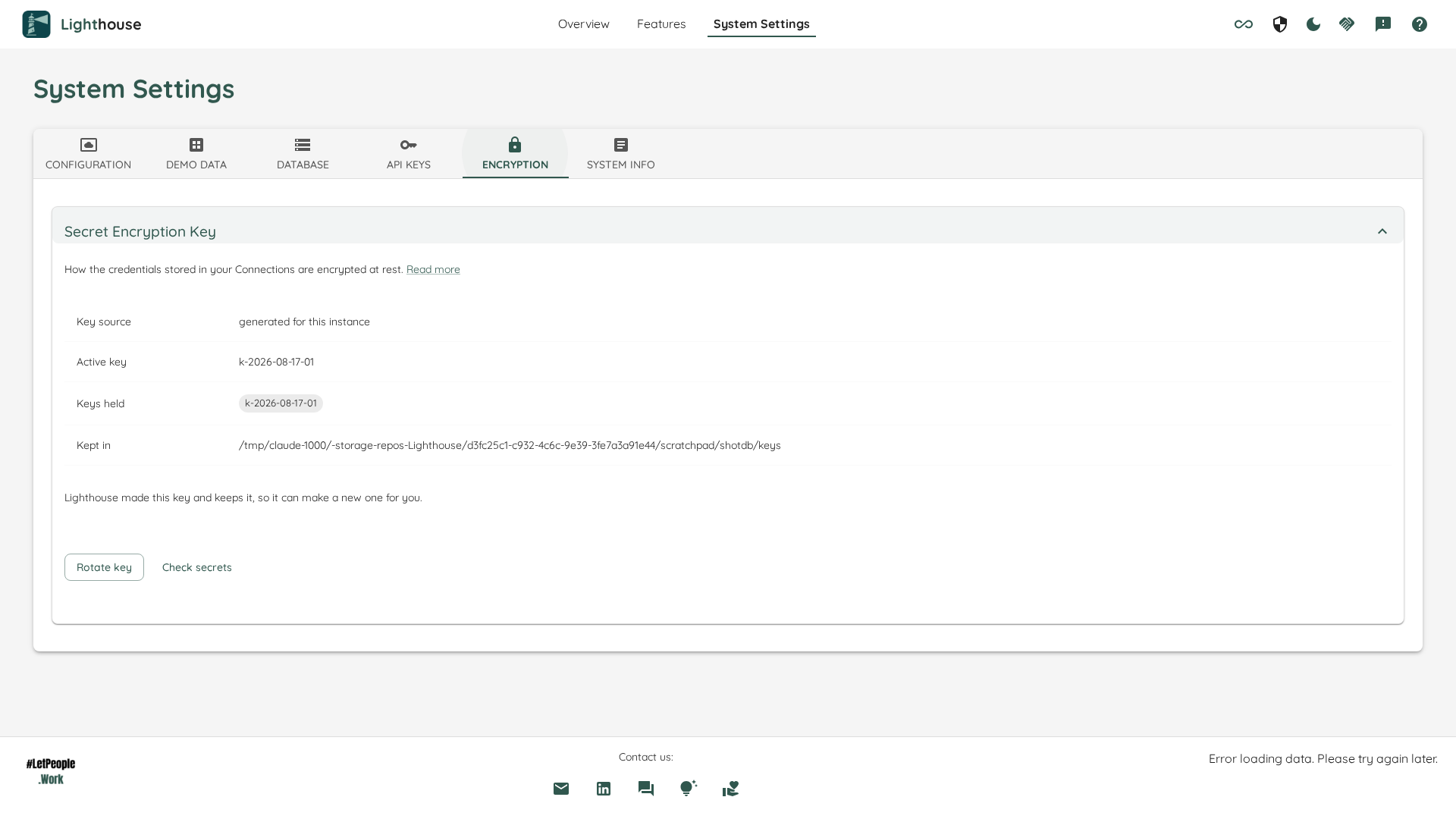
Upgrading does not re-encrypt anything. New credentials use the new key immediately, but everything stored before the upgrade stays under the published key until you press Move stored secrets. It moves them and asks you to re-enter nothing.
⚠️ Action required on Postgres, or in a container without a mounted data volume
If Key source reads the key published with the product, this instance has nowhere durable to keep a key, so there is no Move or Rotate button. Set either
Encryption__KeyStorePathto a directory that outlives the container (on the official image/app/data/keys, with/app/dataon a named volume, not a bind mount) orEncryption__Keyto your own 32-byte base64 key — then restart and press Move stored secrets.On Kubernetes, the chart now refuses to install without
encryption.keyorencryption.existingSecret.
Full detail: Secret Encryption Key, Configuration, Kubernetes. And docs.lighthouse.letpeople.work/security now answers how do you look after the credentials I give you? on one page, written to be forwarded to whoever is asking you.
Dependencies
Your teams already record dependencies — a Predecessor link in Azure DevOps, an is blocked by link in Jira, a relation between two Linear Projects. Lighthouse never read any of it, so a Feature’s blockers were invisible until the meeting where the date slipped.
Every Feature list now has a Dependencies column, one blocker per line, each linking into your tracker. Nothing to configure: if the link is in your tracker, it is on the row. Where a dependency cannot be taken at face value — no shared Portfolio, a cycle, no measured delivery to forecast from — one warning icon per Feature says why.
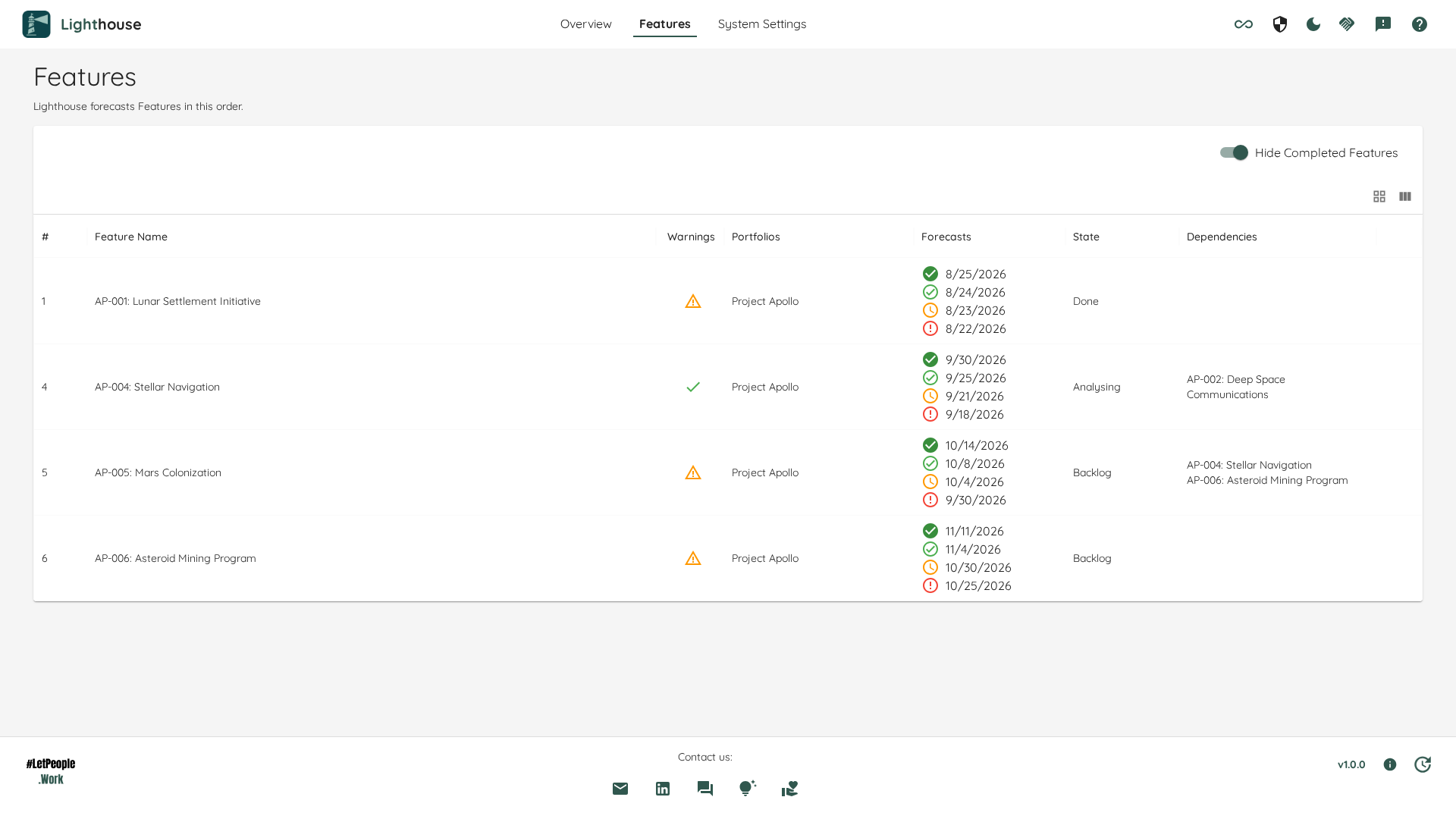
Lighthouse does not let you author a dependency, and never will. If your teams keep them in a custom field rather than the tracker’s own link, or you want a Portfolio’s dependencies read but not counted, both live under Dependency Settings on your Portfolio’s settings page.
Available on every instance, community edition included. ServiceNow is the exception — it has no Features for a dependency to run between. See Dependencies for what each connector reads.
Forecasts take Dependencies into account (Premium)
If a Feature depends on another Feature, the forecast now takes that into account. A Feature is not worked on until the Feature it waits on is forecast to be finished — even if it sits higher up in your order. This works across Teams too: a Feature your platform Team delivers can wait on one your product Team has not finished.
Without a premium licence, the Dependencies column and its warnings work exactly the same, and the dates read as if no dependency had been recorded.
One side effect worth calling out: Refresh everything used to forecast a Portfolio once per Team delivering into it, writing back each time. It is now one forecast and one write per Portfolio per round — faster refreshes and a fraction of the tracker traffic.
Improved Deliveries
Deliveries got a round of improvements. They can now be kept after they are done, annotated while they run, and — on Jira — take their date straight from a Release and send the forecast back to it.
Archive a Delivery instead of deleting it
A finished Delivery used to quietly rewrite itself as its Features moved on, got re-estimated, or were closed — so asking in October what you were forecasting in August left nothing to look at. Archive it and what it showed at that moment is written down: the likelihood, the forecast dates, and every Feature that was in it. Refresh, rename, remove — it reads exactly as it did on the day it closed. Bring it back at any time.
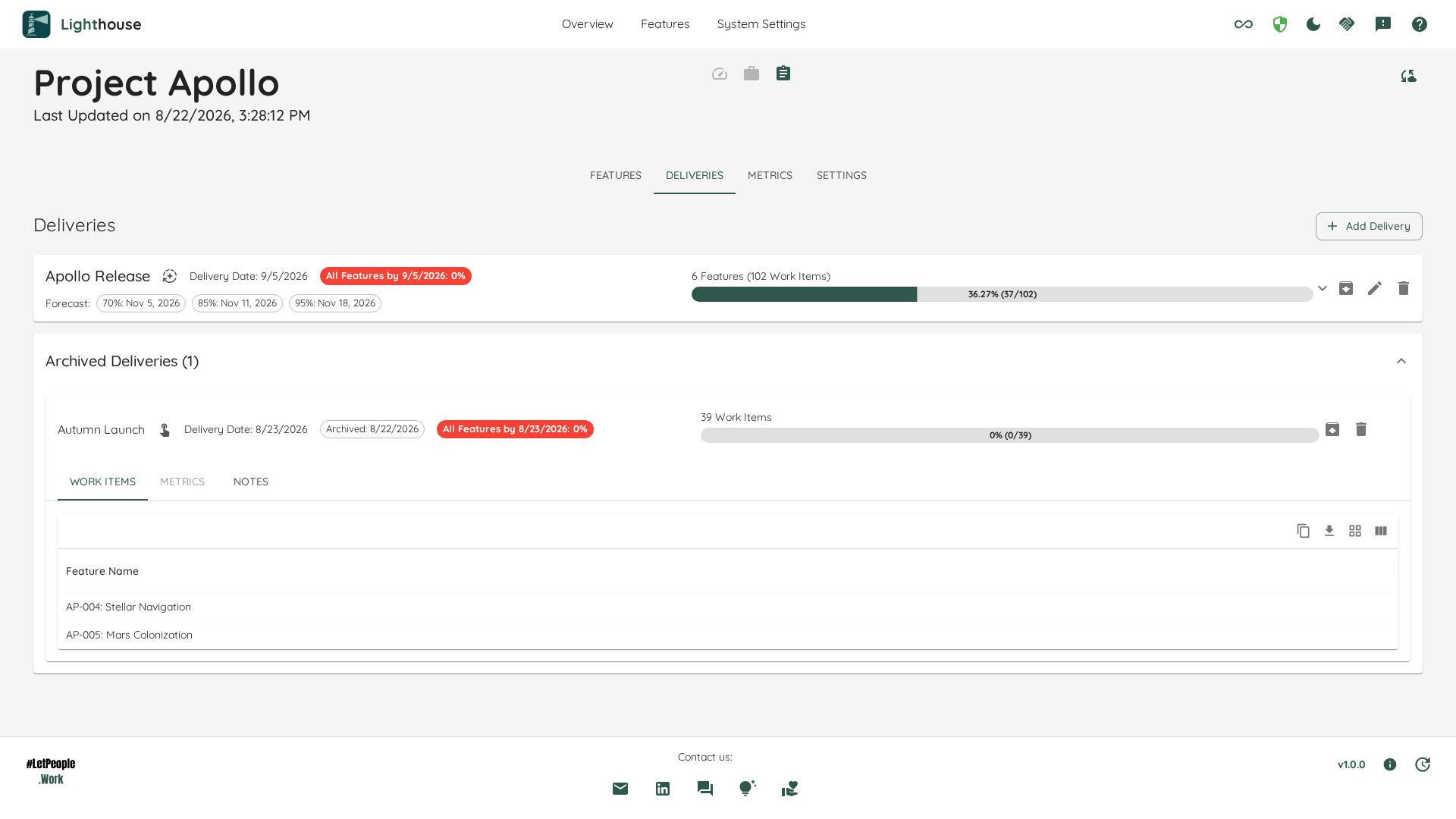
Any Delivery, archived or not, also exports as a CSV or a paste — the headline numbers and the whole Feature grid.
Archiving is not a backup. Deleting an archived Delivery still deletes it permanently, along with its written-down numbers and metric history.
Write down what happened
Deliveries now carry notes, so the reason a date moved lives next to the date instead of in somebody’s memory or a chat thread nobody can find. Notes stay readable on an archived Delivery; they just stop changing.
Bind a Delivery to a Jira Release
Your teams already keep the date in Jira, on a Release, and somebody was retyping it into Lighthouse every time it moved. A Delivery can now follow that Release instead.
Creating one. Pick the Release when you create the Delivery, and it owns the name, the date and the Features in it.
Keeping it current. All three stay in step on the refresh that already runs — nothing is maintained by hand. If the Release is deleted, the values freeze as they last were and the Delivery says the source is gone; a network blip or an expired credential is told apart from a deletion.
Writing the forecast back. Switch publishing on and Lighthouse writes the 70/85/95 dates and the likelihood onto the Jira Release description, for the people who never open Lighthouse. It is off by default and set per Delivery. Lighthouse never writes the release date field itself, never deletes prose it did not write, and tells you on the Delivery if Jira refuses the write.
Archiving, following a Release and publishing back to it need a premium licence. Un-archiving does not, and notes are not gated at all.
Bugfixes and Improvements
- Installing an update now requires a System Administrator — on an instance with authentication enabled, the endpoint that installs an update was reachable by a caller who was not signed in.
- The system information page no longer reports part of your database password — it says where the database is, not how to log into it.
- Work Item Age and Cycle Time are back in the Work Item dialog — opening an item from a run chart showed the dialog with those fields empty, and with no owning team on items that are not Features.
- A Delivery is overdue on your instance’s day, not your browser’s — a Delivery could read as overdue or not depending on the time zone of the person looking at it.
- Refreshes are far quieter in the log — a refresh that removed items wrote a line per item, burying everything an operator was looking for.
- The documented Docker install and the shipped Postgres Compose example were corrected — both used host directories the container is not permitted to write, so the install failed on every Linux host and the Postgres example crash-looped on its second start.
- Updated various third-party libraries.
Contributions ❤️
Special thanks to everyone who contributed feedback for this release:
Lighthouse v26.8.14.1
Faster Updates
Every update asks your work tracking system for the full details of every Work Item the query returns — including the ones nobody has touched in weeks. On a large query that is most of the time an update spends, and most of the load Lighthouse puts on your tracker. On an on-premise instance with years of history, it is the difference between a refresh interval you can afford and one you cannot.
Turn Faster Updates on under System Settings → Configuration and an update runs in two steps instead of one: it first asks for nothing but the identity of each Work Item and the date the tracker says it last changed, then downloads the full details only for the ones whose date moved. On one real Jira Data Center instance, a Team update went from 468 seconds to 2 — same query, same Work Items, same result.
Nothing about your data changes. The whole query is still read on every update, so a Work Item that leaves the query still disappears from Lighthouse on the very next update, exactly as before. And anything Lighthouse cannot be certain about — a connector that cannot sweep, a sweep that failed, a Work Item with no recorded change stamp — falls back to downloading everything. There is no half-updated state.
It applies to Jira Cloud, Jira Data Center and Azure DevOps today. ServiceNow, Linear and CSV keep running the update they always have, whether the toggle is on or off.
A setting that changes what an update asks for still costs you one full update: change the query, the Work Item types, the states, the state mapping, the Done cutoff or the additional fields, and the next update downloads everything again — the Work Items you already have were read under the old settings. The update after that is fast again.
Faster Updates ships as an opt-in and will eventually become the default. Please turn it on and try it out — and if something does not work the way you expect, tell us, so we can improve it before it goes live for everyone.
Quiet Write-Back
When Lighthouse writes a forecast back to Jira, it changes the issue the way a person would — and everyone watching that issue gets an email about it. On a Portfolio with a few hundred Features, that is a lot of mail nobody asked for.
Lighthouse now asks Jira not to notify anyone about the values it writes. Both Cloud and Data Center are covered.
Suppression needs a permission your account may not have, so Lighthouse checks rather than assumes. If the account does have it, the write is quiet. If it does not, the write still happens — and you get a warning in the log instead of silence. See Jira for how to check whether your account qualifies and how to grant the permission if it does not.
Quiet covers email notifications only. Every write still appears in the issue’s history and is still visible to anyone looking at the issue — this hides the mail, not the change.
Bugfixes and Improvements
- Lighthouse no longer goes blank after a browser refresh — a leftover service worker from an older version could serve a stale, broken page to anyone who hit reload. Lighthouse now uninstalls it on the next load, and a page that fails to render shows an error you can act on instead of nothing at all. Reported by Chris Graves.
- Blocked Item rules no longer mark your whole board blocked — an earlier upgrade could leave a Blocked Item rule with no value behind it, which matched every Work Item. Existing rules now repair themselves, and a half-finished rule can no longer be saved in the first place.
- A Jira query ending in
ORDER BYnow works — a data retrieval query whose last clause was an ordering was sent to Jira as invalid JQL, and the update came back empty. - Updated various third-party libraries.
Contributions ❤️
Special thanks to everyone who contributed feedback for this release:
Lighthouse v26.8.8.2
Order Your Features Yourself
Lighthouse forecasts your Features in the order your work tracking system gives them, and re-reads that order on every refresh. So a rank someone changes in Azure DevOps, Jira or Linear re-sequences your forecast without anyone on your team deciding it — and on connectors with no meaningful rank at all, the sequence was never yours to begin with.
Turn on Let Lighthouse own the order of your Features under System Settings → Configuration and Lighthouse takes ownership instead. Nothing moves when you flip it — Lighthouse records the order you are already looking at, exactly as it stands — but from then on refreshes stop re-sequencing it, and every row grows an action menu: Move to Top, Move Up, Move Down, Move to Bottom. A move re-forecasts at once rather than waiting for the next refresh, and the same menu appears in the Feature list on your Portfolio pages, because there is one order and a move made anywhere is the move everyone sees.
There is also a new Features page, sitting between Overview and System Settings, which lists every Feature across all your Portfolios in the order the forecast actually draws from. Every other list in Lighthouse shows you a slice; this one shows the whole backlog, which is the only view that matches how forecasting works — all Features of all Portfolios are always taken into account. The # column is a Feature’s place in that instance-wide order, so it tells you where a Feature really sits rather than where it sits on your screen, and its heading reads Manual once Lighthouse owns the order.
The Features page and the # column are available on every instance. Owning the order is a Premium capability, and turning it back off hands the order straight to your work tracking system again — immediately, and keeping the places you chose in case you turn it on once more.
See Features for the full read.
Contributions ❤️
Special thanks to everyone who contributed feedback for this release:
Lighthouse v26.8.3.8
Features over Time
A burnup tells you the delivery grew. It does not tell you which Feature grew, or when — so the answer tends to arrive at the retrospective instead of while there is still time to act on it.
Delivery metrics now carry a fourth chart. Each day is one stacked bar with a band per Feature, sized by how many Work Items it holds, so scope discovered inside a single Feature is visible on the day it lands. A band that ends is a Feature that left the delivery.
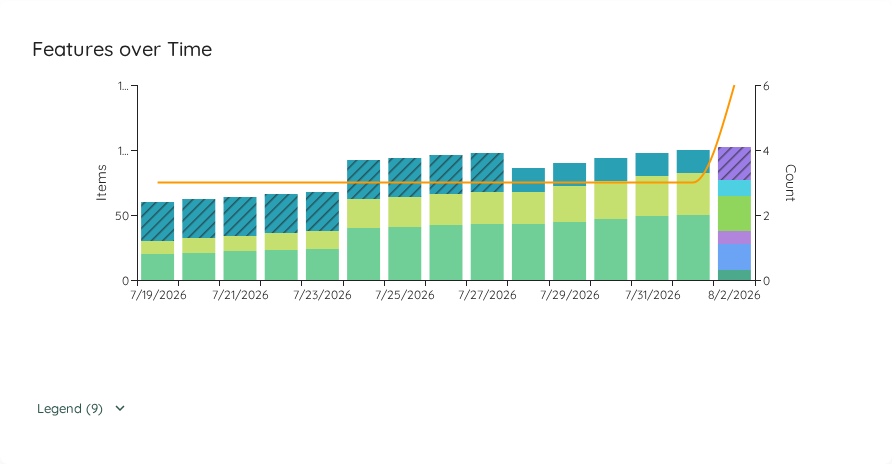
The orange Count line rides its own right-hand scale and answers a different question: how many Features were in the delivery that day. Three Features of ten items and ten Features of three both total thirty, and they are not the same delivery to run.
A hatched band means that Feature’s size is still the portfolio’s default estimate rather than counted items. Watching a band go from hatched to solid is watching a Feature actually get broken down.
Features keep the same colour here as on the fever chart and hold their position in the stack from day to day, so following one across the window is a matter of following one colour. Open the Legend and click Features to show only those bars — useful once a delivery carries more than a handful.
See Features over Time for the full read.
Bugfixes and Improvements
- Updated various third-party libraries.
Contributions ❤️
Special thanks to everyone who contributed feedback for this release:
Lighthouse v26.8.1.14
ServiceNow
Lighthouse now connects to ServiceNow. If your work lives in incidents, change requests, problems or catalog tasks, you get the same throughput, WIP, work item age, cycle time and forecasts your Jira and Azure DevOps teams have always had.
A team is defined by an encoded query. If your instance uses Visual Task Boards, skip writing one: pick a board and Lighthouse fills in the query, the work item types and the state mapping from the board’s own lanes.
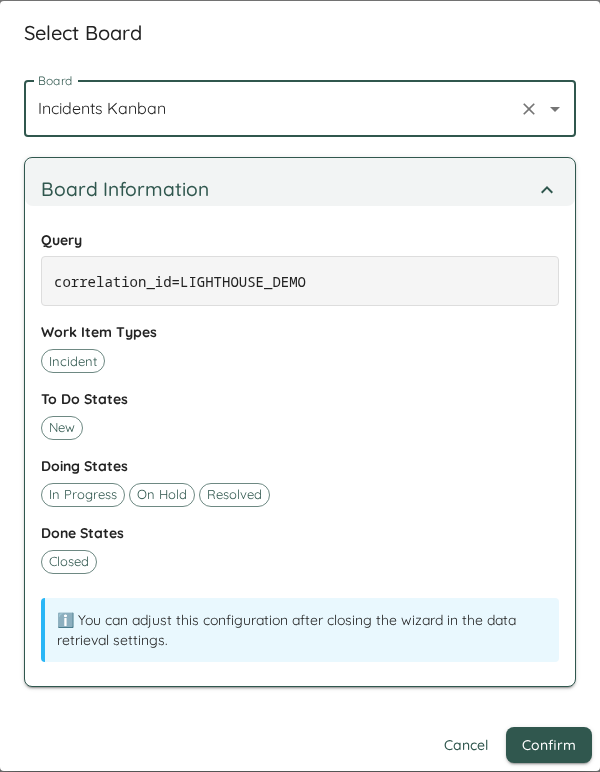
This is the first version, so there are gaps — Portfolios are not supported yet. If you’re using ServiceNow, please reach out and tell us what needs fine-tuning.
Multi-Team Forecasting
Multiple Teams on One Feature
A Feature with two teams is done when both are done. Lighthouse reported the odds for the least likely team — an easier question than “will everyone make it”. The gap is not small: on real data, a Feature reading 85% was really somewhere between 54% and 80%.
Lighthouse now combines every contributing team’s simulation into one joint probability. Single-team Features are unaffected; the more teams a Feature has, the further its number moves.
Two related corrections ship with it:
- A Feature that cannot be forecast now says so. No throughput history means nothing to simulate. That used to read 100%; it now reads Cannot forecast.
- The likelihood is read off the simulation, not the next outcome above it. A date falling between two simulated outcomes reported the higher one, so targets read better than the simulation supported.
Delivery Likelihood
A Delivery should answer “will all of these land by the date”. It reported the odds for the single longest-running Feature instead — too optimistic as soon as more than one team was involved.
Lighthouse now combines every team’s work on every Feature in the Delivery.
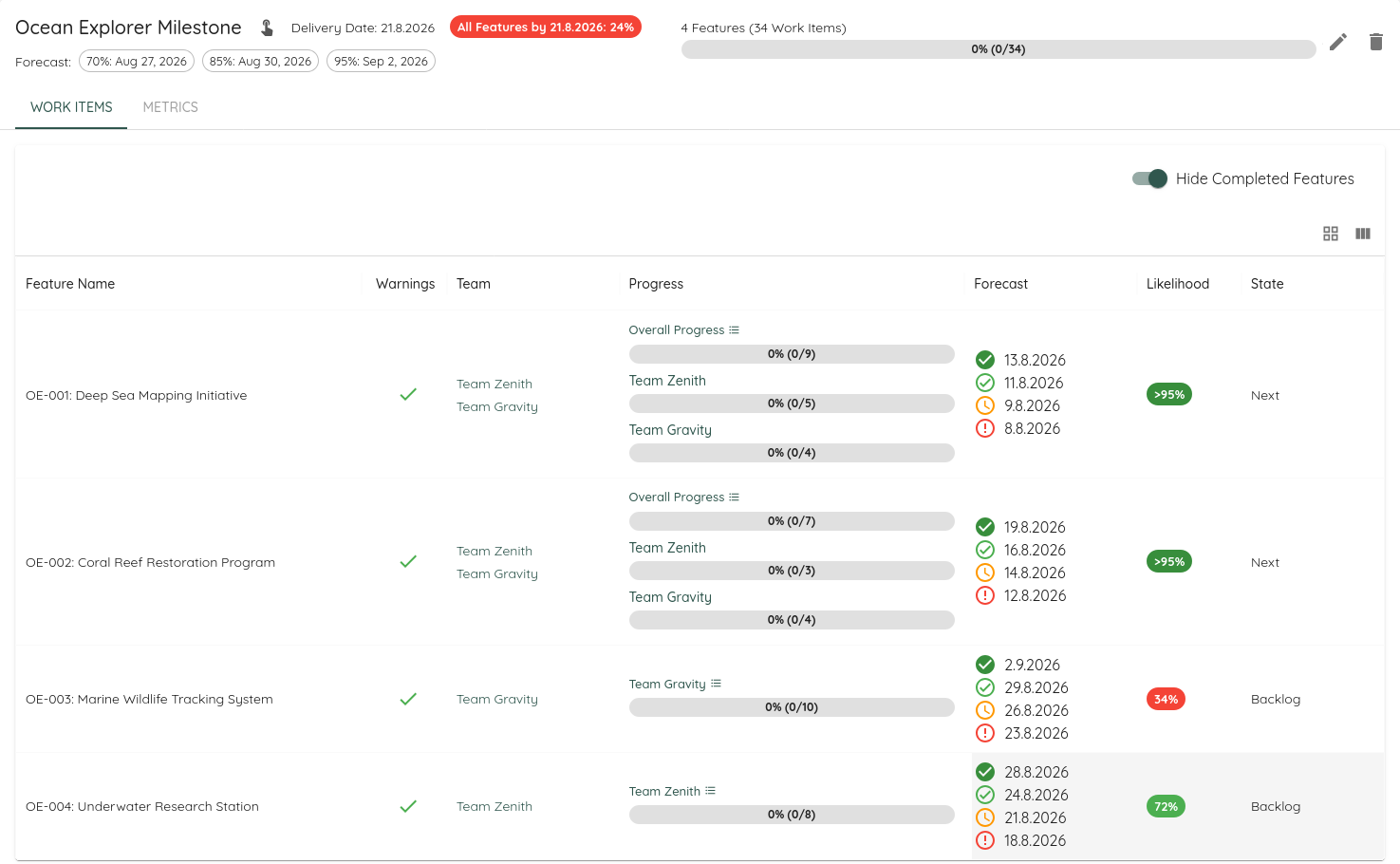
The Feature rows inside a Delivery are unchanged. A Delivery can equal its least likely Feature — that happens when one Feature governs it entirely — so seeing the same number twice is correct.
See How Lighthouse Forecasts for the maths, with a worked example you can reproduce in a spreadsheet.
What to Expect After Upgrading
Percentages will drop, and multi-team ones will drop most. Nothing about your teams changed; the question being answered did.
- The 70/85/95 dates move outward too. Watch only the percentage and the dates will surprise you.
- The recorded Delivery trend takes a one-time step. History stores percentile dates, not each team’s simulation, so past points cannot be recomputed. Read across the step, not through it.
Your Calendar Day, Not UTC’s
If your team isn’t on UTC, “today” — and the first and last day of every metrics window — was a UTC day, not yours. Late afternoon in Auckland or early morning in Ohio, forecasts, throughput windows and daily trend charts were all filed under the wrong day.
Lighthouse now computes calendar days in a configurable instance time zone. See Instance Time Zone.
Bugfixes and Improvements
- Metrics pages only load the tab you are looking at: every widget fetched its data whether or not its category was selected. Widgets now fetch when their category is first visited and keep what they loaded — a much quicker initial load.
- Saving a team’s settings validates them first: auto-save could store a query the connector would reject, leaving a team configured against something that cannot be read. Settings are validated before they are saved, and the field blocking the save is named.
- Updated various third-party libraries.
Contributions ❤️
Special thanks to everyone who contributed feedback for this release:
Lighthouse v26.7.26.8
Are Your Percentiles Getting Better or Worse? — Percentiles Over Time
Every percentile widget in Lighthouse answers where do we stand today. None of them answered the question that actually matters in a retrospective: are we improving? This release adds a Percentiles Over Time chart in the Predictability category that records the 50th, 70th, 85th, and 95th percentile once per day and plots each as its own line, at both Team and Portfolio level.
The lines keep the familiar red→green ramp, so you can read at a glance whether your percentiles are tightening, drifting apart, or holding steady. A toggle in the widget header picks what’s plotted:
- Cycle Time, over a trailing 30 / 60 / 90 day horizon. Each horizon is recorded separately, so you’re looking at the same days through a shorter or longer lens — if the 30-day line moves and the 90-day line doesn’t, whatever happened is recent.
- Work Item Age, measured as of the day it was recorded — a history of how long your in-progress work has been ageing, day by day.
When “Normal” Itself Moves — PBC Over Time
A Process Behaviour Chart tells you whether a data point is normal for your system. The new PBC Over Time chart tells you whether your system’s idea of normal is itself drifting: Lighthouse records the UNPL, Average, and LNPL once per day and plots all three, with a toggle to switch between metric families — Throughput, Work Item Age, Work in Progress, Cycle Time, Arrivals, and Feature Size.
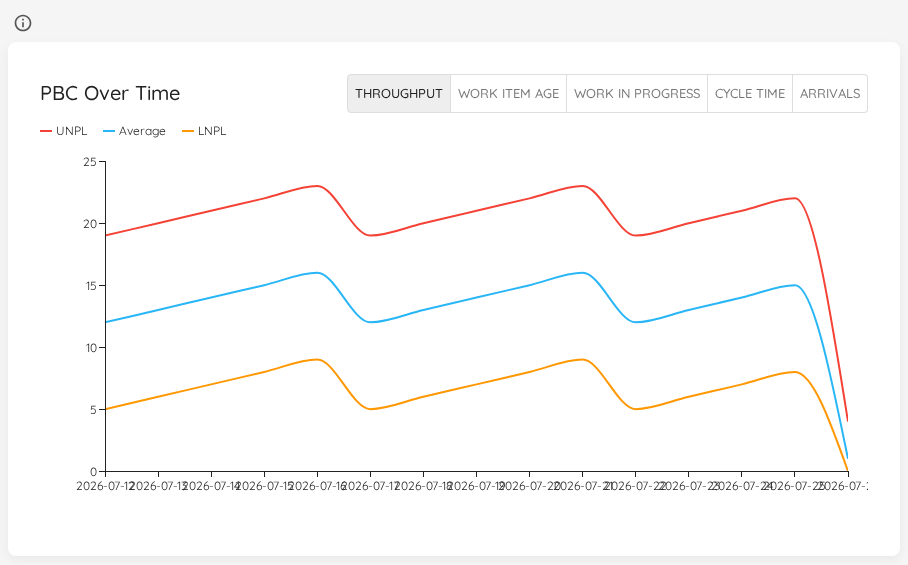
Reading the shape is the point: a widening band means variability is growing and forecasts built on it are getting less useful; a narrowing band means the process is becoming more predictable; the whole band shifting means the average level moved. Together with the special-cause signals on the point-in-time chart, that’s how you tell whether a change you made actually stuck.
One caveat worth knowing: limits are only as meaningful as the baseline they’re computed from. Without a fixed PBC baseline configured, Lighthouse falls back to a rolling window ending today — so the recorded limits move for reasons that have nothing to do with your process.
Both charts build forward from the day your instance starts recording; they are not reconstructed from history. A fresh instance says so plainly instead of drawing a fabricated line. Demo data ships with a backdated history, so it’s populated immediately. See Percentiles Over Time and PBC Over Time.
Both also follow the date range you pick on the dashboard, so you can zoom into the window you’re actually discussing instead of always seeing the full recorded history.
Blocked History for Portfolios
Last release taught the Blocked Overview to answer historical ranges honestly for Teams — a past range is read from what was actually recorded on that day rather than re-judged against today’s rules. Portfolios couldn’t do this: no blocked history was ever recorded for Features, so a feature blocked last month read as not blocked, and one blocked today read as blocked on every range in the past.
Lighthouse now records blocked spells for Features on the portfolio refresh path, so portfolio blocked counts, the Blocked Over Time chart, and its drill-through are as accurate as their team-level counterparts. Demo data is backfilled too, so the portfolio chart is populated on demo instances.
Named Cycle Times on the Flow Overview
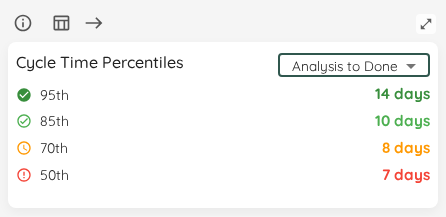
Named cycle times arrived on the Cycle Time Scatterplot. They now reach the Flow Overview as well: when you have more than the default cycle time defined, the Cycle Time Percentiles widget gets a selector, and the percentiles, the RAG status, the previous-period trend, and View Data all follow your selection. So you can watch Concept to Cash on the overview, not just the default span.
Bugfixes and Improvements
- macOS standalone is now Apple Silicon only — Apple is ending support for Intel-based apps, so the macOS standalone build ships as
arm64and the Intel (x86_64) download is discontinued. Existing Intel Mac users stay on their current version; Apple Silicon Macs are unaffected. Reported by Gabor Bittera. - Switching a team or portfolio to a different work tracking system now sticks — with two connections configured, moving an existing team or portfolio from one to the other silently failed to save. The change now auto-saves like every other setting, with no need to nudge the query to trigger it. Reported by Chris Graves.
- Blocked status indicator respects your blocked rules — the Blocked Overview kept telling you to set up a rule even after you had defined one that was matching items. It now derives its status from your actual rule set, so it goes green when nothing is blocked and red when something is.
- Blocked trend no longer drops days the instance was offline — days with no recorded data (a standalone instance switched off over the weekend, say) were being read as zero blocked items, leaving gaps in the Blocked Over Time chart and a misleading previous-period trend. Missing days now carry forward the last known count.
- Third-party package list correct in the container image — the Docker build was missing its SBOM artifacts, so the third-party packages page rendered incorrectly. The standalone builds were unaffected.
- Flow Overview and Flow Metrics widget polish — Flow Efficiency and Work Item Age Percentiles now carry a RAG status, Work Item Age Percentiles gained a previous-period trend, Total Throughput and Total Arrivals gained View Data, and the Work Item Aging chart’s percentile reference lines lost their redundant labels. Work Item Age and item state are also now reported as of the end of the selected range rather than as of today.
- Updated various third-party libraries.
Contributions ❤️
Special thanks to everyone who contributed feedback for this release:
Lighthouse v26.7.11.4
See What’s Blocked — and for How Long
Blocked work is where flow quietly dies, but Lighthouse had no first-class notion of it. This release replaces the fixed-state handling with a generic, rule-based definition of blocked: you describe what “blocked” means for your workflow once, in the Flow Metrics configuration, and Lighthouse applies it everywhere. This allows you to filter based on any additional field or rules you might have.
On top of that definition you get:
- Blocked duration — Lighthouse captures when each item entered and left the blocked state, so you can see how long something has been stuck right on the work-item card.
- Blocked items go stale — an item blocked longer than your staleness threshold is flagged stale, so long-blocked work surfaces alongside your other neglected items instead of hiding in plain sight.
- Blocked Items Over Time — a new Flow Metrics chart showing how many items were blocked across time, at both Team and Portfolio level, so you can tell whether you’re improving. Click any bar to drill through to exactly which items were blocked on that day.
- RAG status — the Blocked overview widget turns amber or red off the age of your longest-blocked item, with a previous-period trend.
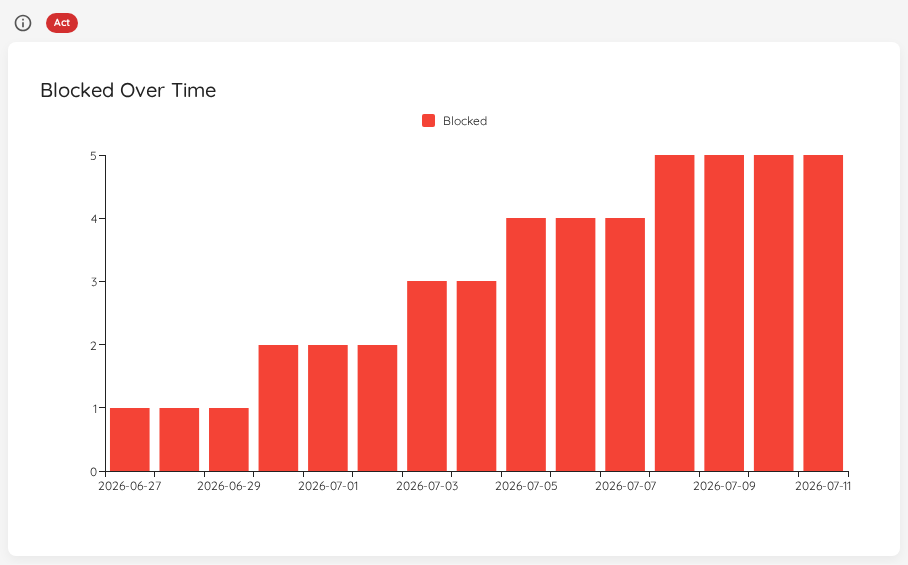
The Lighthouse CLI and MCP clients now expose the blocked-over-time trend as well, so scripts and AI agents can query how blockage is evolving (and read each in-progress item’s blockedSince).
Configure it under Blocked Overview and read about the Blocked Over Time chart.
Bugfixes and Improvements
- Delivery forecasts for large deliveries now show correct dates — a large delivery could show wrong forecast dates while smaller ones were fine; the forecast now derives its dates from the latest-completing feature. Reported by Chris Graves.
- Updated various third-party libraries.
Contributions ❤️
Special thanks to everyone who contributed feedback for this release:
Lighthouse v26.7.3.1
Self-Host Lighthouse on Kubernetes — Official Helm Chart
You can now run the Server edition on any Kubernetes cluster from an official, public Helm chart — no source checkout and no sales call. A single helm install brings up a working instance with a bundled PostgreSQL; for production you point it at your own managed database. Optional OIDC login, an optional MCP server with OAuth auto-discovery, and horizontal scaling via Redis are all configurable through values.yaml.
See Run Lighthouse on Kubernetes with Helm.
Bugfixes and Improvements
- Licenses with accented or non-ASCII names now import correctly — a license issued to a name containing accents (for example Janée) previously failed to import.
- Scatter chart axis labels restored — the estimation and feature-size scatter charts show their x-axis tick labels again.
- Work Item Age Percentiles widget polish — chrome fixes to the widget shipped last release.
- Updated various third-party libraries.
Contributions ❤️
Special thanks to everyone who contributed feedback for this release:
Lighthouse v26.6.16.14
Bugfixes and Improvements
- Blackout periods no longer skew forecasts — changing a team’s or portfolio’s blackout configuration now refreshes the cached metrics straight away, so a forecast reflects your current non-working-day settings instead of a stale calculation. Previously, toggling blackout days could leave the When? forecast showing results from before the change. Reported by Chris Graves.
- Updated various third-party libraries.
Contributions ❤️
Special thanks to everyone who contributed feedback for this release:
Lighthouse v26.6.11.3
Cycle Time, Your Way — Multiple Named Cycle Times (Premium)
The default cycle time runs from work started to work finished. But that’s rarely the only span worth watching. You might want Concept to Cash end-to-end, or deliberately a slice that excludes stages outside your control. You can now define named cycle times — give a name to any start→end pair across your workflow states — and switch between them right on the Cycle Time Scatterplot with a combobox, at both Team and Portfolio level.
The same named window also re-scopes the Cumulative Time per State chart, so you can analyse where work spends its time inside exactly the span you care about, not just the default one.
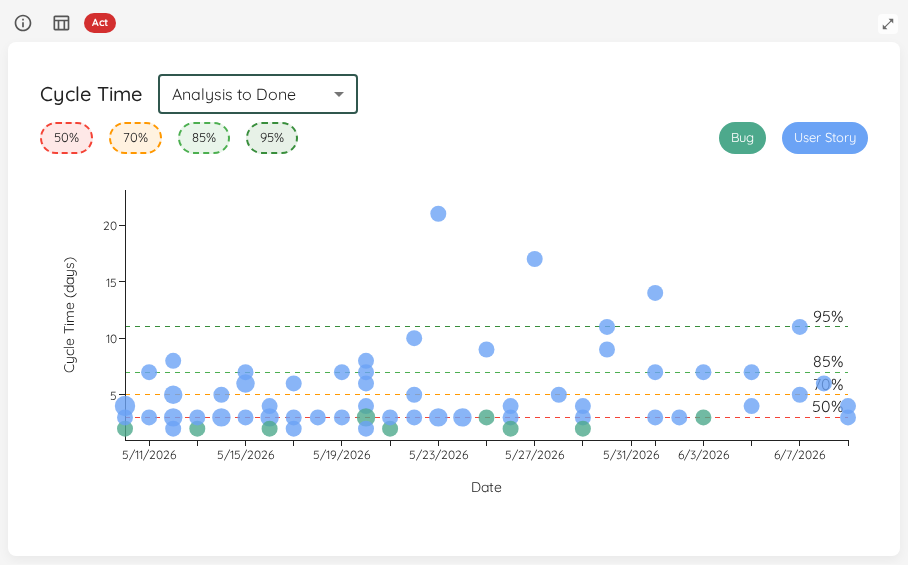
Define them under Named Cycle Times and read how scoping works in Scope to a Named Cycle Time.
How Long Has In-Progress Work Been Ageing? — Work Item Age Percentiles
Cycle Time percentiles tell you how long finished work took. They say nothing about the items still on your board today. This release adds a Work Item Age Percentiles overview widget that shows the 50th, 70th, 85th, and 95th percentiles of Work Item Age across the items currently in progress — a live snapshot of how long your work has been ageing right now, at both Team and Portfolio scope.
A matching selector on the Work Item Aging chart lets you draw either Cycle Time or Work Item Age reference lines behind your in-progress items, so you can compare today’s ageing against either yardstick.
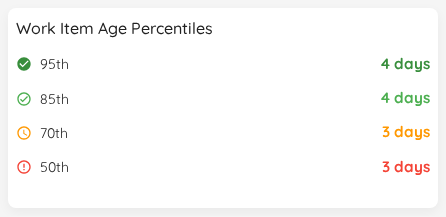
See the Work Item Age Percentiles widget.
Bugfixes and Improvements
- Cumulative Time per State now reads in days — the chart no longer blows up into unwieldy hour or minute figures; its display unit is capped at days so the bars stay readable at a glance. Reported by Gonzalo Mendez.
- Staleness off by default for new teams and portfolios — newly created teams and portfolios no longer start with a staleness threshold enabled. You now opt into stale-item flagging when you want it, instead of having it on from day one.
- Updated various third-party libraries.
Contributions ❤️
Special thanks to everyone who contributed feedback for this release:
Lighthouse v26.6.7.1
Track a Delivery Over Time, Not Just Today
A delivery forecast tells you where you stand right now. What it never showed was the trend: are we closing in on the date, or quietly slipping? This release adds a Metrics tab to every delivery with three charts that build forward from the day the delivery is created.
- Burnup — total scope versus completed work over time, with a dashed Estimated line for the portion of scope that isn’t broken down yet, so placeholder estimates are honest rather than hidden.
- Predictability — the forecast itself, tracked day by day. Flip between How Likely? (probability of hitting the target, against coloured confidence bands) and When? (the 50/70/85/95 percentile dates against the target).
- Fever chart — every feature plotted on a schedule-versus-confidence trail you can replay with a Run control, so a feature drifting into the red announces itself long before the target date.
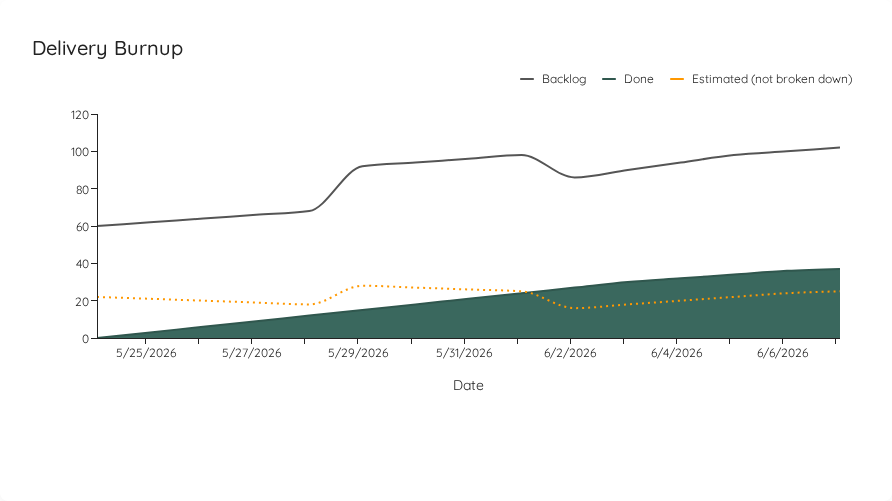
Honest charts when the target moves
Move a delivery’s target date and the charts don’t quietly rewrite history. The target is recorded as it was on each snapshot, so the target line steps on the day it changed and a marker highlights the change — a jump in likelihood is clearly attributable to a moved goal, not to imaginary progress.
See Delivery Metrics over Time for the full walkthrough.
Wait States & Flow Efficiency
Not all Doing time is active work — some of it is waiting: queued behind a person, parked in a review column, sitting through a hand-off. You can now mark which states count as wait states in your team or portfolio settings, and Lighthouse turns that into Flow Efficiency: the share of time work spends actively progressing versus waiting.
It surfaces as a dedicated Flow Overview tile and as a headline figure on the Cumulative Time per State chart, where the waiting bars are highlighted so the cost of queues is impossible to miss.
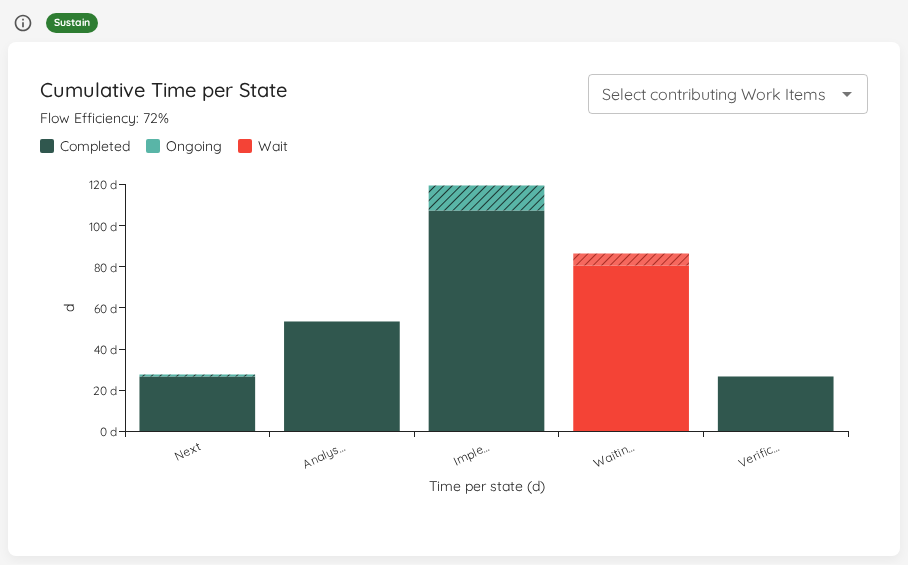
Configure it under Wait States and read the metric details on the Flow Efficiency widget.
Forecasts That Respect Your Non-Working Days
Blackout periods already kept non-working days out of your throughput. Now they also shape the dates forecasts land on: a forecast of N working days steps its predicted calendar date over any known upcoming blackout days — weekends, holidays, planned shutdowns — instead of pretending work happens on days nobody is working. This applies across the When forecast, feature and delivery dates, and the value written back to your work tracker.
Recurring Blackout Rules (Premium)
Entering every weekend by hand was never going to scale. You can now define recurring blackout rules — pick the weekdays, a repeat every N weeks cadence, a start date and an optional open end — and Lighthouse expands them into the concrete non-working days automatically. One-off periods and recurring rules live together in the same settings section and feed forecasting and metrics identically.
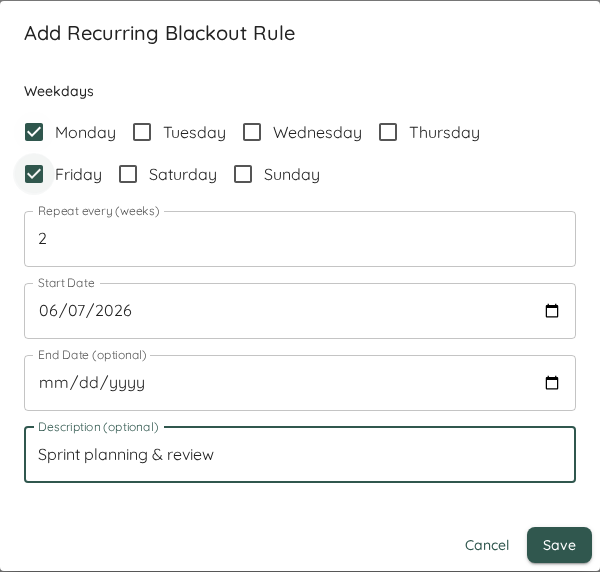
See Blackout Periods & Recurring Rules.
Bugfixes and Improvements
- Never show 100% confidence — forecast likelihoods are now capped at >95% on the manual, delivery, and portfolio forecasts. A Monte Carlo simulation can’t honestly promise certainty, and showing “100%” invited exactly the wrong kind of trust. Reported by Liz Rettig.
- Don’t forecast on too little data — when a team has fewer than five active days of throughput, Lighthouse now suppresses the forecast and tells you why instead of producing a confident-looking number built on almost nothing. Reported by Liz Rettig.
- Cumulative Time per State — hide Completed or Ongoing — a legend toggle lets you show only completed time, only ongoing time, or both, so you can isolate the part of the picture you care about.
- Load Balance Matrix aspect ratio — the matrix no longer stretches out of shape on wide screens; it keeps a square plotting area so the quadrants stay readable. Reported by Gonzalo Mendez.
- Updated various third-party libraries.
Contributions ❤️
Special thanks to everyone who contributed feedback for this release:
Lighthouse v26.5.29.5
See How Long Work Has Been Sitting — Time in State & Stale Items
Cycle Time tells you how long finished work took. It says nothing about the item that’s been parked in Testing for three weeks right now. This release makes “how long has this been sitting here?” a first-class signal across Lighthouse.
- Time in State — every work item now shows how long it has been in its current state, directly in the team and portfolio work-item views.
- Staleness threshold — set a per-team and per-portfolio threshold (in days) under Flow Signals in your settings. Any in-progress item that has sat in its state longer than the threshold is flagged stale, and its Time-in-State indicator turns red so it stands out.
- Stale Items Overview — a new Flow Overview widget counts how many in-progress items are currently stale, with a RAG status that targets zero. Blocked items are deliberately excluded, so a single item is never double-counted as both blocked and stale.
To make this accurate, Lighthouse now captures the full state-transition history of your items from Azure DevOps, Jira, and Linear — plus an optional Current State Since column for CSV imports — so “time in state” is grounded in real transitions rather than a guess.
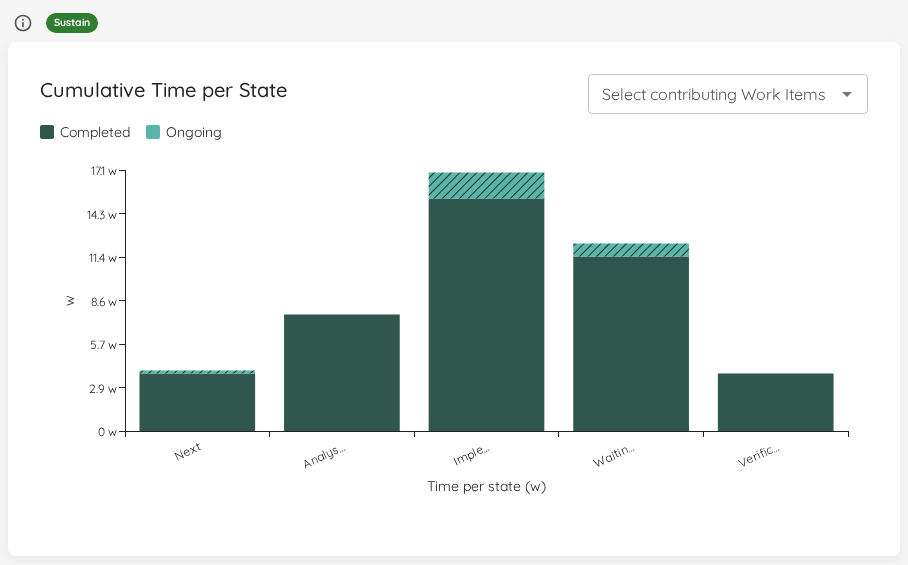
Cumulative Time per State
The new Cumulative Time per State chart (under Flow Metrics) shows where your work actually spends its time — the total days items have accumulated in each workflow state. Units adapt to the scale of the data, and you can click any bar to drill into exactly which work items contributed to it.
Need to focus? A built-in item picker scopes the chart to specific work items, so you can trace a single feature’s journey through your process instead of reading the whole board at once.
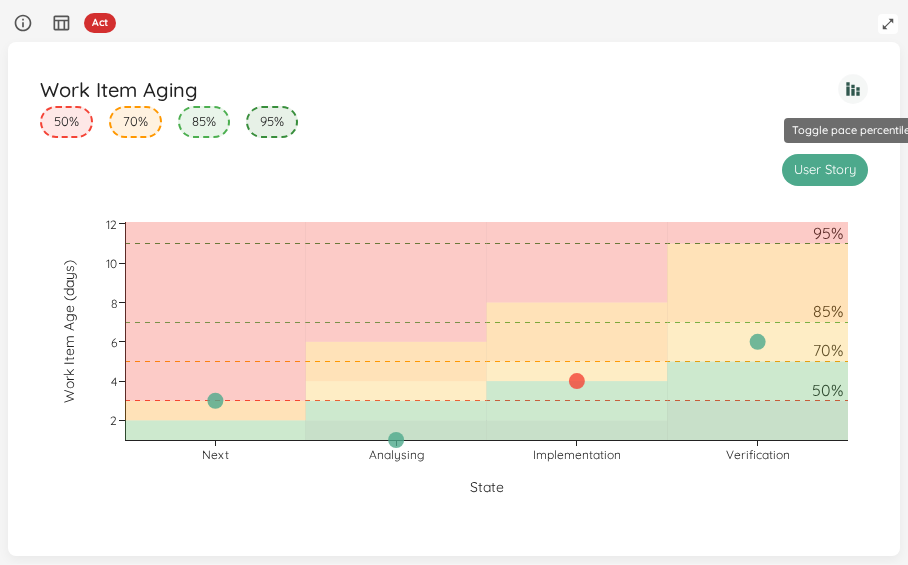
Pace Percentile Bands on the Aging Chart
The Work Item Aging chart can now draw per-state pace-percentile bands behind your in-progress items. Each state column is shaded green at the floor to red at the top, derived from your own historical age-at-exit percentiles — so at a glance you can tell whether an item is aging within its normal range or running hot. Flip the bands on or off with a single chip; the choice is remembered across sessions.
All three of these live alongside the rest of the Metrics widgets.
Save and Run — Without the Buttons
Editing a team or portfolio used to mean: make a change, then remember to hit Save. Forecasting meant filling in the inputs, then hitting Forecast or Run Backtest. This release removes that ceremony.
- Settings auto-save. General team and portfolio settings, state mappings, and the forecast filter now save automatically the moment your input is valid — no Save button. A quiet All changes saved indicator confirms it landed. Validation still runs first; invalid input is held back and shown to you instead of being saved.
- Forecasts auto-run. The New Item creation forecast and Backtesting now run on their own as soon as the inputs are valid — matching the How Many / When forecast that already worked this way. The Forecast and Run Backtest buttons are gone.
For the forecast filter, the expensive throughput recompute stays under your control: a rule edit saves silently, and a one-click Reload throughput now action recomputes when you’re ready.
Bugfixes and Improvements
- Updated various third-party libraries.
Contributions ❤️
Special thanks to everyone who contributed feedback for this release:
Lighthouse v26.5.24.10
Exclude Items for Throughput (Premium)
Does your team carry maintenance, support, or unplanned bug work alongside feature delivery? Until now that left you two options: live with throughput numbers polluted by interrupt work — and forecasts that are too optimistic — or split things into a “fake team” that doesn’t actually exist in your tracker. Neither is great.
The new Exclude Items for Throughput rule lets you tell Lighthouse “don’t count these”: exclude by type, by parent reference, by tags, or any combination of conditions. The filter then flows through every forecast — How Many, When, and Backtesting — so the dates you commit to reflect the work your team actually does, not the noise around it.
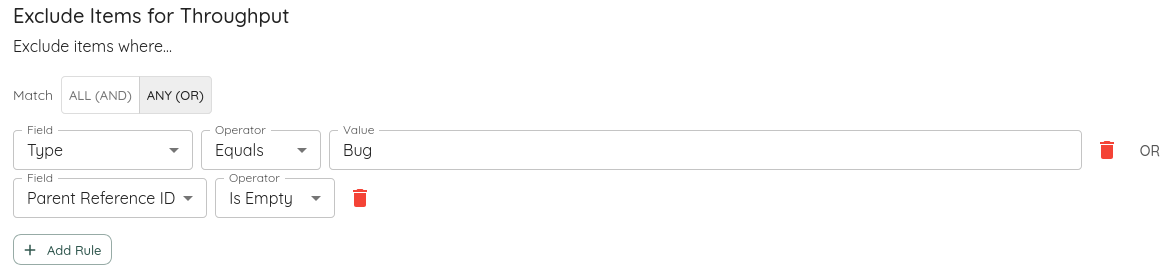
It’s also a conversation tool. Want to show leadership how much faster you’d ship if the team could focus? Run When will this be done? against your raw throughput, then against the filtered throughput, and compare. You’ve always known the interrupt work matters — now you have the numbers to put behind it.
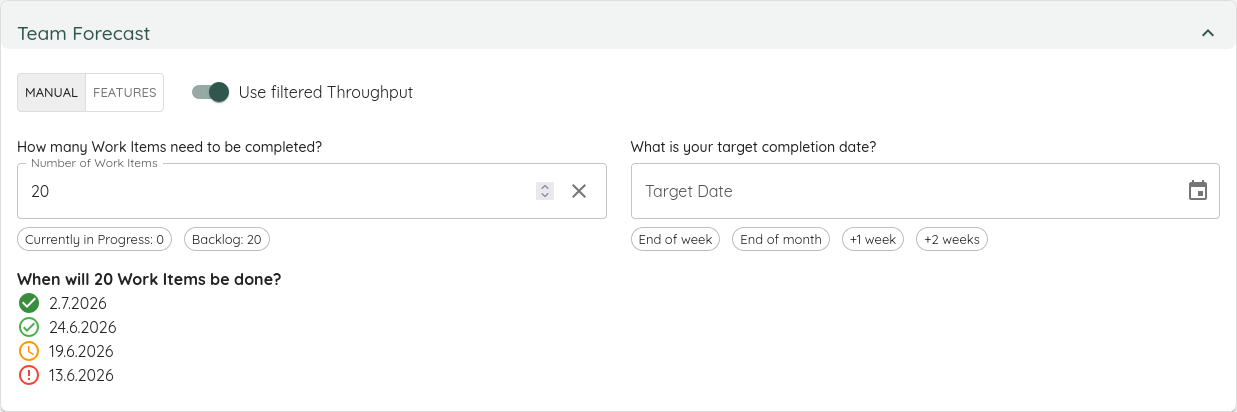
The same idea extends to your metrics: a toggle on the Throughput Run Chart, Throughput Process Behaviour Chart (bars and the Average / UNPL / LNPL bounds), and Predictability Score Details lets you flip between raw and filtered views without leaving the page. The team’s Quick Settings shows an indicator whenever a filter is active, so you always know which world you’re looking at.
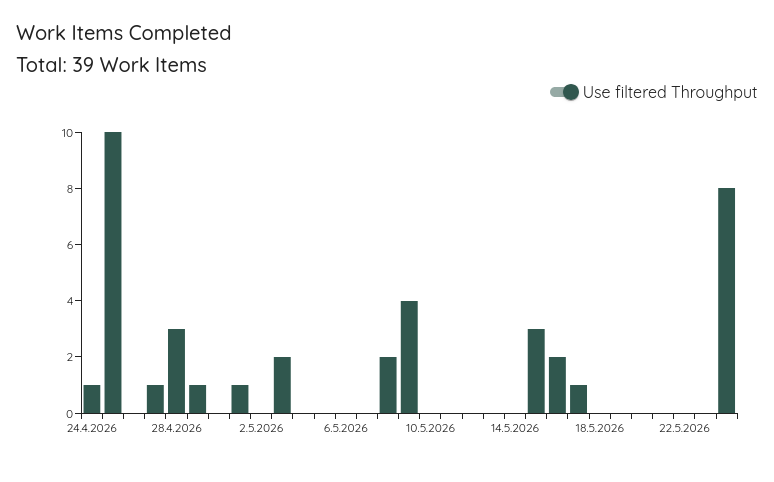
The rule builder works wherever rules are used in Lighthouse — including the Portfolio Delivery editor — and it picked up new conditions along the way:
- Does Not Contain
- Is Empty / Is Not Empty — match
null, empty string, or a missing field; no value input required. - AND / OR group mode for combining rules.
Feature Size — View by Closed Date
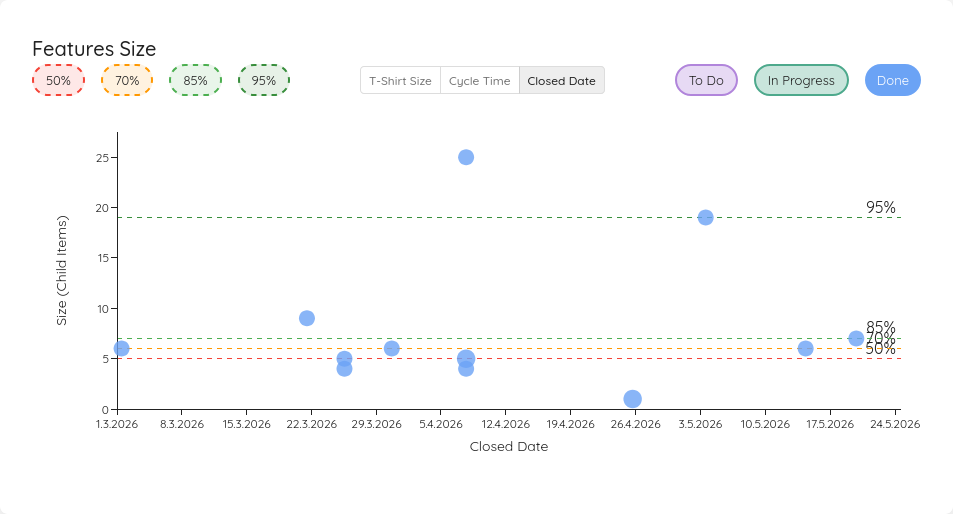
The Feature Size chart got a third Show by mode alongside Estimation Unit and Cycle Time: Closed Date. Picking Closed Date flips the axis (date on X, size on Y), rotates the percentile bands accordingly, and parks any in-flight (not-yet-closed) feature at the Today marker so it stays visible in context.
Documentation Light Mode
The docs site now ships a light / dark color-scheme toggle. The site still defaults to following your OS preference; you can pin either mode explicitly from the header.
Bugfixes and Improvements
- Jira Data Center: 504 Gateway Timeout on team sync — the Jira client used a fixed page size of 1000, which Data Center instances behind a slow reverse proxy can’t always return inside their gateway timeout window. Page size is now configurable on the Jira connection (defaulting to 1000 as before).
- Forecast Backtesting: Historical Window (Days) clear behaviour — clearing the Historical Window (Days) field used to snap the value back to
1on every keystroke, forcing you to type156to enter56. The value now clamps on blur instead of on every keystroke, so clear-and-retype works the way you’d expect. - Started Date reset when reverting to the To-Do state — if you moved an item To Do → Doing → To Do → Done (skipping Doing on the second pass), Lighthouse kept the original Started Date set on the first transition. Started and Closed now match for items that never actually re-entered an in-progress state. Applies across Jira, Azure DevOps, and Linear.
- Updated various third-party libraries.
Contributions ❤️
Special thanks to everyone who contributed feedback for this release:
- Liz Rettig
- Evgeniy Stepchenko
- Alex Priestley
- Gabor Bittera
- Will Pyke
- Gordon Price
Lighthouse v26.5.19.1
OAuth Authentication for Work Tracking Systems
Lighthouse can now connect to Jira and Azure DevOps through OAuth, alongside the existing Personal Access Token flow. OAuth is a Premium feature: pick OAuth in the connection wizard, register a client on the IdP side, and Lighthouse drives the rest — token exchange, refresh, and reconnect.
- Jira via Atlassian 3LO, with Jira Software granular scopes.
- Azure DevOps via Microsoft Entra ID, with
vso.work_writeand per-tenant configuration. - Automatic token refresh with single-flight serialization, so concurrent requests can’t double-refresh and burn rate limits.
- Disconnected-state surfacing — a status icon on the connection list flags connections that need attention, and a Reconnect banner walks you through the popup-based OAuth handshake without leaving the connection edit dialog.
IdP-side setup is documented under the existing work-tracking-system pages: Jira and Azure DevOps.
API Key Scopes on the Listing
The API Keys settings page now shows each key’s scope set in place of the Created By column. The scope column makes it obvious at a glance which Teams and Portfolios a given key can act on. The Scopes column is shown only when RBAC is enabled.
Bugfixes and Improvements
- Cache thread-safety under concurrent metric requests —
Cache<TKey,TValue>was backed by a plainDictionary<,>; under concurrent metric load (multiple teams, background services racing user requests) the dictionary could corrupt and start throwingIndexOutOfRangeExceptionon every subsequent call to the affected key, until process restart. Switched toConcurrentDictionary. Reported by Liz with a detailed diagnosis and reproduction. - Setting Feature WIP from a Portfolio — the Portfolio → Team feature-WIP update returned HTTP 500 because the RBAC scope check on
ForecastController.UpdateForecastForProjectran against the wrong entity. The update did persist, but the error was disruptive. Fixed. - Forecasts refresh in place after Feature WIP changes — previously you had to navigate away and back for the new forecast dates to show up. Forecasts now update immediately, so the impact of a WIP change is visible without losing your place.
- Updated various third-party libraries.
Contributions ❤️
Special thanks to everyone who contributed feedback for this release:
Lighthouse v26.5.14.2
Role-Based Access Control
This release introduces Role-Based Access Control (RBAC) — a Premium feature for fine-grained control over who can read and edit teams and portfolios. RBAC builds on top of OIDC authentication and is configured under Settings → Access.
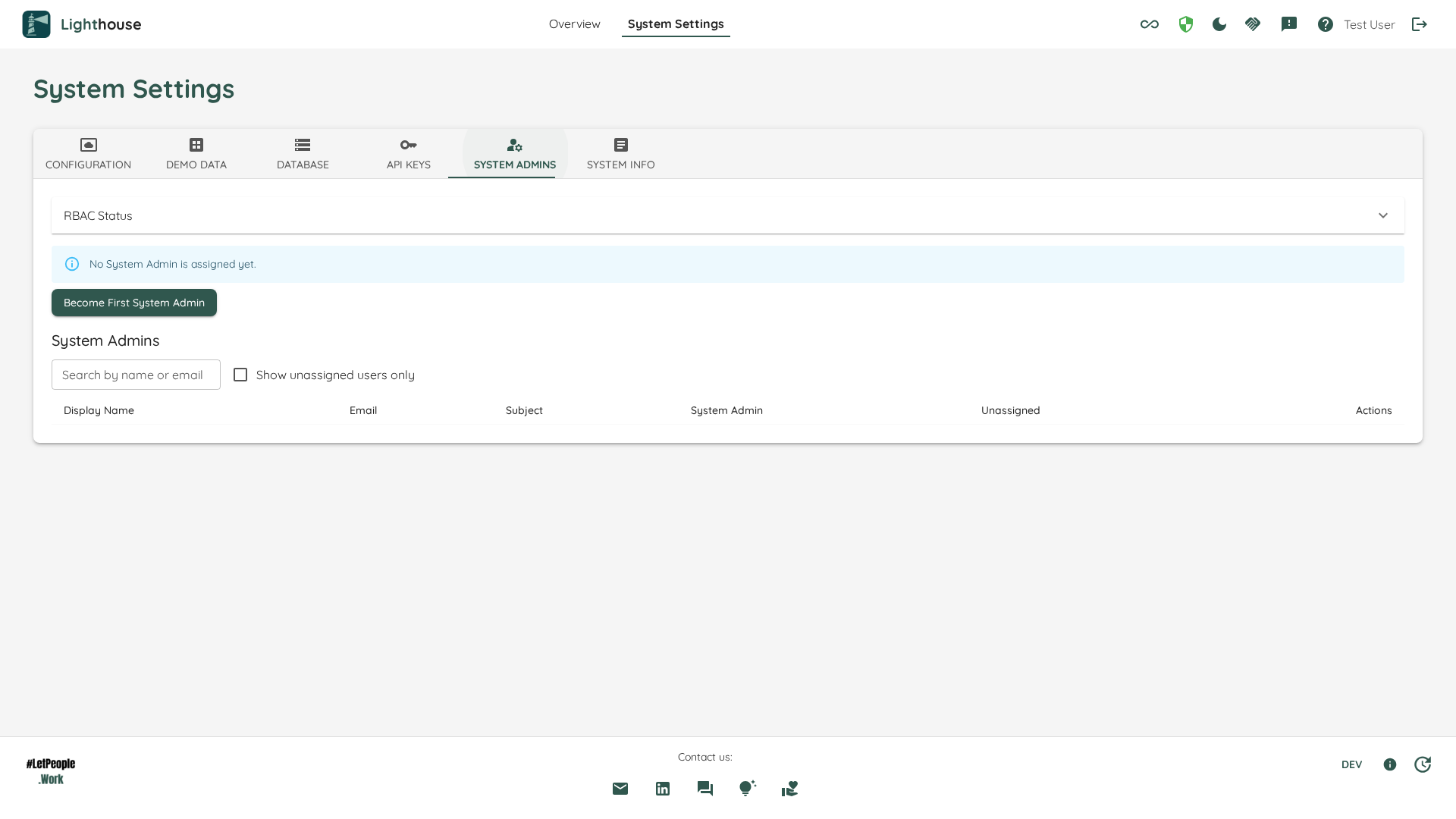
What the four roles can do
- System Admin — full control. Manages users, group mappings, and connections; creates, edits, clones, and deletes teams and portfolios.
- Team Admin (scoped to a specific team) — reads and edits the assigned team’s settings, throughput, features, and metrics.
- Portfolio Admin (scoped to a specific portfolio) — reads and edits the assigned portfolio’s features, settings, and metrics.
- Viewer (scoped to a team or portfolio) — read-only access to the assigned entity.
In v1, only System Admin creates, clones, or deletes teams and portfolios. Team Admin and Portfolio Admin edit their assigned scope but cannot create new entities. We may widen this in a future release based on feedback.
Key invariants
- Portfolios require at least one team to exist somewhere in the system. The Add Portfolio button stays hidden until the first team is created — including for System Admin and during first-time bootstrap. A portfolio without any team to roll up is structurally meaningless.
- First-time bootstrap is open by design. Until you’ve granted the first System Admin via Become First System Admin, every authenticated user has system-admin-equivalent rights — so they can upload the Premium license, configure the work-tracking system, and bootstrap themselves. The system locks down to the granted System Admin (and any configured Emergency Admins) once that step completes.
- Emergency Admins are a recovery path. Users listed in
Authentication.EmergencySystemAdminSubjectsretain System Admin rights even if their database role is removed. Their UI row shows an Emergency Admin badge and the Revoke button is hidden. - SSO group mappings are first-class. Map an IdP group to a role at a specific scope; users in that group inherit the role behaviourally identically to a direct user grant.
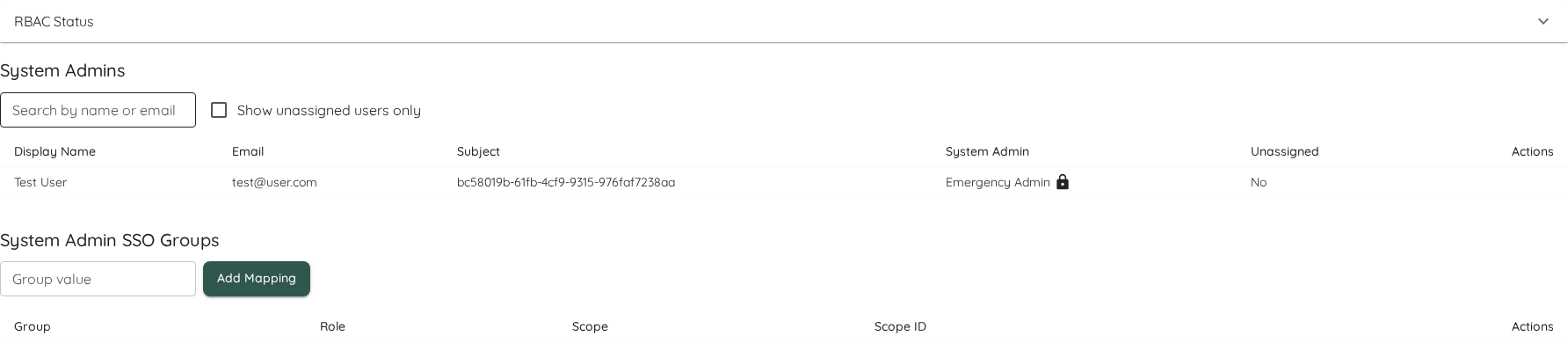
The full role matrix, bootstrap walkthrough, group-mapping guide, and troubleshooting steps are documented under System Settings → Role-Based Access Control. The Authentication page now links across to it.
API Keys with Scopes
API Keys — introduced in v26.5.3.5 for CLI and MCP scenarios — can now be scoped.
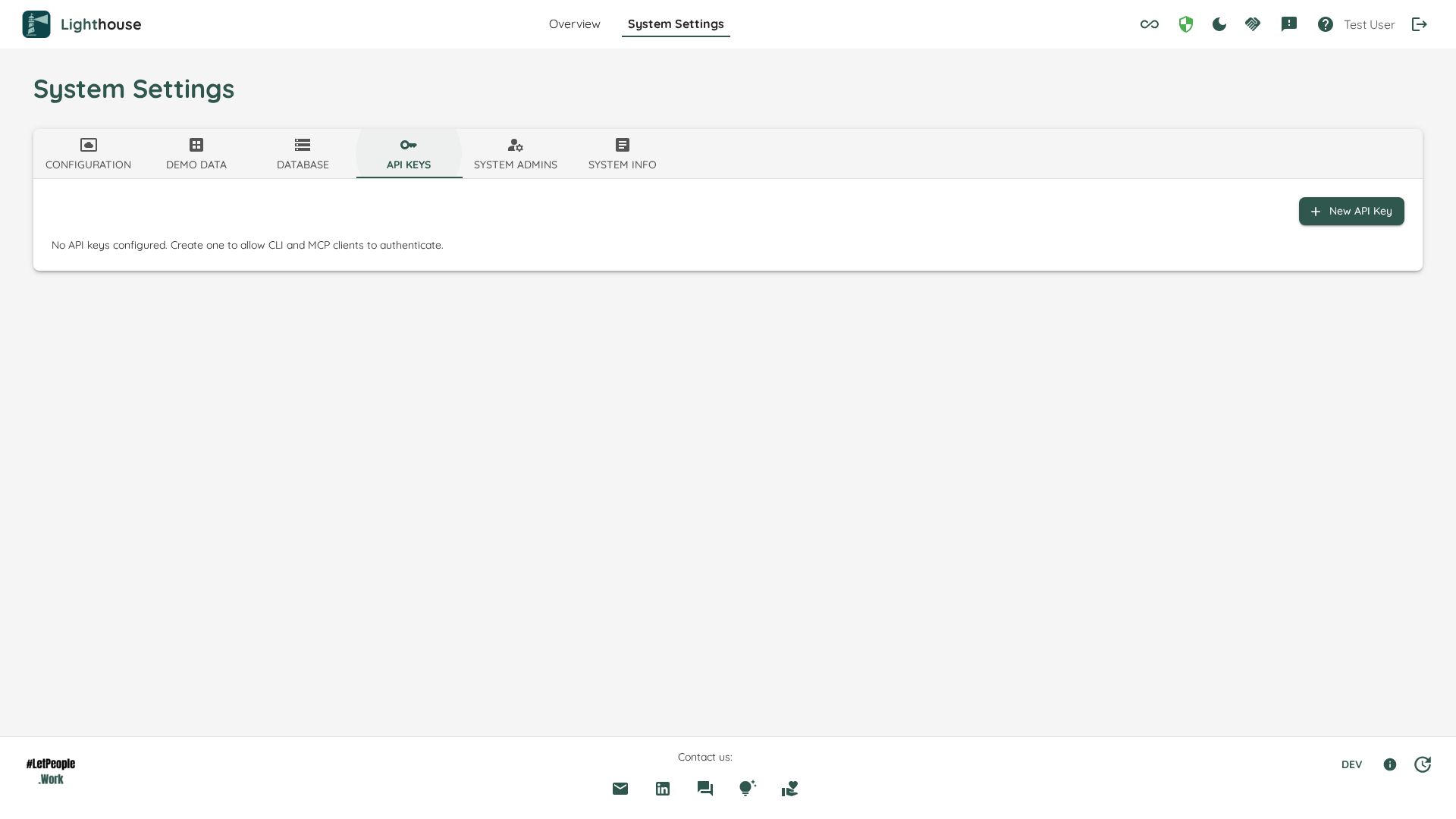
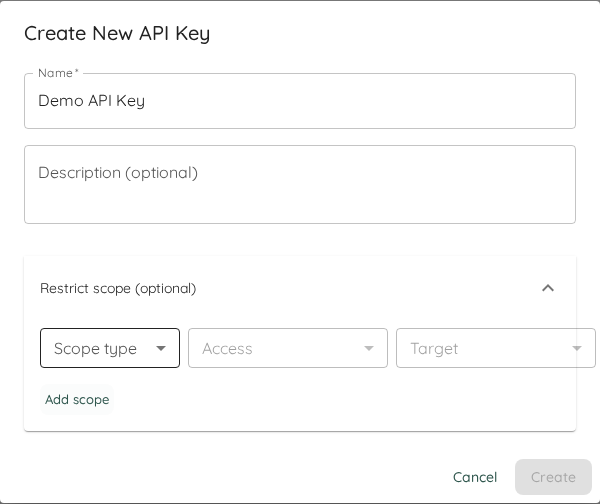
The create dialog now includes a guided scope-row builder so you can compose Team and Portfolio scopes without hand-crafting strings, and API keys inherit the owner’s SSO group claims at issuance time so RBAC behaves identically whether you call Lighthouse from the browser or with a key.
Bugfixes and Improvements
- Connection-list visibility for scoped admins — Team Admin and Portfolio Admin can now read the list of work-tracking-system connections, which is needed for the Edit-Settings tab on their assigned team or portfolio to load. Secret option values remain redacted at the DTO layer; only System Admin can create, edit, or delete connections.
- Manual Delivery date updates — editing the Delivery date on a Manual Delivery sometimes appeared to do nothing: the forecast updated but the displayed date stayed put. Root cause was a timezone shift on westward zones; delivery dates now render in UTC and reflect changes immediately.
- Updated various third-party libraries.
Contributions ❤️
Special thanks to everyone who contributed feedback for this release:
Lighthouse v26.5.3.5
Support for new Lighthouse Clients
This release introduces a new set of external Lighthouse clients for automation and AI-assisted workflows.
You can now use Lighthouse through:
- a dedicated CLI for terminal workflows, scripts, and CI
- a local MCP stdio server for tools such as VS Code / GitHub Copilot and similar local MCP clients
- a shared MCP HTTP server for hosted or team-wide AI integrations
To support these non-browser clients, Lighthouse now also supports API Keys for authenticated CLI and MCP usage.
For setup details, examples, and download options, see the live documentation:
Bugfixes and Improvements
- For various charts, the dates in the x-axis were unreadable for larger time horizons. This should be fixed now.
- Adjusted the RAG calculation for the Feature Sizes in the portfolio to give more clear signals
- Updated various third-party Libraries
Contributions ❤️
Special thanks to everyone who contributed feedback for this release:
Lighthouse v26.4.25.4
Load Balance Matrix
This release introduces the Load Balance Matrix (LB-Matrix):
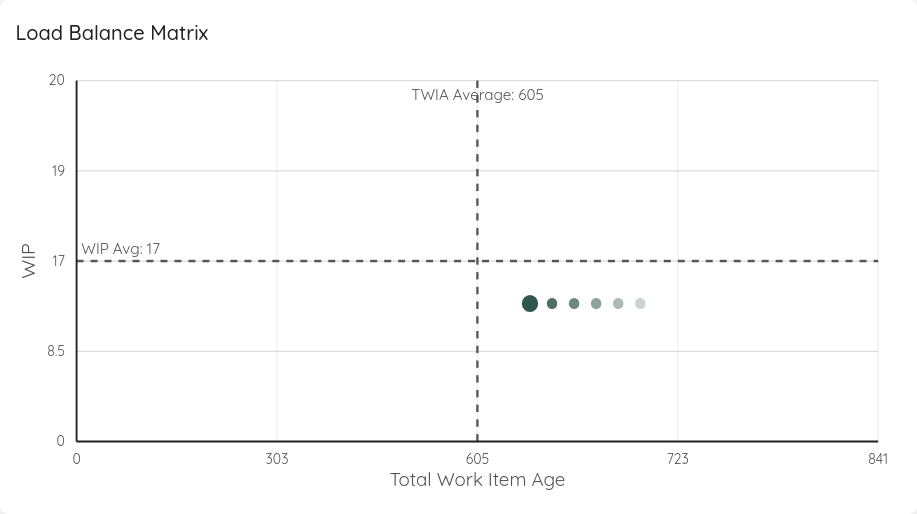
It is based on our blog post Limit Work in Progress without Work In Progress Limits and can be used to control your WIP.
It is available under Flow Metrics in your Team and Portfolio Metrics section and comes with a fully implemented RAG system to help you better control WIP with concrete proposals.
Default Size Tweak
If we use Override States for the default size of features, we used the default size no matter what. However, there may be cases where we started to break down a Feature into work items, and the count is already exceeding the default size. This meant, we use a lower value for our forecasts although we already knew that it will be most likely more work.
The new behaviour is, that in such a case, we’re taking the actual work item cound instead of the default size. This will lead to more realistic forecasts.
This Feature was proposed through our new Product Idea Board
REST API Versioning
The REST API is now available with specific versions, to make sure you have more stable endpoints if you are using a script or other client that works against the Lighthouse REST API.
You can reach the API right now through /api/v1/ and we will introduce new versions whenever there is a breaking api change.
Bugfixes and Improvements
- Issue with showing Dates and States in Cycle Time Scatterplot, Work Item Aging Chart, and Simplified CFD are now fixed
- Updated various third-party Libraries
Contributions ❤️
Special thanks to everyone who contributed feedback for this release:
Lighthouse v26.4.19.10
Metrics Improvements
We’ve worked on the feedback we got from the UX overhaul, and refined our Metrics further. Following changes were made in this release.
Simplified Metrics Categories
The available categories in the Metrics section have been consolidated from six categories to four:
- Flow Overview –> Flow Overview (unchanged)
- Cycle Time –> Merged into Flow Metrics
- Throughput –> Merged into Flow Metrics
- WIP & Aging –> Merged into Flow Metrics
- Predictability –> Predictability (unchanged)
- Portfolio & Features –> Portfolio & Features (unchanged)
Each chart is now appearing exactly in one category. While the Flow Overview will show you the status at a quick glance, the Flow Metrics will allow you to dive deeper and get into details.
Arrivals Run Chart and Process Behaviour Chart
The Metrics Dashboard now includes Arrivals as a first-class metric for both Teams and Portfolios:
- Arrivals Run Chart: Shows the daily count of work items started over the selected date range. Complements the Throughput Run Chart by visualizing the intake side of flow.
- Arrivals Process Behaviour Chart: Applies XmR-chart analysis to the arrival rate, highlighting special-cause variation in how many items enter the system per day.
The Run Chart is part of the Flow Metrics category, while the PBC can be found in the Predictability category alongside the other PBCs.
The Arrivals Run Chart includes a two-factor status indicator that checks both arrivals-versus-departures balance and whether arrivals are continuous or batched.
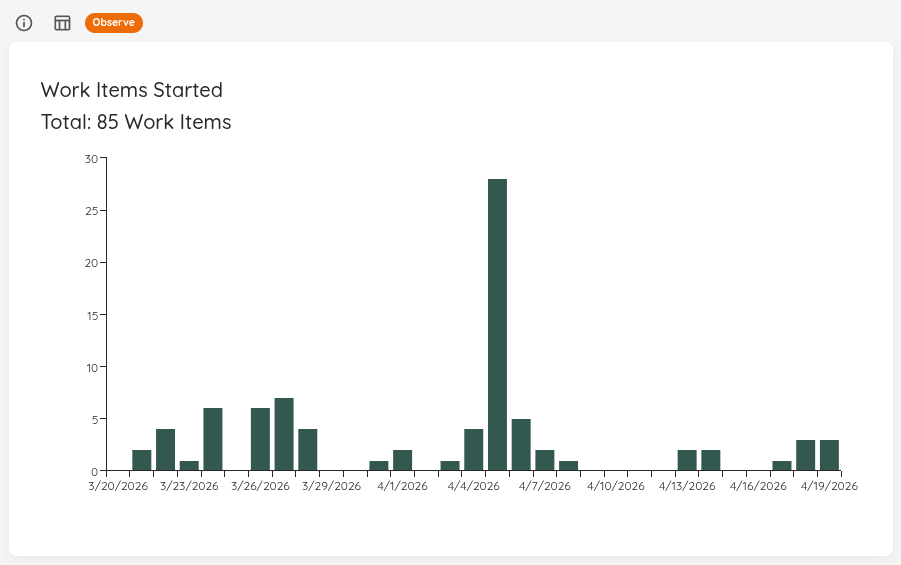
Total Throughput and Total Arrivals Info Widgets
To give a decent overview, both the Throughput as well as your arrivles (items you’ve started) are now visualized in an individual Metric on the Flow Overview page.
Removal of Started vs. Closed Widget
As we have an individual widget for Total Throughput and Total Arrivals, this widget was obsolete and was removed.
Feature Size Percentiles
For Portfolios, you can now also see in the Flow Overview page a summary of your Feature Sizes (similar to the Cycle Time Scatterplot). This allows you to see how big your features are at a quick glance.
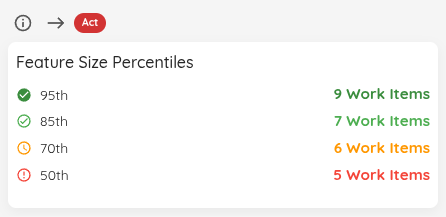
Trend Indicators
All Flow Overview info widgets now display trend indicators comparing the current date range to a prior period:
- WIP Overview, Features Worked On (Teams), and Total Work Item Age compare snapshot values at the start and end of the selected range.
- Predictability Score, Cycle Time Percentiles, Total Throughput, Total Arrivals, and Feature Size Percentiles compare the current period against an equal-length window immediately before the start date.
- Percentile tooltip rows now use a
previous → **current**format with the current-period value emphasized.
The trends are neutral, and simply indicate whether you things are increasing or decreasing compared to a previous period.
Time Filter for Widgets
While previously the WIP Overview, Features Worked On, and Total Work Item Age were simply ignoring any time selected, and showed the current state, they will now resolve their values as of the selected end date. Changing the date range will change the displayed counts to reflect the system at that point in time.
Note: The Blocked Items widget does not support this (yet)
Other Metrics Improvements
Apart from the above, the following things related to metrics were improved:
- The Predictability Score was adjusted to give more accurate results. Previously, with an increase of the input, the score had a tendency to be too optimistic
- Removed the Info icon when a baseline was missing in the PBCs - it will be reflected in the RAG status instead
- The Control Limits as well as the Average Lines for PBCs are now rounded to not have any decimals
- Total Work Item Age over Time RAG status was showing the wrong values
Redesigned Team Forecast
The Team Forecast has been redesigned to make forecasting faster and more intuitive:
- Auto-run forecast: The forecast now runs automatically as you type — no more “Forecast” button.
- Smart quick-pick chips: Select your remaining work directly from contextual suggestions. WIP and Backlog counts are pulled automatically from your team’s current state so you can pick a sensible starting point with one click.
- Feature Selection: Switch to Feature Mode and select Features from your backlog. It will automatically use the remaining work of all selected Features to run the forecast.
- Date shortcuts: Choose common target dates instantly — End of week, End of month, +1 week, or +2 weeks — without opening the date picker.
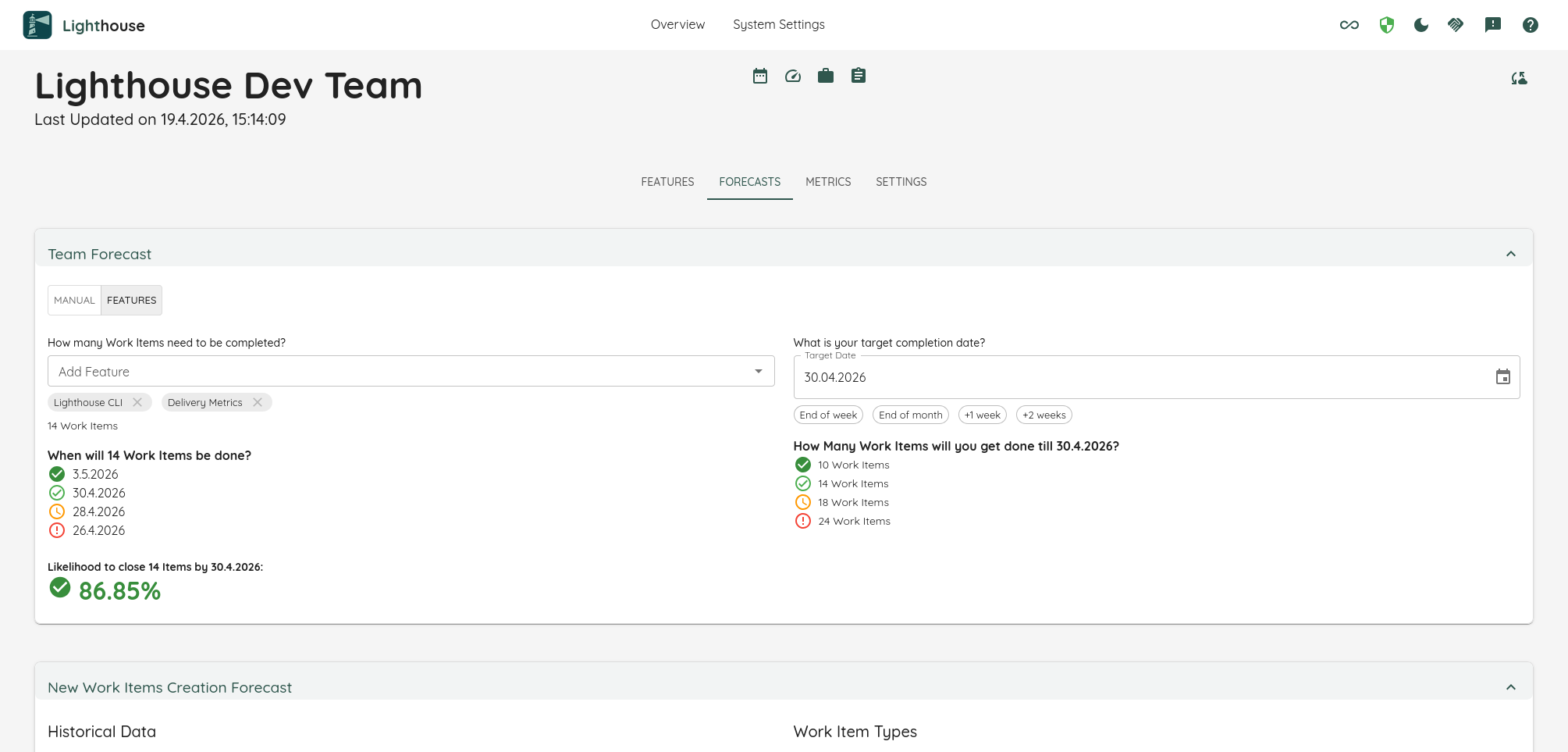
Bug Fixes and Other Improvements
- Product Board: Various references to the newly introduced Product Board were added
- Load all Azure DevOps Boards: Previously only the first 100 boards on any Azure DevOps Projects were shown. Now all boards are loaded.
- Show Work Items for Features in Delivery: You can now, similar to the Team and Portfolio Feature view, see what Work Items belong to a feature when expanding the Delivery View
- Update Manual Deliveries: Fixed issue that prevented any update to a delivery that used manual feature selection mode
Contributions ❤️
Special thanks to everyone who contributed feedback for this release:
Lighthouse v26.4.7.1
Simplified Onboarding
Getting started with Lighthouse is now faster and more guided. The creation flow for Work Tracking Systems, Teams, and Portfolios has been redesigned as a focused step-by-step process — surfacing only what you need to get connected, and deferring advanced settings to the edit view.
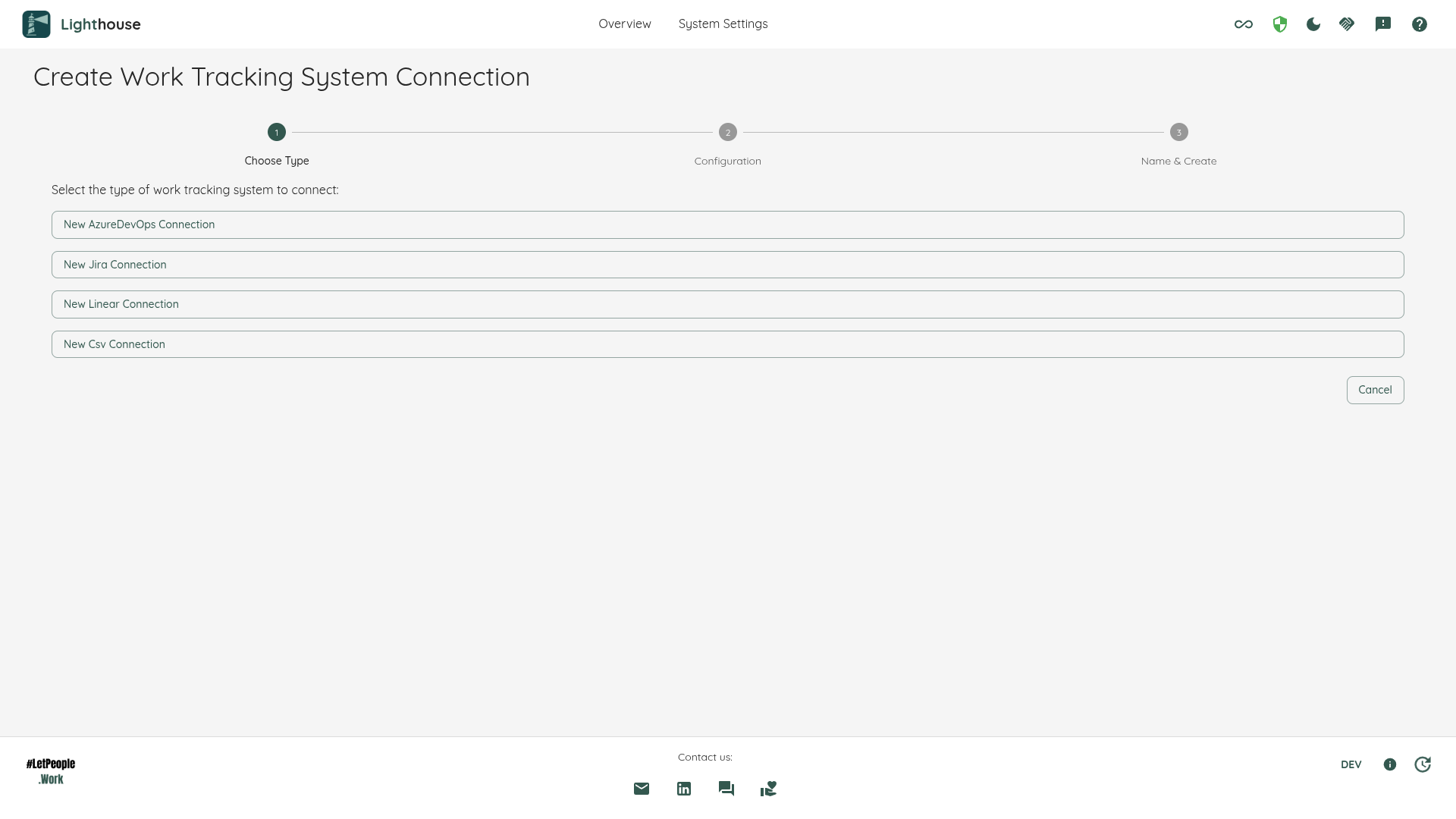
Key changes:
- Connection type first: Choose your provider before filling in any fields. Each authentication method now includes a short description so you know which one to pick.
- Validate on create: The separate Validate button is gone. Lighthouse now validates your connection automatically when you press Create and reports specifically what went wrong if it fails.
- Improved error messages: When a connection fails validation, Lighthouse tells you why — whether the URL is unreachable, the credentials are rejected, or a referenced additional field is invalid.
- Guided Team and Portfolio flows: After picking a connection and entering a name, the wizard walks you through data retrieval, work item types, and states in sequence — and offers to create immediately once enough information is ready.
Advanced options (additional fields, sync settings, state mappings) remain fully accessible after creation in the edit view.
Metrics Dashboard Overhaulded
The Metrics Dashboard has been significantly redesigned to make it easier to navigate and interpret your flow data at a glance.
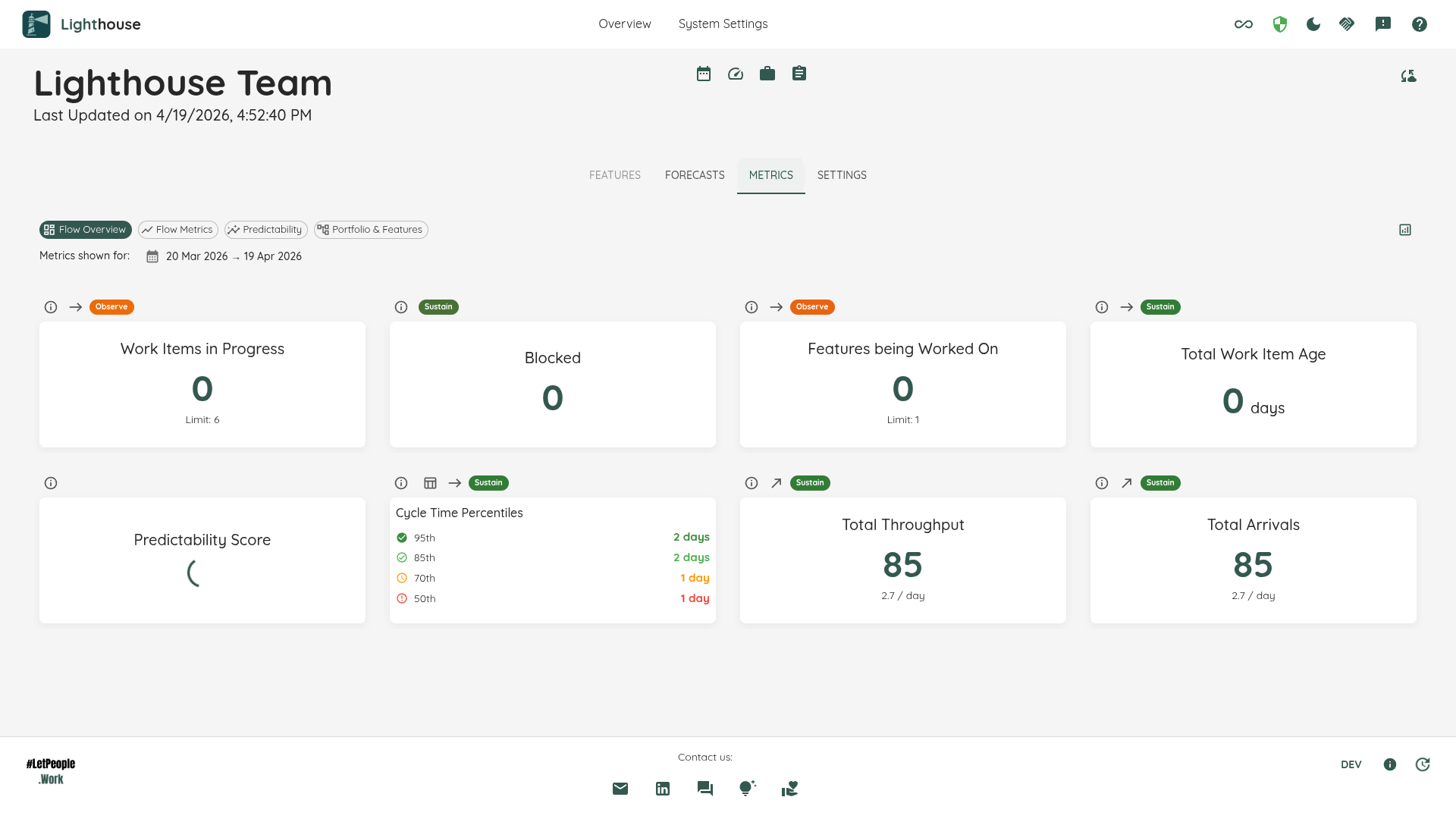
Redesigned Dashboard Categories
The Metrics Dashboard now organizes widgets into six focused categories, each answering a specific question about your delivery system:
| Category | Question |
|---|---|
| Flow Overview | How is my system doing at a glance? |
| Cycle Time | How long do items take? |
| Throughput | How much are we delivering? |
| WIP & Aging | Where is work getting stuck? |
| Predictability | Can we trust our forecasts? |
| Portfolio & Features | How do features flow through the system? |
Each category chip now displays an icon and shows a tooltip on hover explaining what the category helps you understand.
Widget Header
Widgets now feature improved header actions:
- Info button (ℹ️): Click the info icon on any widget to see a brief description of what the widget shows and a Learn More link to the full documentation.
- View Data button (📊): Click the table icon on any widget to open a dialog showing all of the work items that feed that widget. This replaces the previous click-anywhere-on-the-card behavior for the Cycle Time Percentiles and Started vs. Closed widgets — those widgets no longer open a full-dataset dialog on card click. Charts that support context-specific drill-ins (e.g. clicking a single bar, bubble, or data point) continue to work as before.
- Inline RAG chip: Hover over the chip to see the actionable guidance tip.
RAG Status Indicators
Every widget on the Metrics Dashboard shows a Red / Amber / Green (RAG) status indicator. RAG status is computed from live data and your team’s configuration (SLE, System WIP Limit, Feature WIP, blocked indicators, etc.) so you can spot issues at a glance without interpreting each chart individually.
How it works:
- Red = action required (missing configuration, threshold exceeded, or process signal).
- Amber = attention needed (approaching limits or moderate changes).
- Green = within healthy operating range.
- Toggle the Show Tips button in the dashboard header to show or hide the RAG chips.
Other UX Improvements
Improved State Mapping UX
Configuring state mappings on teams and portfolios is now significantly more intuitive:
- Source states are picked from Doing: You can only select states that are currently in the Doing list — no freeform typing required.
- Auto-sync with Doing: Adding a mapping automatically replaces the included states in your Doing list with the new mapping name. Removing the mapping restores the original states.
- No duplicates: A state can only belong to one mapping at a time, keeping your configuration clean.
A reminder is shown after saving to indicate that a data refresh is needed for changes to take effect.
Feature Progress Bar Simplified
On the Feature List, if a feature is tracked by only a single team, Lighthouse now shows a single progress bar instead of displaying both a team bar and an identical total bar. This removes redundant information and makes the list easier to read at a glance.
More Specific Validation Messages
When a connection fails validation, Lighthouse now reports specifically what went wrong — whether the URL is wrong, credentials are invalid, or there is a problem with a referenced additional field. This makes it easier to identify and fix issues without guessing.
Settings No Longer Reload Unexpectedly
Settings pages no longer reload while you are actively editing them due to background data updates. Your in-progress changes are preserved while the app continues to refresh data in the background.
Automatic Browser Cache Invalidation
When a new version of Lighthouse is deployed, browsers now automatically load the updated interface instead of serving a stale cached version. No manual hard-refresh is needed after an update.
⚠️ Breaking Change: Tags Removed from Teams and Portfolios
The Tags field has been removed from Team and Portfolio configuration. If you previously used tags to organise or filter your teams and portfolios, this capability is no longer available.
Open-Source Software (OSS) Attribution
The System Info page in System Settings now includes an OSS Attribution section listing all open-source components bundled with Lighthouse, along with their versions and licenses. This makes it straightforward to review every third-party dependency that Lighthouse ships with.
Bug Fixes and Other Improvements
- Standalone real-time updates fixed: The SignalR connection in the Standalone (desktop) edition was broken, preventing live updates from appearing in the UI without a manual page reload. This has been fixed.
- Write-back with duplicate work items: When a work item appeared multiple times across queries, write-back would fail. Lighthouse now handles duplicates correctly.
- Updated various third-party dependencies.
Contributions ❤️
Special thanks to everyone who contributed feedback for this release:
Lighthouse v26.3.28.14
Authentication Support
Lighthouse now supports OpenID Connect (OIDC) authentication to protect your instance. When enabled, users must sign in through your identity provider before accessing Lighthouse — unauthenticated requests are redirected to the sign-in screen.
Key highlights:
- Fail-closed design: If authentication is enabled but misconfigured (e.g. no
Authorityset), Lighthouse displays an error screen and refuses to start, rather than accidentally leaving the app unprotected. - Session management: Sessions last 8 hours by default, configurable via
SessionLifetimeMinutes. Users see a Session Expired screen when their session ends. - Provider guides are available for Keycloak, Microsoft Entra ID, Google, and Auth0.
See the Authentication documentation for the full configuration reference and setup instructions.
Note: Authentication is a Premium feature. A valid Premium license is required to use it.
Linear Integration — Production Release
The Linear integration has moved from preview to a fully supported production provider. If you were using Linear during the preview phase, you will need to reconfigure your teams and portfolios. While we are not supporting 100% the same features as with Jira and Azure DevOps yet (for example, additional fields are not yet available), the basic functionality now works.
Here is what changed:
Teams: Linear teams are now configured using a team selection wizard instead of typing team names manually. The wizard lists all available teams from your connected Linear workspace. Work item types are fixed to Issue and do not require manual configuration.
Portfolios: Linear portfolios automatically retrieve all projects in the authenticated workspace as Lighthouse features. No query or work item type configuration is needed. Just create a portfolio with a Linear connection, configure your states, and you’re ready to go.
Hierarchy: Lighthouse now maps the full Linear hierarchy:
- Issues (team work items) roll up to Projects (portfolio features)
- Projects roll up to Initiatives (parent features)
This means your Monte Carlo forecasts and metrics correctly reflect the Linear project structure. Initiative names, statuses, and URLs are fetched directly from the Linear API.
See the Linear documentation for updated setup instructions.
State Mappings for Teams and Portfolios
Lighthouse now supports State Mappings — a way to rename or group raw provider states into meaningful Lighthouse states before placing them in To Do, Doing, or Done. If you create a state mapping, it can be used like a regular state, and all the source states will be transformed into the mapped state.
You can use that to:
- Group multiple states into one: For example, group Code Review, QA Review, and Design Review into a single In Review state and place it in Doing.
- Rename a single state: For example, map your provider’s In Dev state to Development and then use Development in your Doing list.
How it works:
- Open team or portfolio settings and scroll to the State Mappings section (below the To Do / Doing / Done state lists).
- Add one or more mappings — give each a name and select the source states it should contain.
- Use the mapped name in your To Do, Doing, or Done configuration just like any other state.
Refresh History
In the System Settings, you can now see statistics to the last 30 refreshes that you did for each of your teams and portfolios:
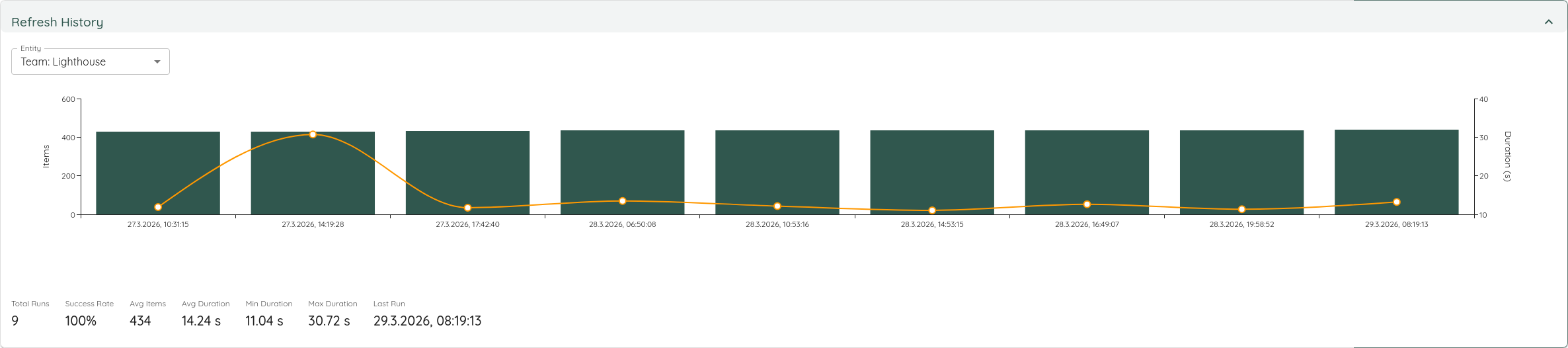
This includes how many items were fetched and how long it took to execute it. This may be useful to track Lighthouse performance over time, to see if it’s degrading as you onboard more users, teams, and portfolios or not.
Other Improvements and Bug Fixes
- Cycle Time Dates No Longer Appear in the Future for Positive-Offset Timezones.
- Standalone version will now ensure that all processes are stopped when exiting. This was not the case before, and could prevent updates as files were still in use.
- When running Lighthouse in Docker, the logs were not displayed in the UI, but a generic Logs not found message. This has been addressed, logs show up now.
- Updated various third party dependencies
Contributions ❤️
Special thanks to everyone who contributed feedback for this release:
Lighthouse v26.3.25.6
Blackout Periods
Lighthouse now supports Blackout Periods — a way to mark specific dates or date ranges as non-working days directly in your configuration. Common use cases include public holidays, company off-days, or any planned period where your team is not delivering work.
Blackout periods affect Lighthouse in two key areas:
Forecasting: When running a Monte Carlo Simulation, Lighthouse skips blackout days entirely. The simulation does not count those days as working days and does not sample throughput for them. This means your forecasts automatically account for known non-working periods — no manual throughput adjustment or buffer needed.
Metrics charts: Blackout days are highlighted with a hatched overlay in the following charts, so you can immediately tell why throughput was zero or WIP dipped on those days:
- Throughput Run Chart
- WIP Over Time
- Total Work Item Age Run Chart
- Process Behaviour Charts (all variants)
- Cycle Time Scatterplot
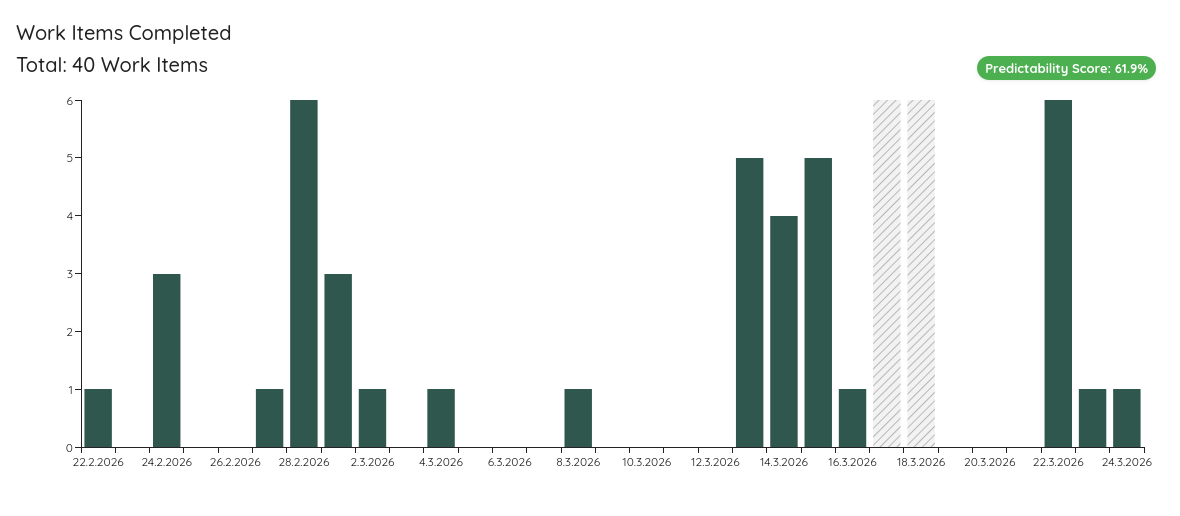
Blackout periods are configured globally in System Settings → Configuration → Blackout Periods and apply to all teams and portfolios. See the Configuration documentation for details.

Database Management
Lighthouse now includes built-in Database Management capabilities, available under System Settings → Database Management. You can create encrypted backups of your database, restore from a previous backup, or clear all data — directly from the UI.
⚠️ **This feature is replacing the previously used Configuration Export/Import mechanism. Please be aware that your exported configurations cannot be loaded anymore with this version ** ⚠️
Key capabilities:
- Backup: Creates an AES-encrypted ZIP archive of your database. The backup is password-protected using PBKDF2 key derivation (SHA-256, 100 000 iterations). Downloads are available as a single file.
- Restore: Upload a previously created backup to replace the current database.
- Clear: Removes all data from the database, giving you a clean slate.
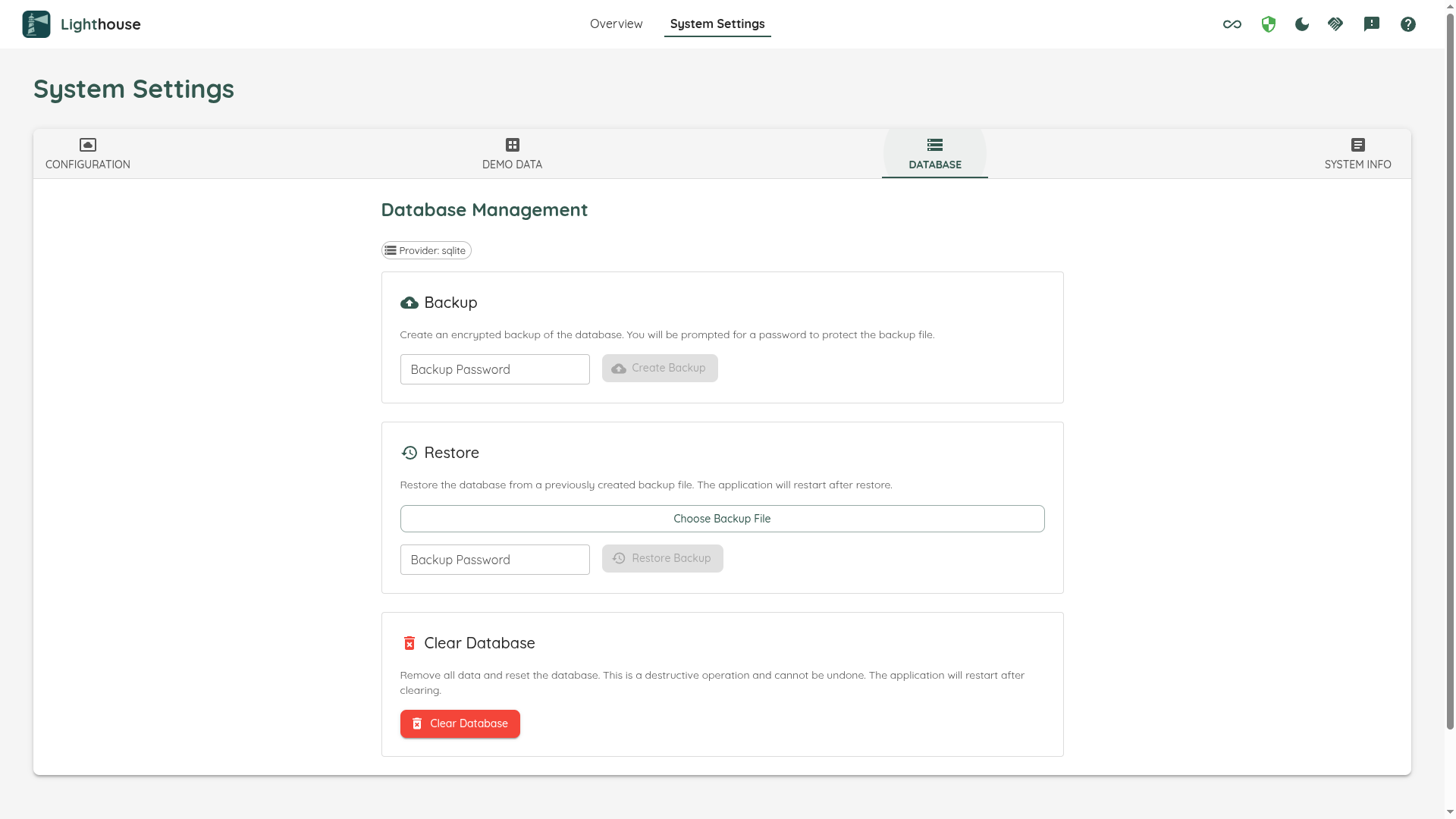
Provider support:
| Provider | Backup format | Requirements |
|---|---|---|
| SQLite | Raw database files | None — works out of the box |
| PostgreSQL | pg_dump / pg_restore | postgresql-client tools must be installed (included in the official Docker image) |
Operational notes:
- While a database operation is in progress, all other data-modifying operations (team updates, forecasts, etc.) are blocked to prevent data corruption.
- Backup passwords are never stored — keep them in a safe place.
Restructure Feature View
The feature view used to have icon indicators for:
- Using the default size instead of the real number of child items
- Being actively worked on by a team
These icons were part of the Name column, and thus you could not search and/or sort by them. With this release, we introduced dedicated columns for:
- Warnings
- Active Work in Progress
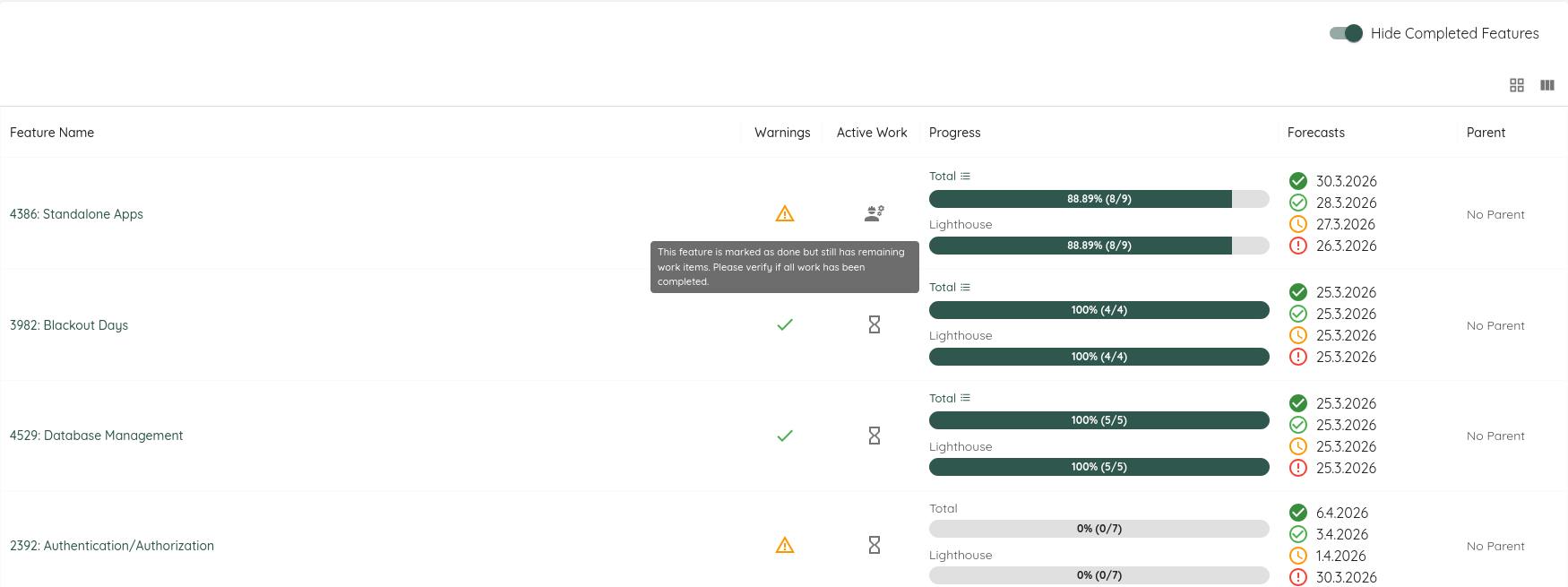
Furthermore, the following change was made to the Hide Completed functionality. Previously, it only filtered by Feature state. So if your Feature was in a done state, it would not be displayed anymore. Now, next to this filter, it also checks the remaining work. If the Feature is in a done state, but has child items that are not done yet, it will still be displayed. Furthermore, in this scenario, we also display a warning (in the new column), as this is an indicator that something is wrong. This is important as having remaining items will impact your forecast, so either the Feature state is wrong, or the child items were not update. The warning is a nudge to get your backlog in order.
Other Improvements and Bug Fixes
- In the previous versions, you could enable the MCP Feature without a license. During startup, it was crashing as it should only be available with a license, effectively logging users out. This is now handled, so that enabling the feature is only allowed with a license, and if you somehow get into the other state anyway, Lighthouse will still manage to start.
- Standalone version will restart after an update has been applied
- Updated various third party dependencies
Contributions ❤️
Special thanks to everyone who contributed feedback for this release:
Lighthouse v26.3.20.4
Standalone Apps
Lighthouse now ships as a native desktop application for Windows, macOS, and Linux — no server setup, no browser, no terminal required.
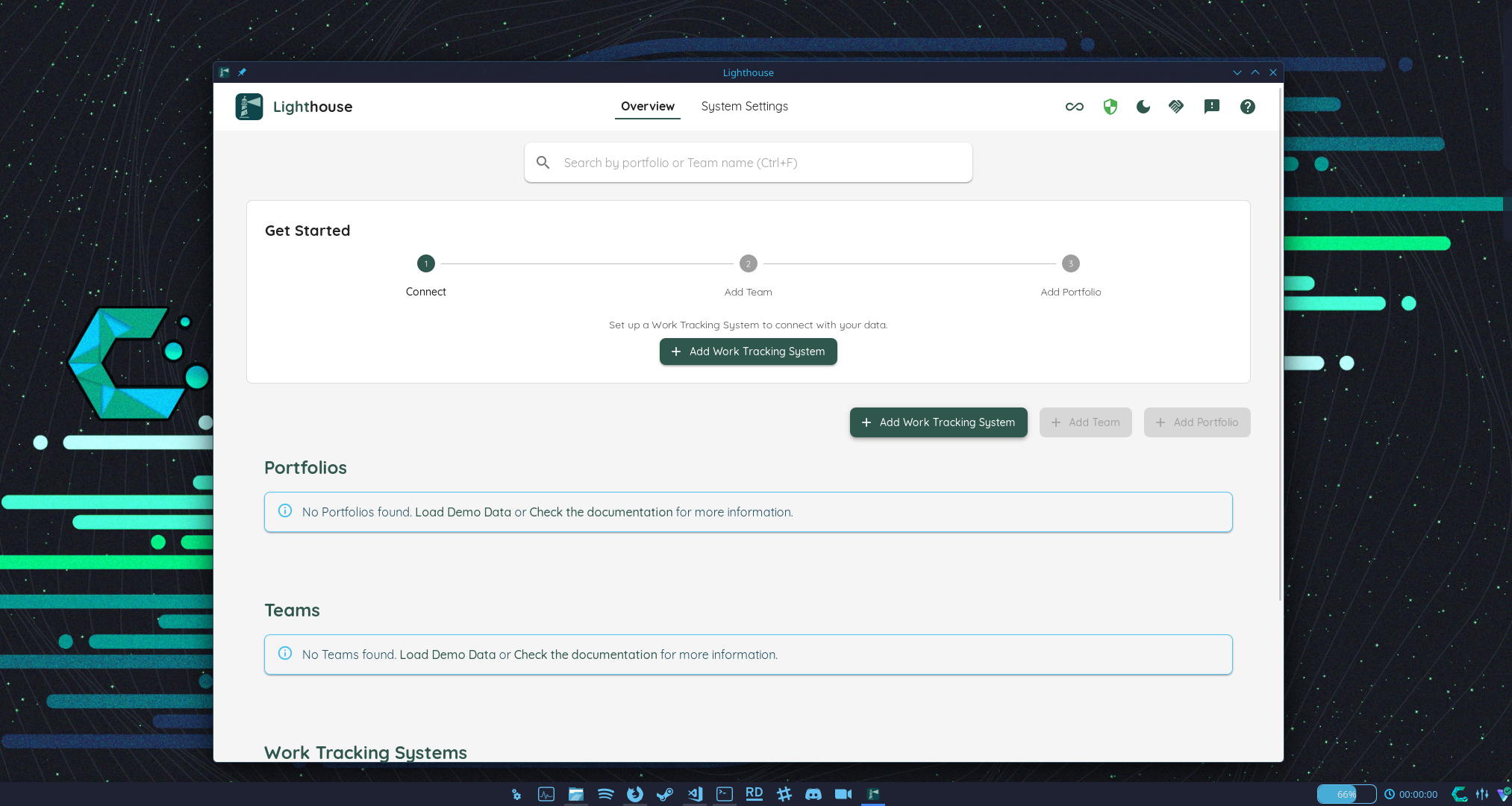
The Standalone edition is ideal for individual users who want a self-contained Lighthouse experience on their own machine. It launches like any other desktop app and manages its own backend automatically.
What’s included:
- Full Lighthouse feature set in a native window
- Built-in automatic updater — the app checks for new releases on startup and prompts you before installing
- No network configuration required
Available packages:
| Platform | Package | Notes |
|---|---|---|
| Windows | NSIS Installer (.exe) and MSI Installer (.msi) | Recommended — installs to Program Files with auto-updater and uninstaller |
| macOS | App Image (.dmg) and App Bundle (.zip) | Runs natively on Apple Silicon (arm64, macOS 11+); signed, notarized, and auto-updates. Intel Macs are no longer supported |
| Linux | AppImage (.AppImage) | Single-file, runs on most distributions without installation |
For full installation instructions and guidance on choosing between Standalone and Server editions, see the Installation docs.
Scoped Access Token Support for Jira Connections
Lighthouse now supports Scoped Access Tokens as an authentication method for Jira Cloud connections. Unlike regular API tokens — which inherit all permissions of the user who created them — scoped tokens let you grant only the specific permissions Lighthouse needs. This is especially useful in organizations using service accounts, where regular API tokens are not supported.
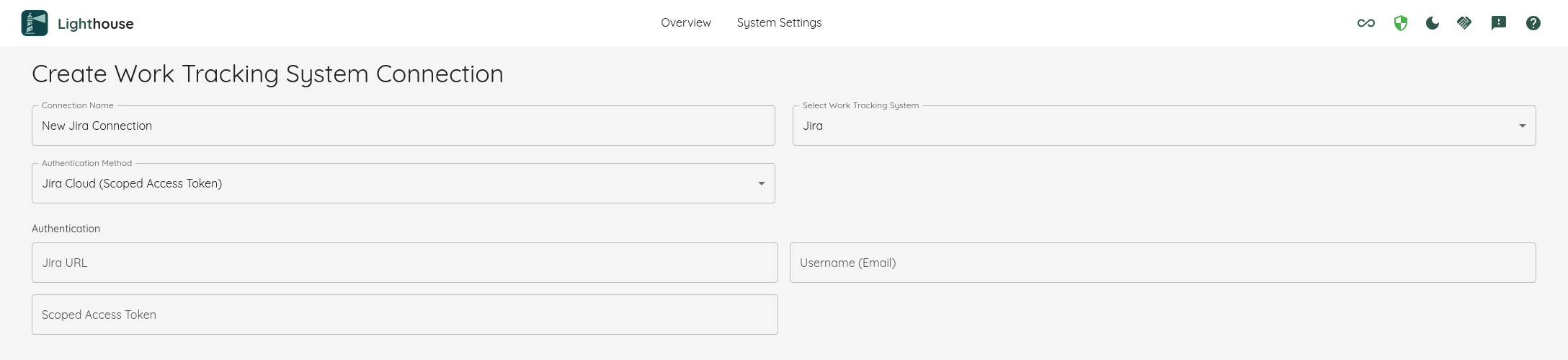
The required scopes for read-only access are read:jira-user and read:jira-work. If you use the Write Back feature, you additionally need write:jira-work.
Due to a Jira restriction, the boards endpoint does not support scoped token authentication. If you are using a scoped token, Lighthouse will show “No Boards available” and the Board Wizard cannot be used. You can either configure your teams and portfolios manually, or use a personal API token for the initial setup and switch to a scoped token afterwards.
For full setup instructions, see the Jira documentation.
System Info
The Logs tab in System Settings has been renamed to System Info. In addition to the existing log viewer, it now displays details about your running Lighthouse instance — such as version information and other system properties. Clicking any of the displayed values copies it to your clipboard, making it easy to share when reporting issues or reaching out for support. A direct link to the API documentation (Swagger) is also available from this page.
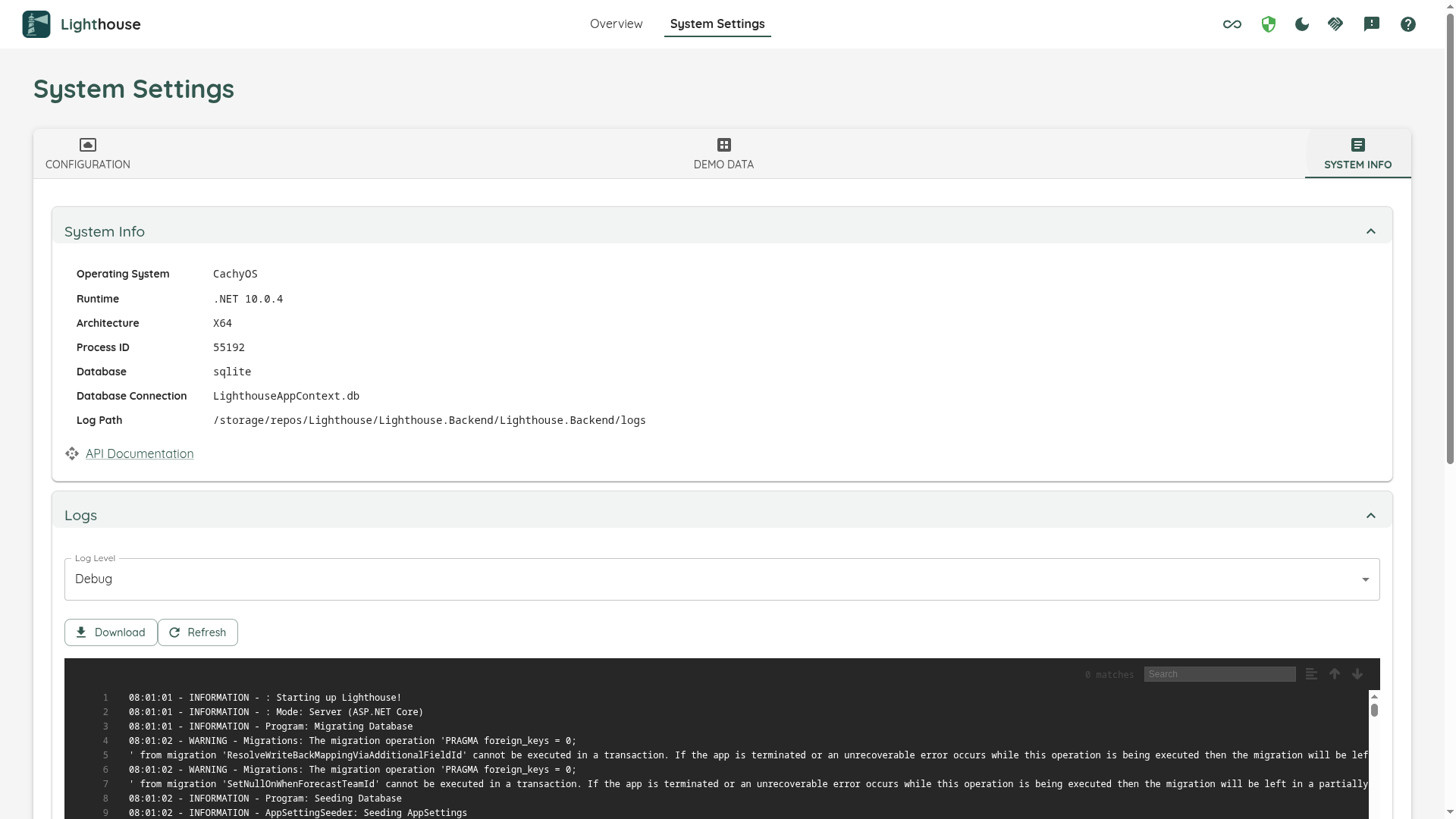
Other Improvements and Bug Fixes
- Fixed an issue where deleting a team caused an error in case you deleted a Portfolio that included this team
- Removed fixed ports from config - plese check the configuration on how to set up https and override ports.
- Updated various third party dependencies
Contributions ❤️
Special thanks to everyone who contributed feedback for this release:
Lighthouse v26.3.13.16
Invert Percentiles for New Item Forecasting
The percentile display for the New Item Forecasting feature has been inverted. Previously, the percentiles were shown in a way that could be confusing. They are now displayed in a more intuitive order, making it easier to interpret the forecast results at a glance. This means, you read it now as follows: There is a yy% chance that we create x items or less
This means that the higher the percentiles, the higher the number. The less risk you want to have, the more items you should be expecting.
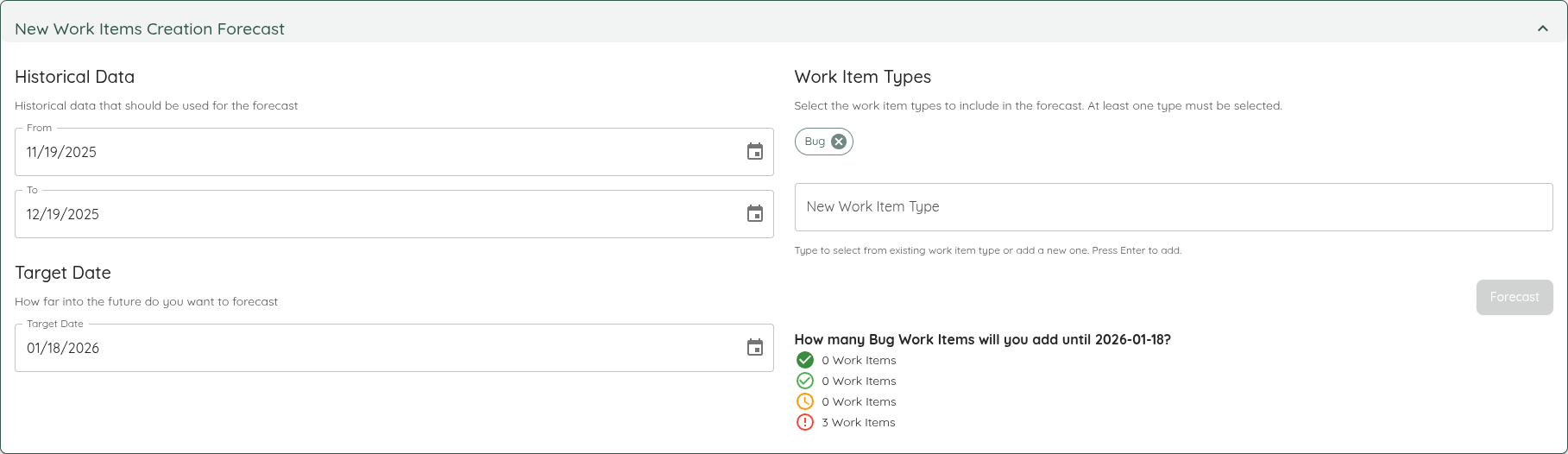
Other Improvements and Bug Fixes
- Fixed an issue where the Parent Override setting was not being applied correctly on Azure DevOps connections and caused the update of teams to get stuck
- Fixed an issue where Involved Teams were not respecting the Ownership Settings configured on a Portfolio
- Fixed an issue where the automatic update of Portfolios was not refreshing the Features, causing stale data to be displayed
- Fixed an issue in MCS Backtesting where the start date of the backtesting period was incorrectly included in both the Historical Throughput and the Actual Throughput charts
- Updated various third party dependencies
Contributions ❤️
Special thanks to everyone who contributed feedback for this release:
Lighthouse v26.3.9.4
Improvements for Write Back to Work Tracking Systems Functionality
After shipping the first version of the sync functionality, this version brings small improvements based on the first feedback:
- Additional Fields were not properly resolved, causing on Jira to fail writing back if you used the key of a field instead of the id. This is fixed now and you can reference your additional fields as you like
- Instead of updating all the items always, Lighthouse will check if the value that it’s going to write differs from what’s already there. A write operation is only happening if the values are different, reducing the time for updates and the load on the system.
Furthmore, we looked into disabling notifications on Jira on an update from Lighthouse. However, there is no realiable way to suppress the notifications if someone put themselves as a watcher on an Issue. Please be aware that an update operation may trigger a couple of emails if people subscribed to it…We’re looking for potential workarounds for this issue and have updated the documentation with a warning.
MCS Backtesting
The MCS Backtesting now allows you to select fixed dates instead of only a rolling window. This will make it easier to backtest with your actual settings, for example if you exclude a specific time period (like Christmas). The default setting will be based on your teams Forecast Configuration - if you have a rolling window it will be set to this, if you use fixed dates, it will automatically pick your current configuration of those.
Furthmore, you will now be able to inspect the actual Throughput in a dedicated Run Chart, that was added as a third tab next to the MCS Backtesting Result and the Historical Throughput Run Chart.
Other Improvements and Bug Fixes
- The Setting for the PBC Baseline is now properly labeled, as it was Enable PBC before, indicating it would not be enabled without a baseline
- There is a Clear Button to clear the PBC Baseline
- Improved various third party packages to their latest version
Contributions ❤️
Special thanks to everyone who contributed feedback for this release:
Lighthouse v26.2.28.12
Write Back to Work Tracking Systems [Premium Only]
Lighthouse can now write data back to your work tracking systems. You can configure mappings on your connections to automatically update fields in Azure DevOps, Jira, or other supported systems when forecasts or features are updated. This enables teams to keep their work tracking systems in sync with Lighthouse’s forecasting data without manual intervention.
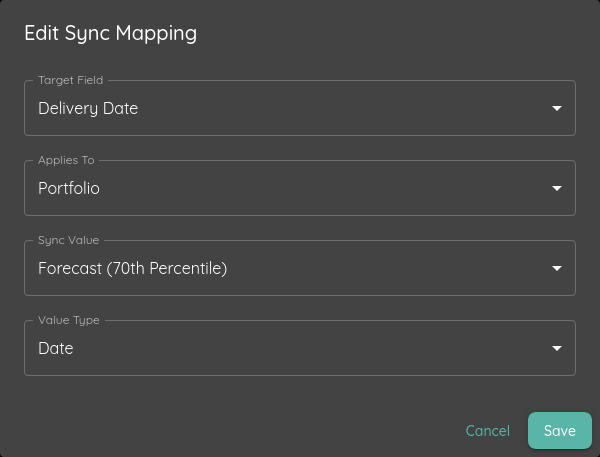
Currently, you can write back:
- Work Item Age and Cycle Time (Team and Portfolio)
- Feature Size (Portfolio only)
- Forecasts per Feature (Portfolio only)
The values are written to your system after every update of your Team and Portfolio.
Work Tracking Systems Adjustments
Work tracking system connections have been moved from the Settings page to the Overview page, making them more accessible. The Overview now shows your configured connections alongside portfolios and teams, with full create, edit, and delete capabilities. Onboarding prerequisites are enforced: you must create a connection before adding a team, and a team before adding a portfolio.
For new systems, an Onboarding is displayed to guide them through their first steps: Create Connection –> Create Team –> Create Portfolio
As the Work Tracking Systems contain more and more functionality (including the Sync functionality introduced in this release), they are displayed as a full page now instead of just a dialog. The side effect of this is, that you cannot create Work Tracking Systems as part of the Team or Portfolio creation.
Involved Teams in Portfolios
Before, users had to manually select all teams that contributed to a Portfolio. This was adjusted, and Lighthouse is now automatically inferring which Teams are contributing any work to a Portfolio. This should simplify the setup, and allows you to simply add new teams (or new work to a team) and it will automatically be picked up as contributor to a Portfolio.
Other Improvements and Bug Fixes
- The PBCs for Feature Size and Cycle Time were showing Invalid Date depending on your region - this should be working now in all regions
- There were situations where Teams would stop updating, and were not deletable anymore. We tried to correct the root cause of this (although we are not 100% sure, as we could never reproduce it on our test environment)
- The tab next to Overview is now called System Settings, to more clearly distinguish it from Team and Portfolio Settings
- The Cut-Off date for Work Items on Team Level is now, by default, the same value as for Portfolios: 365 days
- Update of various third party dependencies
Contributions ❤️
Special thanks to everyone who contributed feedback for this release:
Lighthouse v26.2.22.1
Visualizing Estimations
You can now configure an estimation field on your Team and Portfolio settings and visualize how estimates correlate with cycle time. Configure numeric estimates (e.g., story points) or categorical estimates (e.g., T-shirt sizes like XS/S/M/L/XL) with explicit ordering.
Once configured, a new Estimation vs. Cycle Time scatter plot appears in your Metrics tab, showing estimation values on the x-axis and cycle time on the y-axis. Click any data point to drill into the underlying work items.
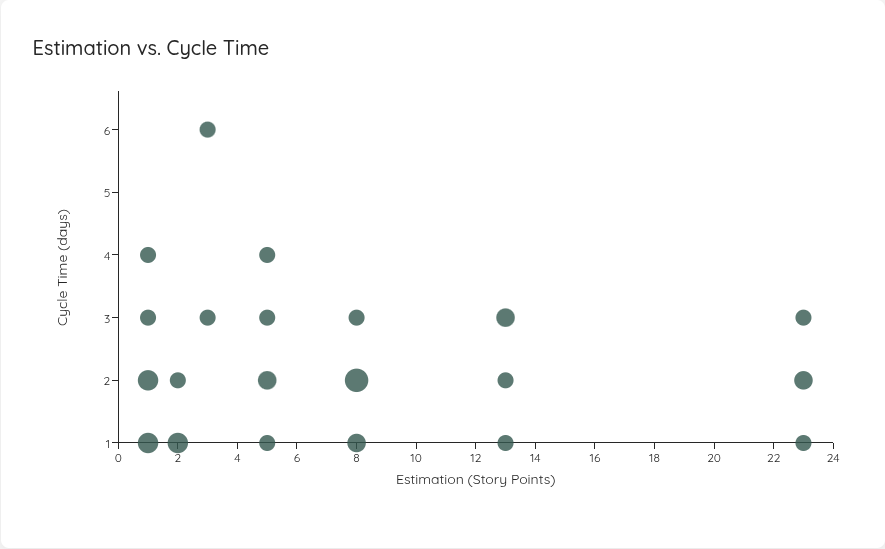
Feature Size Chart – Estimation Y-Axis Toggle
When an estimation field is configured, the Feature Size chart now lets you toggle the y-axis between estimation values and cycle time directly on the chart. If no estimation field is set, the chart continues to use cycle time as before.
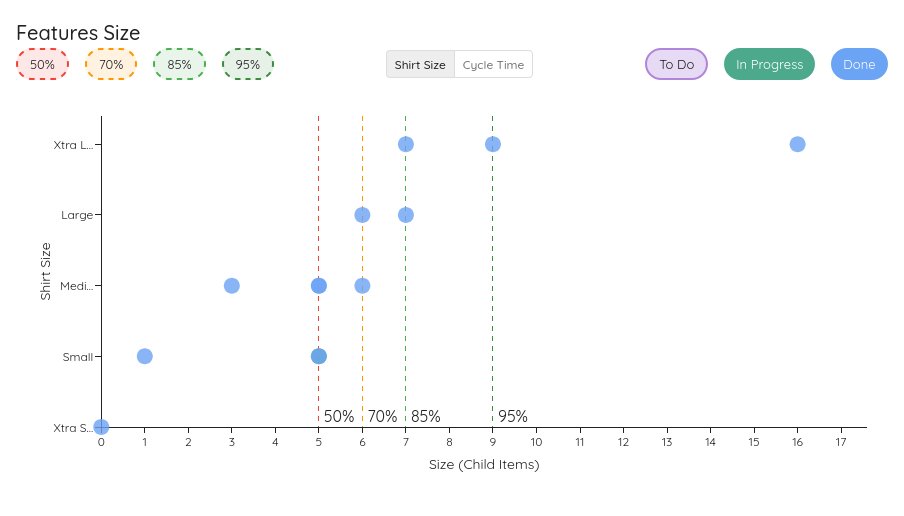
Process Behaviour Chart Improvements
After releasing the PBC feature, we got some feedback and refined the functionality as follows.
You don’t need to set a baseline anymore. While it’s still recommended, the PBCs will show up when no baseline is set and use the selected timeframe for the metrics also as a baseline. In that case, a small info icon will appear on the chart which states the missing baseline.
For the Cycle Time PBC, we’ve adjusted the tooltip so that instead of the Cycle Time value, you see the specific item that is represented in that dot.
Furthermore, there is a new PBC for Portfolios for the Feature Size:
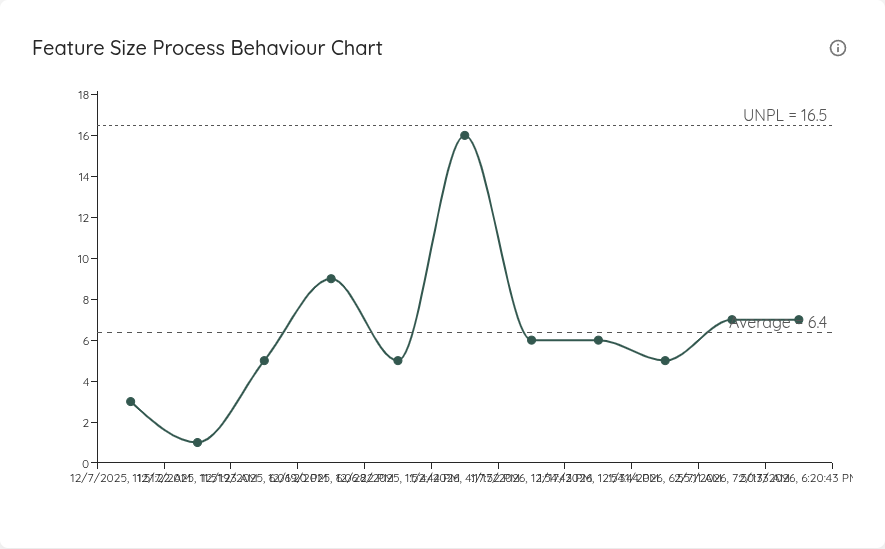
Use this to see which Features were within the normal variability, and which ones are an indication of a special cause.
Additional Field Improvements
So far, the additional fields had to match the casing specified by your Work Tracking System. This lead to situations where for example “fixVersion” and “Fix version” where valid, while “FixVersion” was not. This has changed in this version, as casing is ignored, which should make the additional field setup a lot simpler.
Furthermore, Jira Fields that can have multiple values (for example labels or fixVersions) are now stored properly. Before, Lighthouse would store a lot of additional information (the whole json object), which now is properly parsed and only the actual data is stored. If multiple values are specified in a field, Lighthouse stores it separated by ,.
Other Improvements and Bug Fixes
- You can now click on the Total Feature Progress and see the details of the work items assigned to that specific features in both the Team and Portfolio Feature View
- The Feature Tab for Teams was always disabled after selecting another tab, preventing moving back to it. This is fixed and the Features tab is only disabled, if the team has no Features assigned.
- Update of various third party dependencies
Contributions ❤️
Special thanks to everyone who contributed feedback for this release:
Lighthouse v26.2.11.7
Process Behaviour Charts
Process Behaviour Charts (PBCs) help you understand whether changes in your system are likely just normal variability, or whether you are seeing a special cause (something worth investigating). Lighthouse now supports PBCs for both Teams and Portfolios, for Throughput, Cycle Time, Work In Progress, and Work Item Age.
In order to get the chart, you must configure a baseline for your PBC. You do this in the Team Settings or Portfolio Settings. Once you did this, the charts will appear in your Metrics tab:
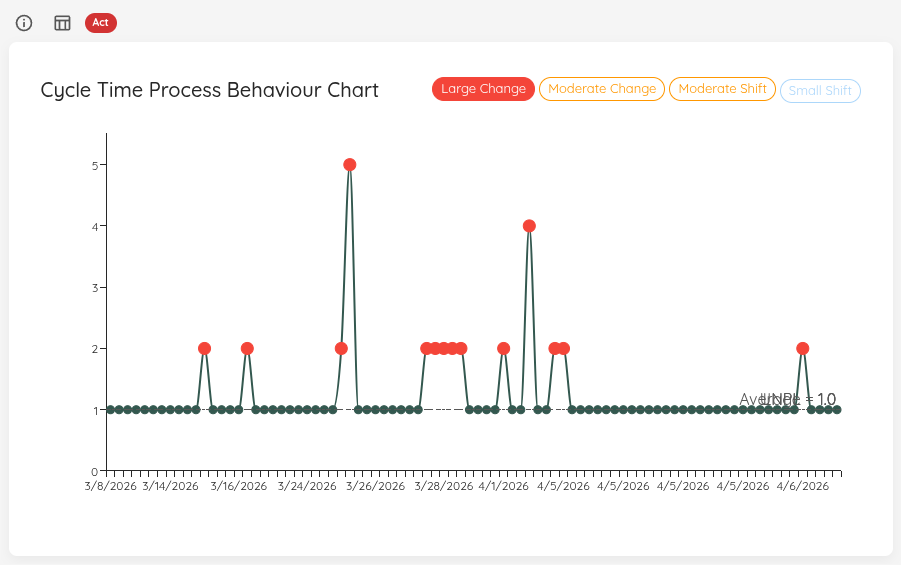
Adjustments to Additional Fields Configuration
If you add or modify the additional fields, you must make sure to refresh your teams and portfolios before the fields are loaded. This was not obvious, thus we added a small info box about it.
In case of using an Option Field in Jira as additional field, Lighthouse was fetching too much information (a whole json object). This is fixed in this version and you get the exact value that is selected.
On top of that, you can now also specify the “id” of a field, next to the already supported “Key” and “Name” properties. This is useful as (some?) versions of Jira Data Center do not expose a key property. In most cases, id and key will actually be the same property (at least in Jira Cloud), so not much will change if you do not use Jira Data Center.
Furthermore, we decided to make the additional fields part of the premium features. The additional fields allow to deal with customization from your Jira instance and will mainly be used for advanced features or quality of life improvements. For both those things we do have the premium model in place.
Starting with this release, you are restricted to a single additional field if you are on the community version. This allows you to test various scenarios and features, to make sure it works with your work tracking system, while giving us a marketable feature to sell premium licenses.
Other Improvements and Bug Fixes
- The Feature List for deliveries now also allows you to Hide completed Features
- Update of various third party components
Contributions ❤️
Special thanks to everyone who contributed feedback for this release:
Lighthouse v26.2.7.3
Rule-Based Delivery Feature Assignment [Premium Only]
You can now automatically assign Features to Deliveries using rule-based expressions instead of manual selection. Define rules using available fields (Type, State, Tags, any Additional Field) with operators like equals, contains, or not equals to create dynamic feature selection.
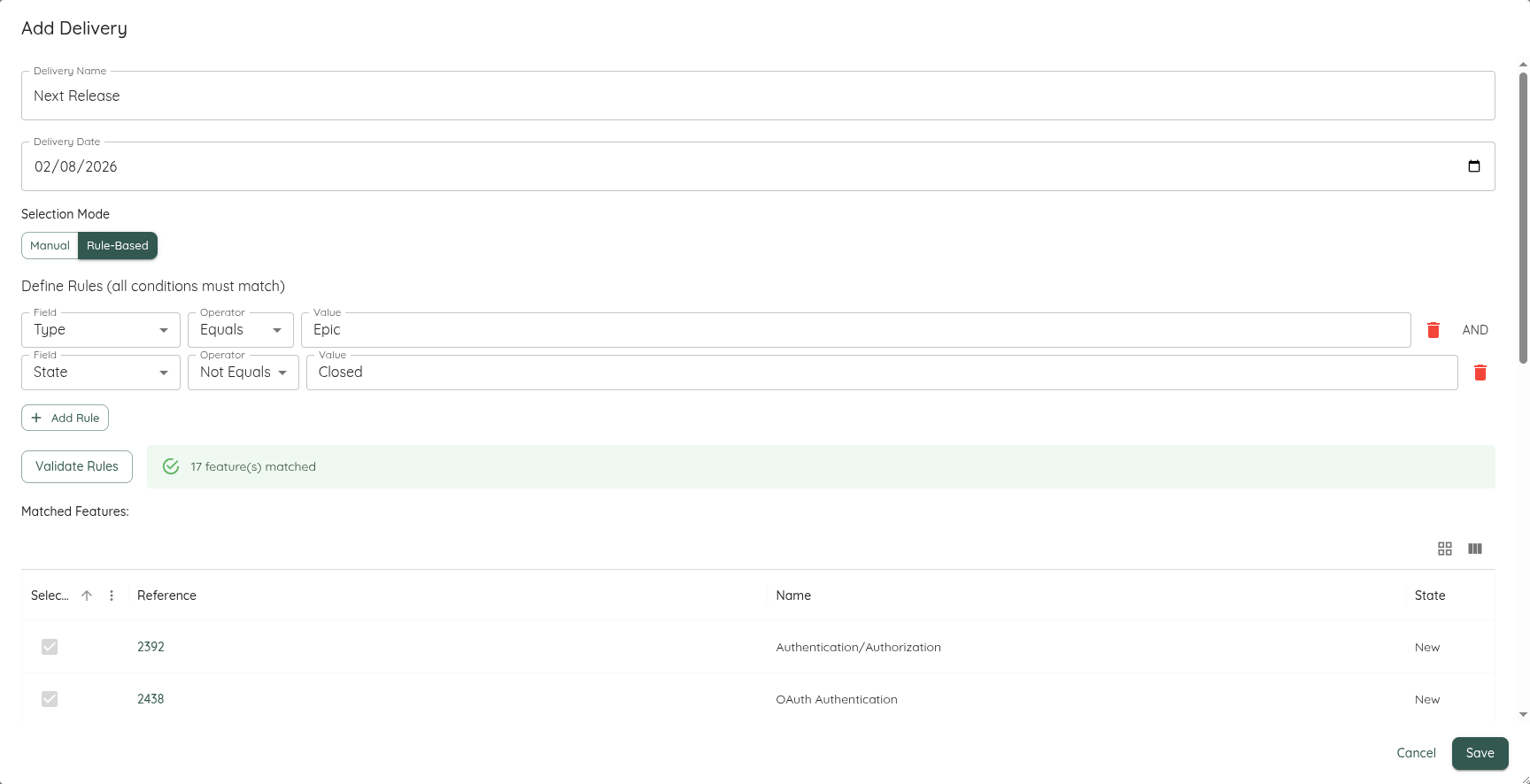
When creating or editing a Delivery, switch to the expression editor to define your rules. Multiple rules are combined with AND logic. The system validates your expression and shows matching features before saving. Deliveries using expressions automatically update when the Portfolio refreshes, adding new matching features and removing those that no longer match.
This feature is ideal for teams using FixVersions (Jira), Area Paths (Azure DevOps), or custom tags to organize their release planning.
MCS Backtesting Improvements
The Forecast Backtesting visualization has been enhanced with improved clarity and usability:
- Actual completion date now shown as a clear vertical line instead of an additional bar
- Added the average forecast as a comparison value
- Improved layout and spacing for the Predictability Score display
- Fixed issue where backtesting time frames were incorrectly calculated
These changes make it easier to evaluate forecast accuracy and understand the relationship between predictions and actual outcomes.
Changes to Premium Features
- Terminology Configuration is now a premium feature
- New Work Item Prediction (forecasting arrival of work) is now available in the Community Edition
Feature Management Improvements
Managing features across teams and portfolios has been streamlined:
- Completed features are now hidden by default to reduce clutter
- Feature state is now visible in the feature list instead of just showing the State Category as an icon
- Removed the “Updated on” column to simplify the view
- Feature tabs are disabled on Teams that aren’t part of any Portfolio
Other Improvements
- Manual forecasts now allow you to specify either a target date OR remaining items, not requiring both
- System startup now displays
localhostURLs instead of[::]for better clarity - Fixed issue where Total Work Item Age widget didn’t match the Work Item Age Run Chart
- Fixed compatibility issue loading configurations from older Lighthouse versions
- Resolved Jira custom field handling issue that could cause connection problems in case you had duplicate names of custom fields (thanks Jira…)
Contributions ❤️
Special thanks to everyone who contributed feedback for this release:
Lighthouse v26.1.30.10
MCS Back-Testing
You can now validate Lighthouse’s Monte Carlo Simulation forecasts against historical data using the new Forecast Backtesting feature. This helps build confidence in the forecasting system by comparing predicted outcomes with actual historical throughput.
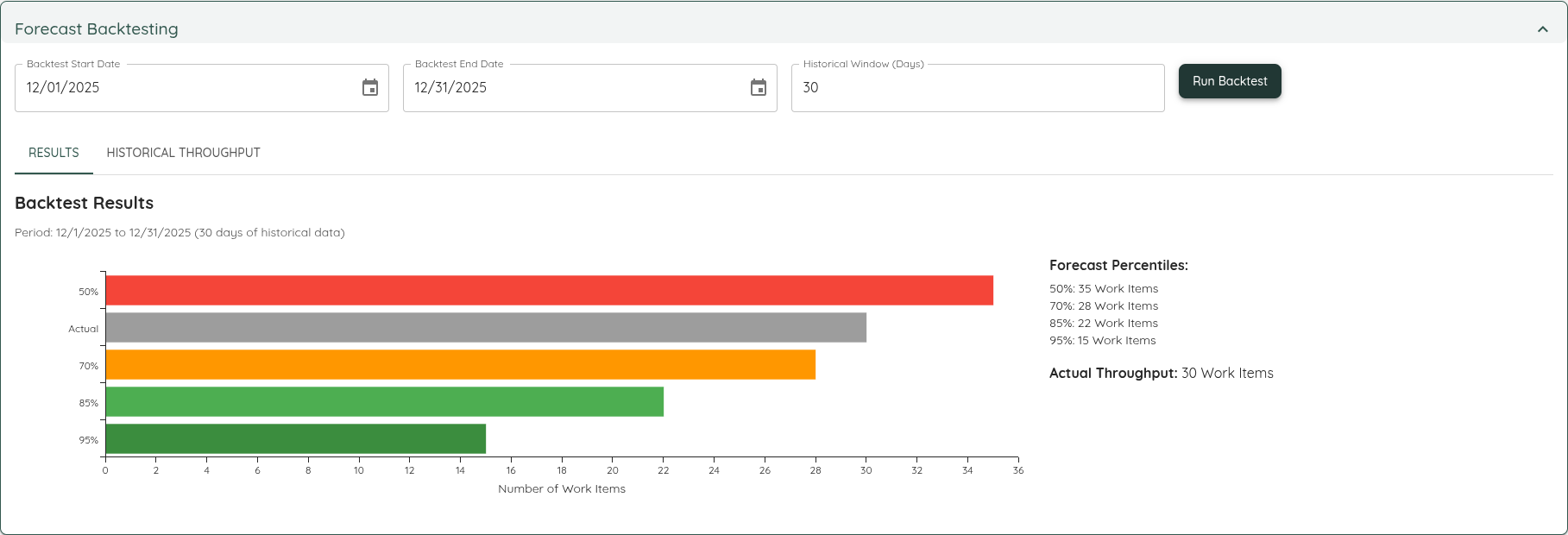
Navigate to any Team’s Forecasts tab to find the new Forecast Backtesting section. Select a historical time period and run a backtest to see:
- How many items the MCS predicted would be completed (at 50%, 70%, 85%, and 95% confidence levels)
- The actual number of items that were completed during that period
This feature empowers teams to assess the reliability of Lighthouse forecasts using their own historical data.
Delivery Improvements
The Feature Selection for the Delivery creation now features two new improvements:
- A Select All button that will select all Features that are currently in view (this will respect any filter you’ve set in the grid - only the visible features will be selected)
- The state of a feature is now shown as a dedicated column
Spotlighting Charts
You can now spotlight a chart in the Metrics section. By doing so, you’ll get an expanded view of this chart. This is especially useful when teaching about flow metrics or when you want to highlight something specific.
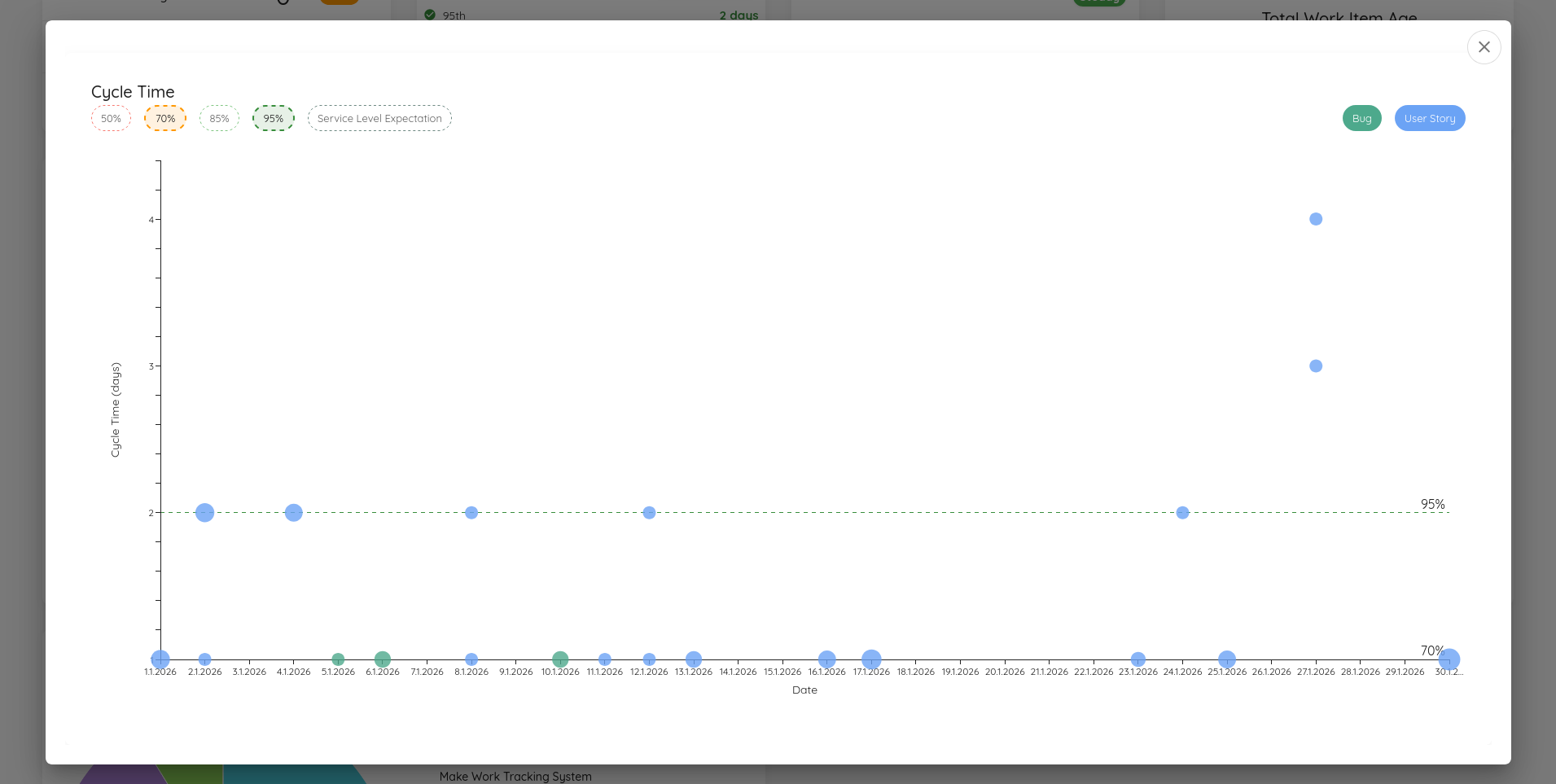
Other Improvements
- The various “reload” buttons have now more distinct icons so they are not easily mixed up
- If percentiles on the Feature Size, Cycle Time Scatterplot, or Work Item Aging chart are overlapping, by default only the higher percentile will be shown
- Updated various third party dependencies
Contributions ❤️
Special Thanks to everyone who contributed their feedback to this release:
Lighthouse v26.1.17.4
Jira and Azure DevOps Board Wizards
If you use a Jira or Azure DevOps connection, Teams and Portfolios can now fetch some settings through a Board Wizard from their existing Boards. The Wizard will display all available boards. If you chose a board, it will read:
- The JQL/WIQL for this board
- The work item types on this board
- The states with a state mapping (by category)
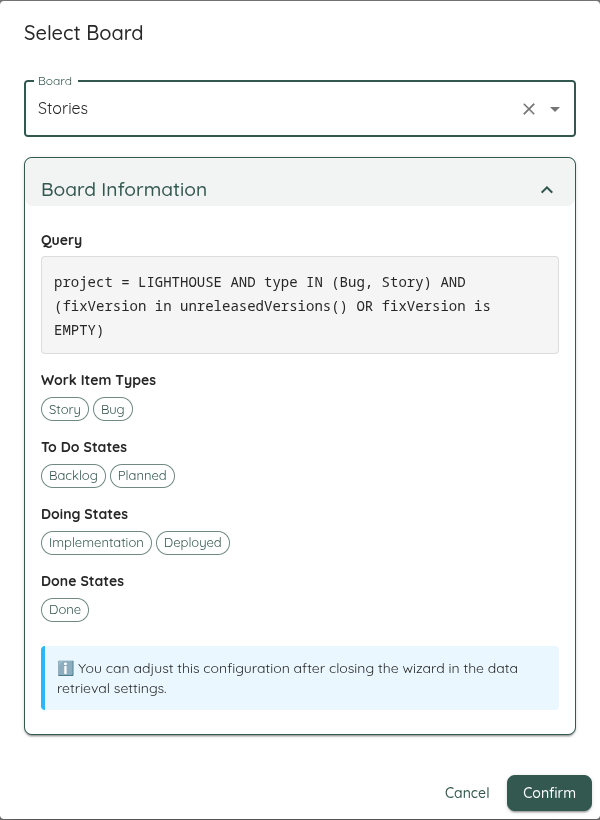
This one-time sync should simplify the initial creation of your Teams and Portfolios!
Delivery Improvements
After releasing the Delivery functionality, we got various feedback and improved the following things:
- The Delivery Header is now showing the 70, 85, and 95% likely dates
- All Deliveries are now ordered by their Delivery date, starting with the earliest first
- You can now see and select Done Features when you create or edit a delivery. The done Features are displayed in ~strikethrough~
- The Delivery Creation Dialog can now be resized
- The label of the “Delivery Date” Textbox was not readable and was improved
- Instead of the “internal” ID of the Features, we display now the ID from your System (e.g. the Key if you are on Jira)
- If deliverie dates were in the past, the likelihood was not correct. Now it’s either 0% (if there is pending work) or 100% (if everything is done). There can’t be anything in between for deliveries that are in the past

Other Improvements
- Updated various third party dependencies
- Attempted to improve Date handling, so that we do not get “one-off” issues depedning on the timezone you are in
Contributions ❤️
Special Thanks to everyone who contributed their feedback to this release:
- Anoop A Parapurath
- Agnieszka Reginek
- Mihajlo Vilajić
- Chandan Bala
- Chris Graves
- Ann K Brea
- Nick Brown
- Paul Brown
- Myriam Greger
Lighthouse v26.1.9.6
This release was focused on improving the additional field functionality of the Work Tracking Systems. Following changes related to this were implemented:
- Username is not shown in “Other Options” anymore if you choose Jira Data Center Auth Option
- You don’t need to specify the token (or other secrets) if you modify only the additional fields
- For Jira Data Center, it will now automatically use the ‘Epic Link’ (for Teams) and ‘Parent Link’ (for Portfolios) fields to try to set the parent. If this convention is followed, no specific additional field and override is needed
- For Azure DevOps, you can now also specify the Field Name, not only the reference. Example: Previously you had to specify ‘Microsoft.VSTS.Scheduling.Size’, while now you could also refer to it simply via ‘Size’. Both options work, reference or name. No migration is needed if you have already something specified.
Other Improvements
- Updated various third party dependencies
- Added a system info on startup that shows you the details of your Lighthouse instance:
Lighthouse v26.1.5.1620
This is a hotfix release that attempts to fix an issue that caused the validation to fail for Azure DevOps Work Tracking Connections if they had any additional field defined. The check for the available fields is now changed, which should make it work for all environments, independent of user rights.
Special thanks to Lorenzo Santoro for reporting this and supporting with debugging!
⚠️ Important: Please read through the release notes of version 26.4.1.1559 to understand the impact of upgrading to this version!
Lighthouse v26.1.4.1559
⚠️⚠️ This release contains breaking changes - please read carefully ⚠️⚠️
This release was focused on a lot of infrastructure work in and around the Work Tracking System Connection. While the impact on the functionality right now is not as big, it will make future enhancements easier. This will include onboarding of new systems, supporting different authentication options, and dealing with the special configurations of the systems within their organization.
The Work Tracking System Connection configuration now looks like this:
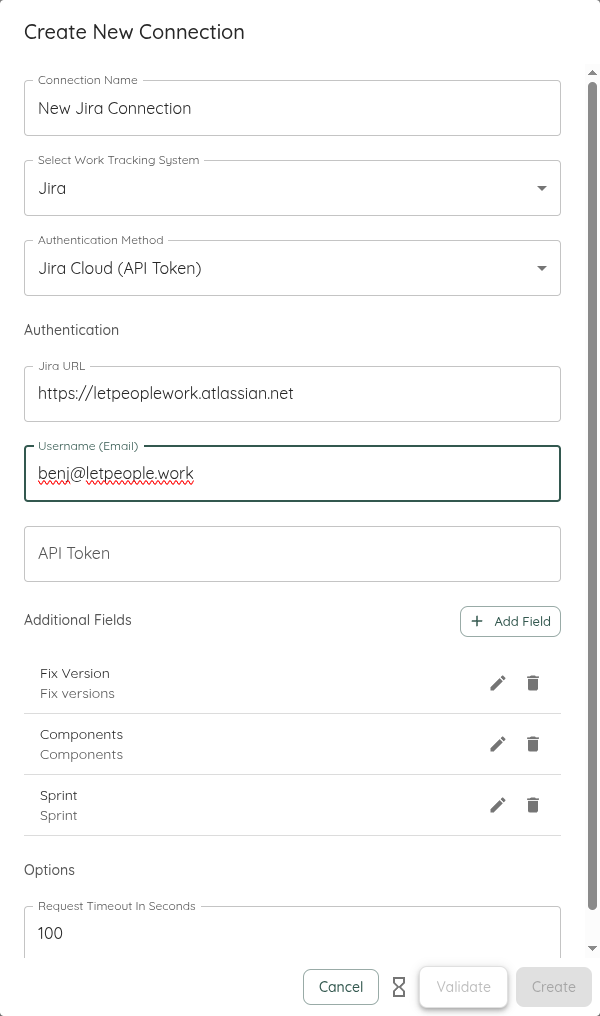
Authentication Options
If a system supports different means for Authentication (right now only Jira), you can select the option. This will also adjust the options you need to specify. This is a big UX improvement over the previous approach where all options where visible, and depending on whether you filled in some field or not it would chose the authentication option.
Note: Existing systems will be working as before and all this data will be migrated
Additional Fields Configuration
For each supported Work Tracking System Connection, you can now add Additional Fields that should be fetched for all Work Items and Features. This allows to have data specific to your system and configuration in Lighthouse. Currently those additional fields are only used for Parent Overrides, Size Estimates, and Feature Owner definition (see below). However, this will be expanded in future.
Currently supported are Azure DevOps and Jira. They both come with a set of predefined additional fields:
- Azure DevOps: Area Path, Iteration Path, Size
- Jira: Fix Version, Component, Sprint
You can modify and remove those defaults as you please.
Note: This only applies to newly created system. Migrated Work Tracking System Connection will not have any additional fields by default.
Upon Validation of the system, It will check the Additional Fields. If a field cannot be found (e.g. due to a typo), the validation will fail. Please see respective documentation for Jira or Azure DevOps.
Options
At the bottom of the Work Tracking System Connections, you can find now options. So far only Jira and Azure DevOps offer additional options. It’s the Request Timeout that was previously specified in the Work Tracking System Settings page. This is now specific per connection. If you had an existing value set, it will automatically be migrated.
Known Unpleasantries
As of now, you will have to provide the Authentication Token even if you don’t change the authentication in the Work Tracking System Connection Dialog. We plan on improve this in future.
Parent Override Field ⚠️
While previously you could define any field in the Parent Override Field with free text, you now can chose from the additional fields. Instead of free text, you will get a selection
⚠️ If you had an override specified before, this change will not be migrated. Please manually add your additional field and set it up through the Team and Portfolio settings. ⚠️
Size Estimate Field ⚠️
While previously you could define any field in the Size Estimate in the Portfolio Settings, you now can chose from the additional fields. Instead of free text, you will get a selection.
⚠️ If you had a Size Estimate specified before, this change will not be migrated. Please manually add your additional field and set it up through the Portfolio settings ⚠️
Feature Owner Field ⚠️
While previously you could define any field in the Featuer Owner in the Portfolio Settings, you now can chose from the additional fields. Instead of free text, you will get a selection.
⚠️ If you had a Featuer Owner specified before, this change will not be migrated. Please manually add your additional field and set it up through the Portfolio settings ⚠️
Additional Work Tracking System Connection Related Changes
- The UI will now display the field for the Query only after selecting a work tracking system and show a tailored description (for example “JQL Query”)
- You can now specify CSV content directly, without the need of having a file uploaded
- The File Upload button for CSV looks slightly different as it’s done in a more generic way
Removal of Unparented Work Item Queries ⚠️
⚠️ The “Unparented Work Item Query” that could be specified per Portfolio has been removed. All “Unparented Features” are also removed. This due to the fact that the functionality was hard to maintain and rarely used. Furthermore, it doesn’t fit in the new design with Deliveries anymore. In future, there may be a replacement of this functionality, but for now, it is removed without a successor.
If you were heavily relying on this, please reach out to us for feedback.
Lighthouse v25.12.28.1246
New macOS App Bundle & Deployment Changes
Lighthouse for macOS is now delivered in a proper app bundle structure, aligning with standard macOS application conventions.
You can now download Lighthouse for macOS as either a zip or a dmg file (recommended for easiest installation). Both formats are fully signed and notarized by Apple, ensuring maximum security and trust for all users.
⚠️ Important: Updates are now handled differently on macOS. All users must manually update to this version. Future updates will require the new app bundle structure - automatic updates from older versions will not work. Please download and install the latest version from our website to continue receiving updates and security fixes.
Rework Settings for Portfolios and Teams
In order to change settings for Teams and Portfolios, you don’t need to change the page anymore. Instead, you’ll see the settings as dedicated tab. This should make it easier to change the settings and see the impact.
Furthermore, the notion of Quick Settings was introduced. For selected settings, you now see a Quick Settings Toolbar across all the tabs of a team and portfolio. On click, you can directly change these settings.
The following Quick Settings are available:
- Throughput Forecasting Configuration: Select which Throughput Period should be used for the forecasting of this team (Team only)
- Service Level Expectation Configuration
- System WIP Configuration
- Feature WIP: For a team, just change that individual teams Feature WIP. For Portfolios, change the Feature WIP of all involved teams.
Changing the Throughput Forecasting Configuration or the Feature WIP will trigger an automatic re-forecast for the affected team.
Other Improvements
- Added a “Cut Off” for Teams and Portfolios that will define where to cut off “done” items. This should help to reduce the load on the server as we will not fetch items that were done 5 years ago. This is configurable in the settings, and will default to 180 days (teams) and 365 days (portfolio).
- The “Update All” button in the Overview page was removed, and instead it’s displayed in the header. Additionally, it will now be disabled if updates are running, and visualize how many update tasks are still ongoing.
- Updated various third party dependencies
Contributions ❤️
Special Thanks to everyone who contributed their feedback to this release:
Lighthouse v25.12.19.1534
Deliveries
Deliveries are named milestone dates for a portfolio that group a set of Features intended to be released together. They help you communicate target dates, track which features belong to a delivery, and see delivery-level progress alongside feature forecasts.
⚠️ Milestones have been removed and replaced with Deliveries. Deliveries are the new way to group features for release milestones.
Deliveries appear in their own view for each Portfolio, including target date and the list of included features.
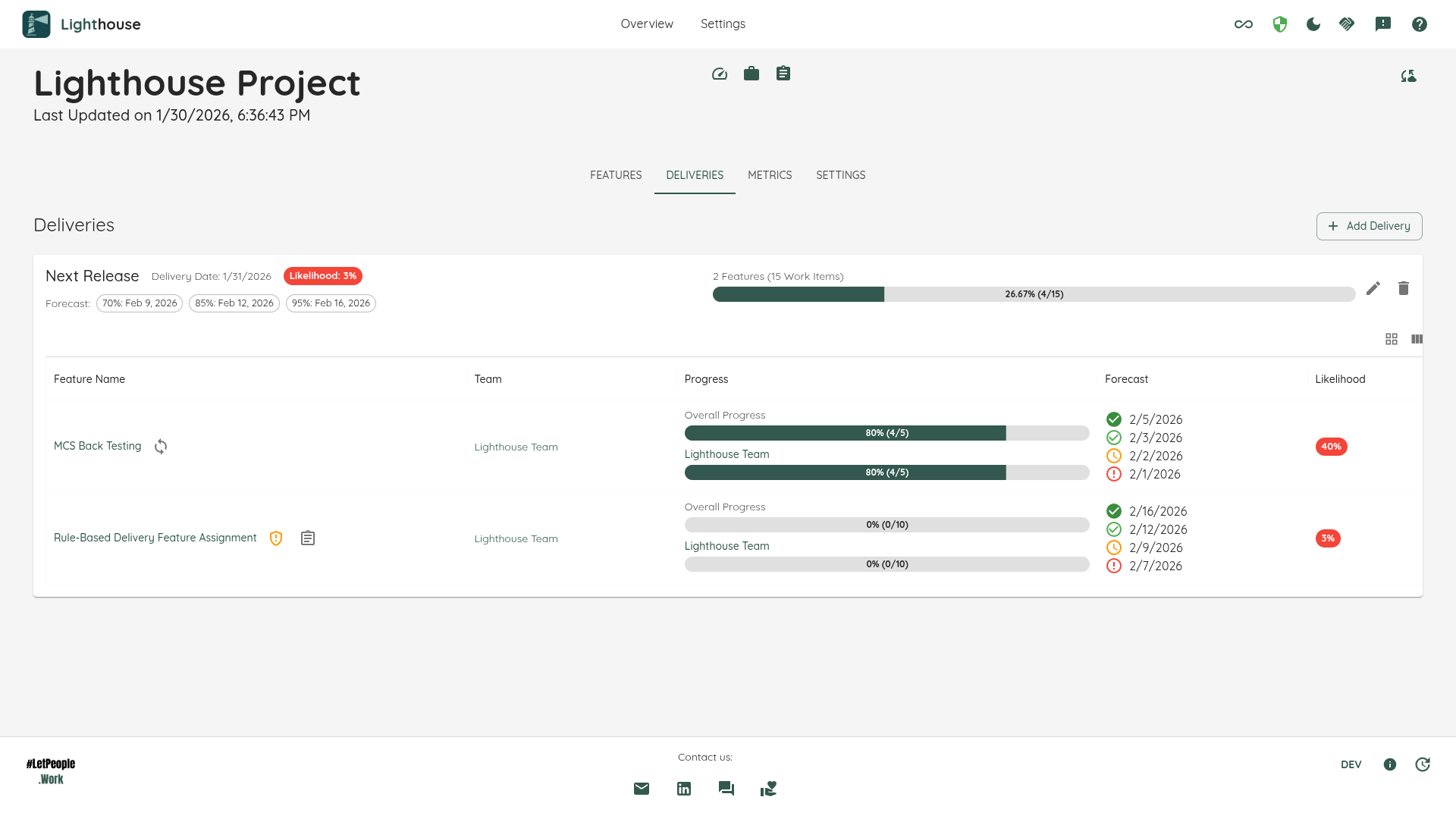
The delivery row shows the delivery name and date, an expand control to reveal included features and their statuses, and action buttons to edit or delete the delivery. Expanding a delivery displays each feature and its forecasted completion so you can assess delivery risk and progress at a glance.
Use deliveries to communicate release milestones and to group related features — this makes it easier to discuss release risk and progress with stakeholders.
Deliveries are also shown in the overview page for each Portfolio.
Note: If you are using the community edition, you can create one delivery. With a premium license, you get unlimited deliveries.
Digital Code Signing
The versions for Windows and macOS are now digitally signed. This means you can trust that the executables are coming from LetPeopleWork GmbH. On Windows, this means that you won’t see the “Unknown Publisher” warning anymore, but can verify that the executable is trustworthy.
On macOS, you may still get a warning (after the download), but you could check through the commandline that it’s signed and notarized through Apple. In a next release, this will improve also on macOS.
Bug Fixes and other Improvements
- Update of third party software to latest versions
- Work Distribution Chart details displayed Cycle Time for all Items. This lead to always showing 0 for in Progress work. For those item, now the Item Age is displayed.
- If you had an expired license, the update to a newer license was causing an error. This is fixed now.
- Reworked the tab structure in the Teams view, splitting Forecasts and Features into dedicated tabs.
Contributions ❤️
Special Thanks to everyone who contributed their feedback to this release:
Lighthouse v25.12.7.1118
Rename Project to Portfolio
As a preparation for future changes, we started renaming what used to be called Project to Portfolio.
The driver behind this change is that a Project has a dedicated start and end date. While you can use Lighthouse for this, it would mean, you will lose all the historic data (your metrics) for a new project.
We are aware that names have specific meanings in every context, so we also made sure you can override the name for Portfolio through the System Settings (so you can call it Initiative, Project, or whatever you like and makes sense in your context).
⚠️ While this sounds like a simple change, we started cleaning up our code and also urls. While urls that point to /projects will still work, eventually they will be turned off. If you find other things that don’t work as before, please let us know. We did our best to verify everything, but can’t rule out we missed something.
Cloning of Teams and Portfolios
You can now clone existing Teams or Portfolios with a single click through the Overview. Just click on the clone icon, and you will get a copy of the settings that you can adjust to your liking.
⚠️ This functionality makes setting up Default Teams and Default Projects obsolete. In order to reduce our effort, we decided to remove this functionality with this release. If you want to quickly create new teams or portfolios based on a default, please use the clone functionality.
Contributions ❤️
Special Thanks to everyone who contributed their feedback to this release:
Lighthouse v25.11.23.1453
Data Grid Enhancements
We’ve further improved the data grid component with additional convenience functions and column visibility controls. This includes:
- The possibility to show and hide columns
- The option to re-arrange the column order
- Improved the resizing of columns
- Storing those settings per user and table
This should improve the usability of the datagrids!
Jira Integration Improvements
Lighthouse now supports using Jira’s Flagged field to mark work items as blocked, providing better integration with Jira workflows for identifying and tracking impediments. If you are using the Flag feature, you can simply add the keyword Flagged as a Blocking Label to your configuration, and Lighthouse will automatically detect it.
Categorization for Items in Scatterplots
The Work Item Aging, Cycle Time, and Feature Size chart are all now displaying the different types of items with a specific color. The Feature Size Chart is categorizing by Status Category, while the other two are differentiating by Item Type. The categories are visualized on top as a legend, and can be toggled on and off through clicking.
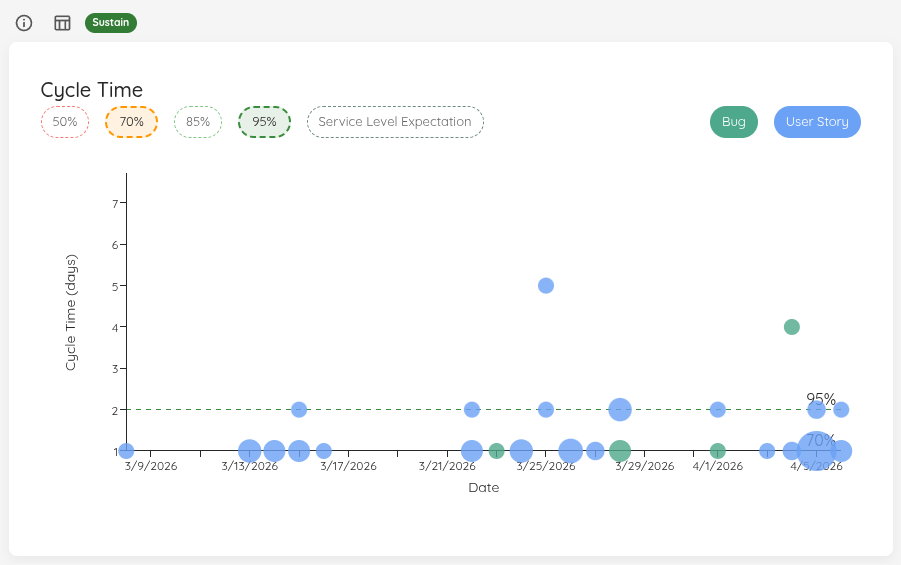
Context for Work Distribution Chart
The Work Distribution chart now includes tabular data views for detailed insights into underlying items. This gives some more context to the pie chart that visualizes the distribution. Additionally, the colors are aligned with the colors used for seperating items in the scatterplots (see above).
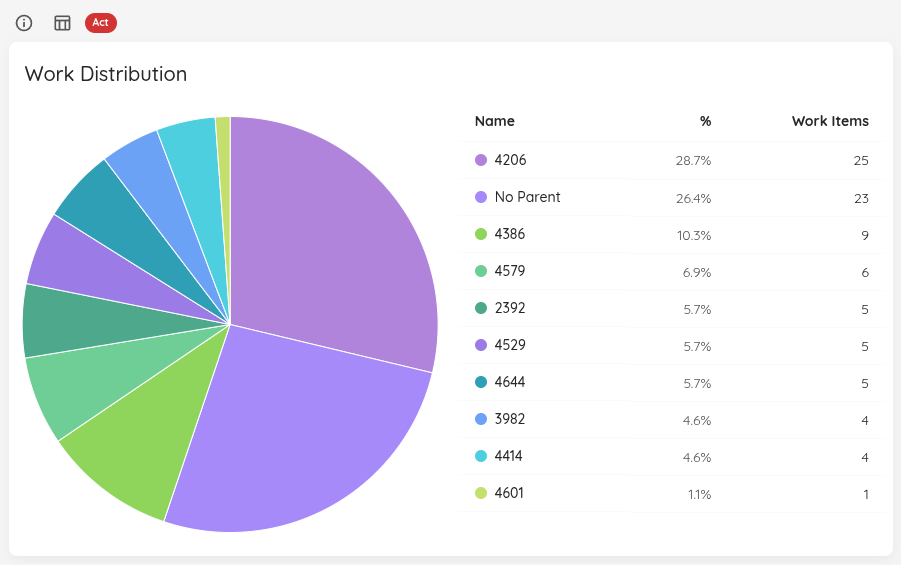
Continuous Improvements & Bug Fixes
- Fixed issue with Work Item Chart and Capitalization that could cause display inconsistencies.
- Resolved Docker startup failures due to missing .NET version compatibility.
- Update of various third party packages.
Contributions ❤️
Special Thanks to everyone who contributed their feedback to this release:
Lighthouse v25.11.15.1404
Work Distribution Chart
The Work Distribution chart provides a visual breakdown of how work items are distributed across their parent work items (such as Features, Epics, or Initiatives). This pie chart helps you understand where your team’s effort is focused.
Hovering over the chart will show you which item had how many child items. Clicking on it will bring up a dialog with additional information.
Additional License Options
We’ve extended the options in the license dialog for our premium users. You can now do the following things.
Clear a License
If you want to free up the license slot you can clear the license. Alternatively, if you have an expired license and don’t want to see the warning, you can also clear the information.
Renew your License
Starting with the last month of your license validity, you can Renew your license. Clicking on the renew button will bring you directly to our homepage and prefill the dialog to order a new license, valid from the date your current one expires.
Email Support
Through the ✉️ emoji, you can send us an email with your favorite mail client. Moreover, we’ll prefill some information that will help us to better support you!
You can find all details in the documentation.
New Data Grid & Export
We’ve replaced many custom tables we had in Lighthouse with a common component that we can reuse across the application. This will simplify the maintenance while bringing you a unified design, as well as some more options. You can now sort & filter based on the various columns!
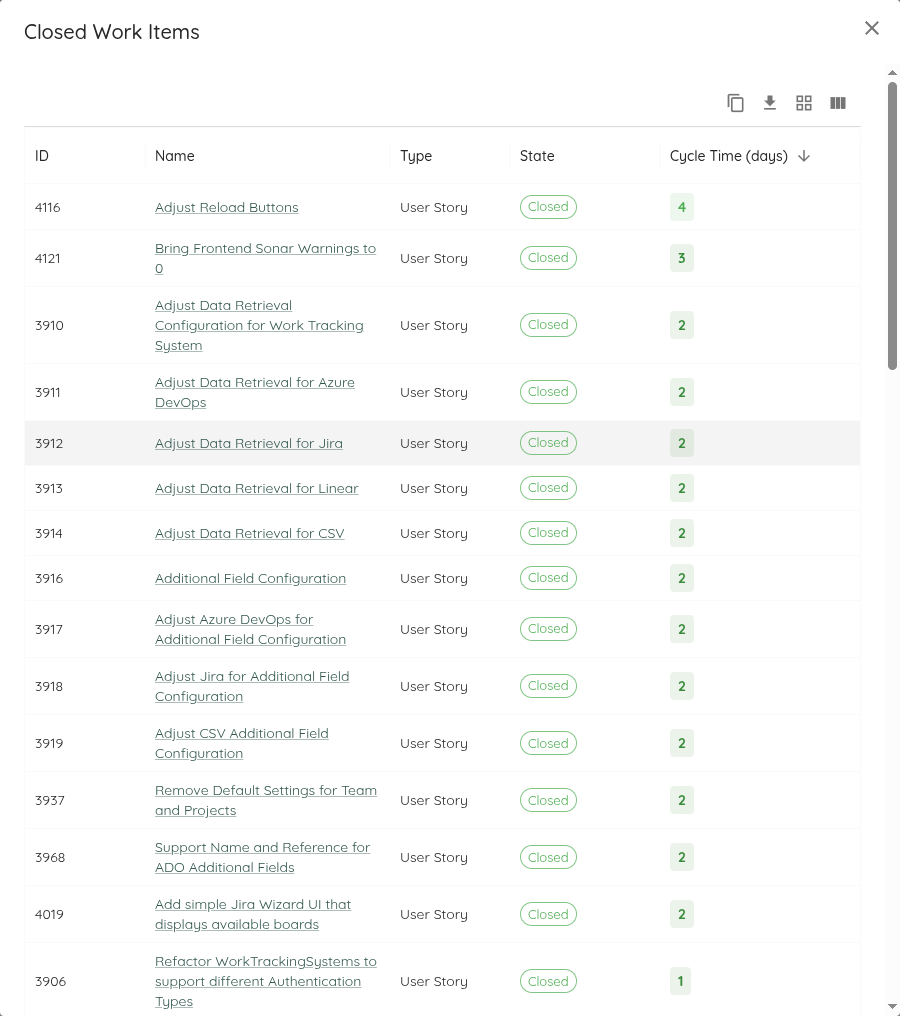
For premium users, the data grid also offers the possibility to export the data in the table in one click:
- You can copy it to your clipboard, so you can paste it easily in chats or emails
- You can export it as a csv file, if you want to do some custom analysis on it
Note: While we did our best to make sure everything works as it did before, we may have missed a few things. If you experience side effects, or things simply not working anymore related to the new tables, please reach out!
Continuous Improvements & Bug Fixes
- Removed “Load all Scenarios” from Demo Data as the demo data was fine tuned for individual scenarios and this leads to messy data
- Adjusted Work Item Age over Time Chart to take different time zones into account
- You can now directly link to the metrics of a project or team. The link will also include the selected time frame. This allows easy sharing with a colleague if you look at a specific time frame.
- Update of various third party packages.
Contributions ❤️
Special Thanks to everyone who contributed their feedback to this release:
Older Releases
See Github for older release notes.